


State Variation in Early-Onset Colorectal Cancer in the United States, 1995-2015
- PMID: 31141602
- PMCID: PMC6792093
- DOI: 10.1093/jnci/djz098
State Variation in Early-Onset Colorectal Cancer in the United States, 1995-2015
Abstract
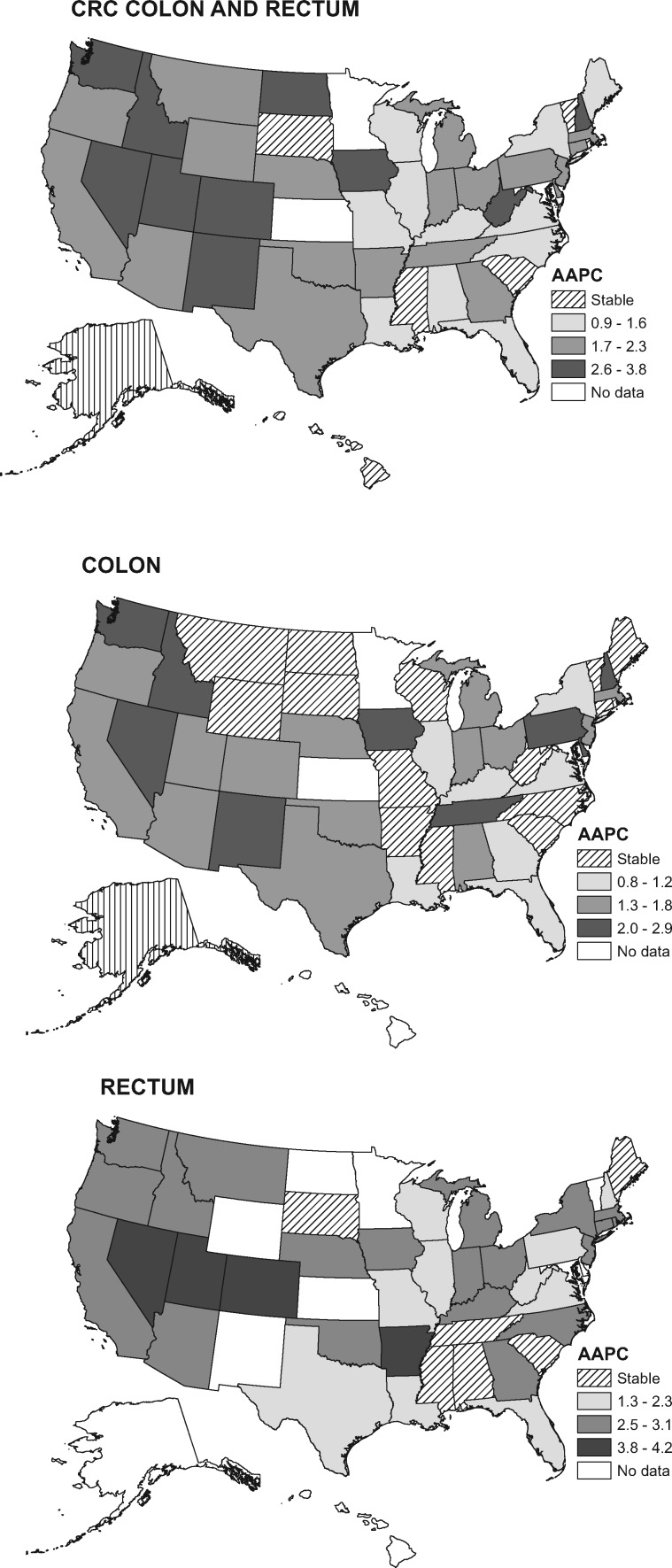
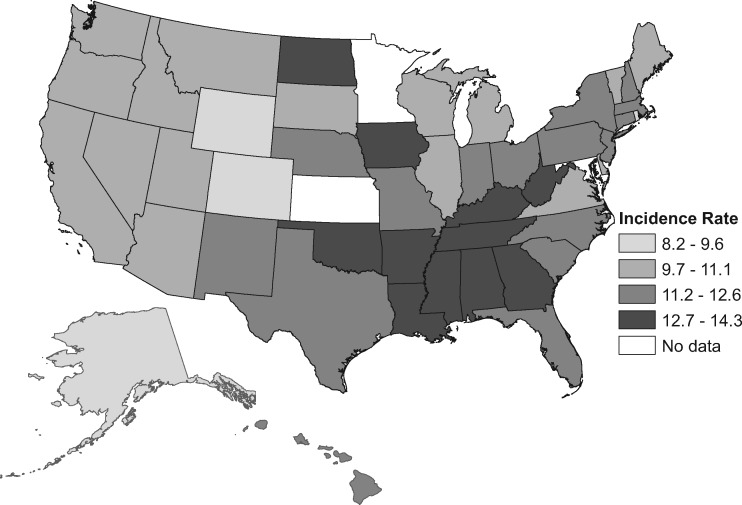
The extent to which the increase in early-onset colorectal cancer (CRC) in the United States varies geographically is unknown. We analyzed changes in CRC incidence and risk factors among people aged 20-49 years by state using high-quality population-based cancer registry data provided by the North American Association of Central Cancer Registries and national survey data, respectively. Early-onset CRC incidence was mostly stable among blacks and Hispanics but increased in 40 of 47 states among non-Hispanic whites, most prominently in western states. For example, rates increased in Washington from 6.7 (per 100 000) during 1995-1996 to 11.5 during 2014-2015 (rate ratio = 1.73, 95% confidence interval = 1.48 to 2.01) and in Colorado from 6.0 to 9.5 (rate ratio = 1.57, 95% confidence interval = 1.30 to 1.91). Nevertheless, current CRC incidence was highest in southern states. From 1995 to 2005, increases occurred in obesity prevalence in all states and heavy alcohol consumption in one-third of states, but neither were correlated with CRC incidence trends. Early-onset CRC is increasing most rapidly among whites in western states. Etiologic studies are needed to explore early life colorectal carcinogenesis.
© The Author(s) 2019. Published by Oxford University Press. All rights reserved. For permissions, please email: journals.permissions@oup.com.
Figures
Comment in
-
Western States Show Biggest Increase in Early-Onset Colorectal Cancer.Cancer. 2019 Oct 15;125(20):3487. doi: 10.1002/cncr.32528. Cancer. 2019. PMID: 31557332 No abstract available.
References
-
- North American Association of Central Cancer Registries, SEER*Stat Database: NAACCR Incidence Data—CiNA Analytic File, 1995–2015, Public Use, accessed October 18, 2018.
-
- Fritz A, Percy C, Jack A, et al. International Classification of Diseases for Oncology. 3rd ed. Geneva, Switzerland: World Health Organization; 2000.
Publication types
MeSH terms
LinkOut - more resources
Full Text Sources
Medical
