Review
. 2019 May 28;11(6):485.
doi: 10.3390/v11060485.

Hepatitis E Virus Drug Development

Affiliations
Review

Hepatitis E Virus Drug Development

Volker Kinast et al. Viruses. .

Abstract

Hepatitis E virus (HEV) is an underestimated disease, leading to estimated 20 million infections and up to 70,000 deaths annually. Infections are mostly asymptomatic but can reach mortality rates up to 25% in pregnant women or become chronic in immunocompromised patients. The current therapy options are limited to the unspecific antivirals Ribavirin (RBV) and pegylated Interferon-α (pegIFN-α). RBV leads to viral clearance in only 80% of patients treated, and is, similar to pegIFN-α, contraindicated in the major risk group of pregnant women, emphasizing the importance of new therapy options. In this review, we focus on the urgent need and current efforts in HEV drug development. We provide an overview of the current status of HEV antiviral research. Furthermore, we discuss strategies for drug development and the limitations of the approaches with respect to HEV.

Keywords: antivirals; drug development; hepatitis E virus; ribavirin; sofosbuvir; therapy; vaccine.


Conflict of interest statement

The authors declare no conflict of interest.

Figures

Figure 1
Figure 1
Schematic representation of hepatitis E virus (HEV) particle and the major clinical manifestations. (A) HEV particle and genomic organization. The HEV genome is composed of a single-stranded RNA genome of ~7.2 kb and is encapsulated in an icosahedral capsid. HEV virions can occur in both a non-enveloped and in an enveloped form. The viral RNA, which is capped with 7-methylguanosine (7mG) at the 5´noncoding region and polyadenylated at the 3′noncoding region, comprises three open reading frames (ORF). Furthermore, GT1 is believed to contain an additional ORF (ORF4). ORF1 encodes the replicase proteins, including a methyltransferase (MT), cysteine protease (Pro), helicase (Hel), and RNA polymerase (Pol), as well as three regions without a reported enzymatic function (Y, hypervariable region (HVR), and X). ORF2 encodes the capsid protein, whereas ORF3 encodes a viroporin. (B) Major clinical manifestations. The majority of HEV infections are asymptomatic. GT3 and GT4 infections can become chronic in immunosuppressed individuals, with high risk for developing severe complications, such as liver cirrhosis. HEV has also been reported to cause a variety of extrahepatic manifestations, like Guillain–Barré syndrome. Infections with HEV GT1 cause acute hepatitis, with high mortality rates up to 25% in pregnant women.
Figure 2
Figure 2
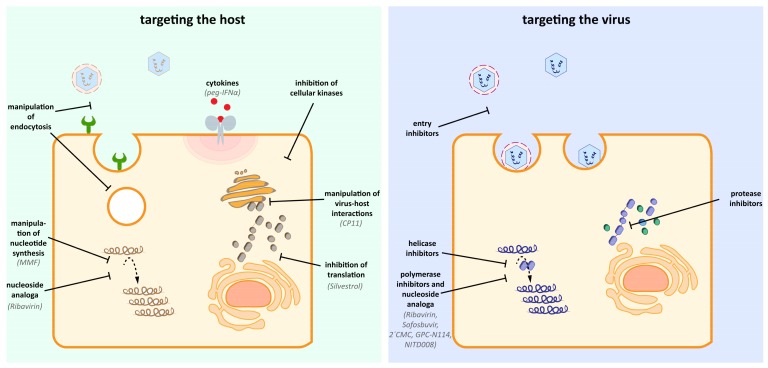
Potential host and viral targets of antiviral drugs. Antiviral therapy against HEV can rely on the inhibition and manipulation of host components, which are important for the HEV life cycle. Additionally, direct acting antiviral specifically can target viral enzymes (e.g., helicase, polymerase, protease) without affecting host components. Notably, the nucleoside analog Ribavrin is reported to exert antiviral effects by targeting both the virus and the host [19].
Figure 3
Figure 3
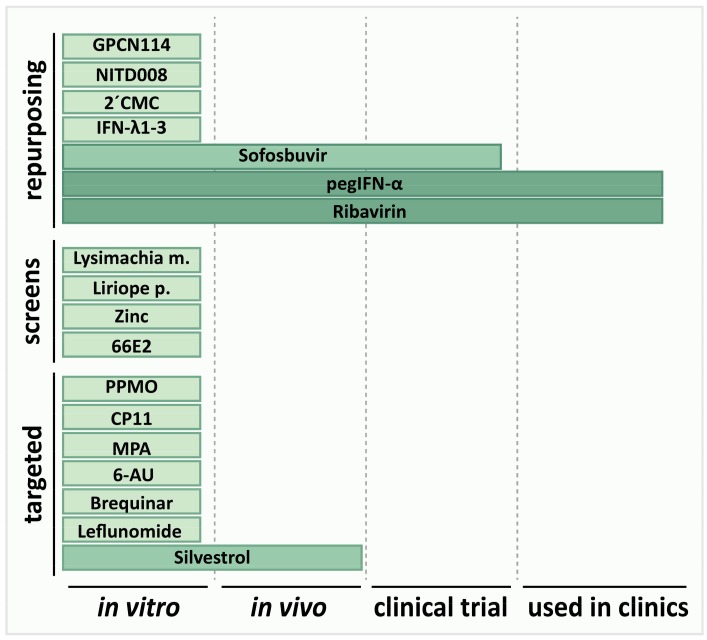
Overview of molecules/extracts with antiviral activity against HEV. The depicted molecules/extracts are classified according to the strategy that was used to identify them. So far, the antiviral activity against HEV of only four drugs (Sofosbuvir, pegIFN-α, Ribavirin and silvestrol) was approved in experimental settings beyond in vitro cell culture systems. Both drugs in the clinics are used off-label and therefore have not been tested in clinical trials against HEV.

References

    1. Smith D.B., Simmonds P., Izopet J., Oliveira-Filho E.F., Ulrich R.G., Johne R., Koenig M., Jameel S., Harrison T.J., Meng X.-J., et al. Proposed reference sequences for hepatitis E virus subtypes. J. Gen. Virol. 2016;97:537–542. doi: 10.1099/jgv.0.000393. - DOI - PMC - PubMed
    1. Wang B., Akanbi O.A., Harms D., Adesina O., Osundare F.A., Naidoo D., Deveaux I., Ogundiran O., Ugochukwu U., Mba N., et al. A new hepatitis E virus genotype 2 strain identified from an outbreak in Nigeria, 2017. Virol. J. 2018;15:163. doi: 10.1186/s12985-018-1082-8. - DOI - PMC - PubMed
    1. Spina A., Lenglet A., Beversluis D., de Jong M., Vernier L., Spencer C., Andayi F., Kamau C., Vollmer S., Hogema B., et al. A large outbreak of Hepatitis E virus genotype 1 infection in an urban setting in Chad likely linked to household level transmission factors, 2016–2017. PLoS ONE. 2017;12:e0188240. doi: 10.1371/journal.pone.0188240. - DOI - PMC - PubMed
    1. Haque F., Banu S.S., Ara K., Chowdhury I.A., Chowdhury S.A., Kamili S., Rahman M., Luby S.P. An outbreak of hepatitis E in an urban area of Bangladesh. J. Viral Hepat. 2015;22:948–956. doi: 10.1111/jvh.12407. - DOI - PMC - PubMed
    1. Izopet J., Lhomme S., Chapuy-Regaud S., Mansuy J.-M., Kamar N., Abravanel F. HEV and transfusion-recipient risk. Transfus. Clin. Biol. 2017;24:176–181. doi: 10.1016/j.tracli.2017.06.012. - DOI - PubMed

Publication types

LinkOut - more resources