Review
. 2019 Jul;17(7):403-416.
doi: 10.1038/s41579-019-0201-x.

Pushing the envelope: LPS modifications and their consequences

Affiliations
Review

Pushing the envelope: LPS modifications and their consequences

Brent W Simpson et al. Nat Rev Microbiol. 2019 Jul.

Abstract

The defining feature of the Gram-negative cell envelope is the presence of two cellular membranes, with the specialized glycolipid lipopolysaccharide (LPS) exclusively found on the surface of the outer membrane. The surface layer of LPS contributes to the stringent permeability properties of the outer membrane, which is particularly resistant to permeation of many toxic compounds, including antibiotics. As a common surface antigen, LPS is recognized by host immune cells, which mount defences to clear pathogenic bacteria. To alter properties of the outer membrane or evade the host immune response, Gram-negative bacteria chemically modify LPS in a wide variety of ways. Here, we review key features and physiological consequences of LPS biogenesis and modifications.


Figures
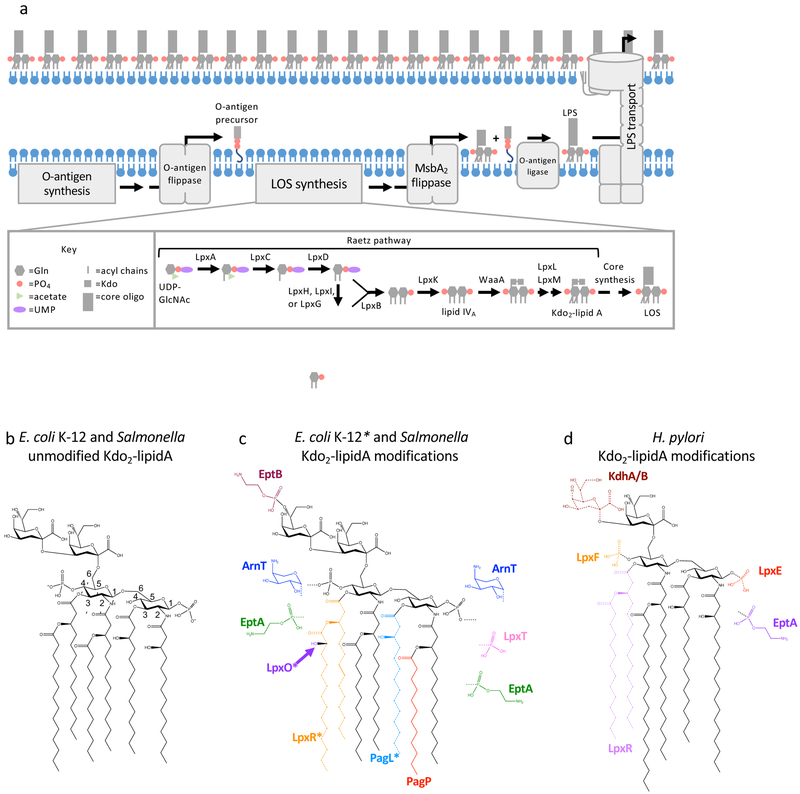
Figure 1.
Figure 1.. Lipopolysaccharide biogenesis, structure, and modifications.
(a) Overview of LPS biogenesis in E. coli and Salmonella. Briefly, synthesis of the lipid A and core domains of LPS occurs in the cytoplasm and at the cytoplasmic interface of the IM. O antigen, if present, is synthesized separately attached to the carrier lipid, undecaprenyl-pyrophosphate. LOS and O-antigen precursors are flipped across the IM separately by MsbA2 and O-antigen flippases, respectively. O antigen is attached to LOS on the periplasmic side of the IM. Finally, LPS is transported from the IM to the surface of the OM by the Lpt complex. (b) Unmodified Kdo2-lipid A synthesized by E. coli K-12 and Salmonella enterica spp. strains (c and d) Summary of chemical modifications of Kdo2-lipid A that can occur after synthesis in E. coli K12 and Salmonella enterica spp. (c) and Helicobacter pylori (d). Enzymes that catalyze the modification are color coded along with the chemical group. Chemical groups drawn with dotted lines indicate the enzyme catalyzes hydrolysis to remove the group. Asterisks indicate that LpxO, LpxR, and PagL are present in Salmonella enterica spp. strains but not present in E. coli K12 strains.
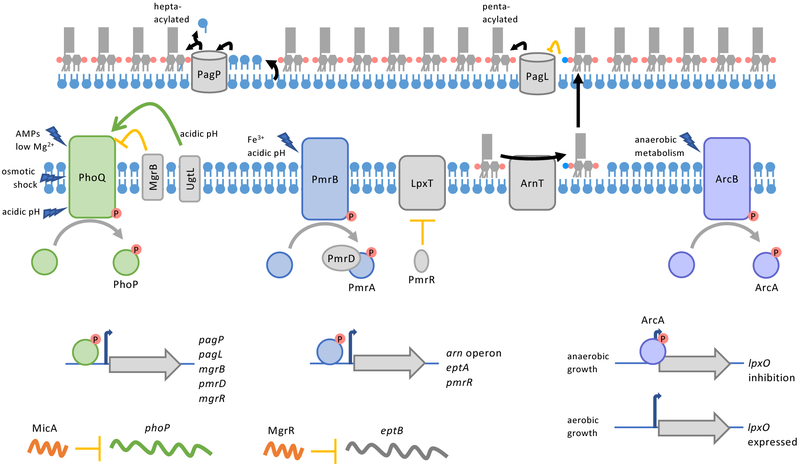
Figure 2:
Figure 2:. Regulation of LPS modifications
(a) Regulation of LPS modification enzymes in Salmonella enterica subsp. enterica serovar Typhimurium. TCS PhoPQ, PmrAB, and ArcAB regulate genes that encode enzymes that alter the acylation (PagP, PagL), modify phosphates (aminoarabinose by ArnT and phosphoethanolamine by EptA), and hydroxylate an acyl chain (LpxO) of lipid A, respectively. PhoPQ also upregulates the protein PmrD which binds to and protects phosphorylated-PmrA, connecting these TCS. Small RNAs are connected to PhoPQ regulation; MicA inhibits translation of PhoP, and MgrR, when upregulated by PhoPQ, inhibits the gene eptB, encoding a core-oligosaccharide modifying phosphoethanolamine transferase. In addition, PhoPQ and PmrAB upregulate genes involved in negative feed-back loops for the respective TCS. PhoPQ upregulates MgrB that binds to and inhibits PhoQ. PmrAB upregulates the small protein PmrR and genes that for modifying lipid A with aminoarabinose (arn operon) and phosphoethanolamine (eptA). PmrR post-translationally inhibits the lipid A phosphotransferase LpxT. Decrease in LpxT activity and increased lipid A modification by ArnT and EptA alter the charge of the OM so that metal ions that activate PmrB are blocked from entering the cell. Finally, the activity of OM enzymes PagP and PagL are regulated by availability and modification of their substrates, respectively. When glycerophospholipids are mislocalized to the outer leaflet of the OM, PagP catalyzes the transfer of an acyl chain from donor glycerophospholipids to acceptor lipid A molecules. PagL deacylation of lipid A is inhibited by aminoarabinose modification of lipid A.
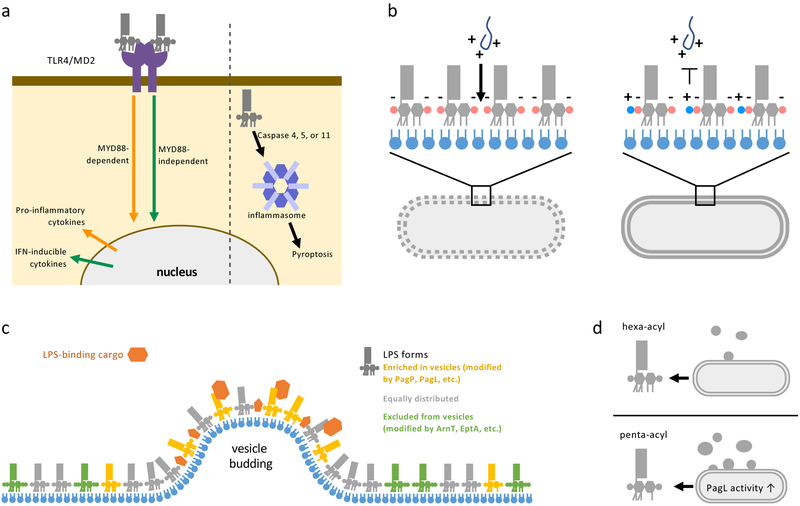
Figure 3:
Figure 3:. Consequences of LPS modifications
(a) LPS can stimulate immune cell responses through recognition by surface receptors (left) or binding to the cytoplasmic inflammasome (right). TLR4/MD2 receptors on the surface of mammalian immune cells recognize lipid A and can activate two signaling pathways. The myeloid differentiation primary response protein 88 (MYD88)-dependent pathway upregulates proinflammatory cytokines that lead to inflammation and bacterial clearance. Alternatively, signaling through TIR domain-containing adaptor inducing IFNβ (TRIF), known as the MYD88-independent pathway, produces interferon (IFN) inducible cytokines that result in less inflammation, but are critical for adjuvanticity. Modifications of the phosphates and acyl chains of lipid A affect how well LPS is recognized by the TLR4/MD2 receptor and which signaling pathway is induced. Inflammasome recognition is mediates by caspases and lead to an inflammatory cell death pathway called pyroptosis. Modifications to acyl chains of LPS reduce stimulation of murine inflammasome response but does not affect stimulation of human cell-lines inflammasomes. (b) Cationic antimicrobial peptides (AMPs) produced by host immune cells or used as antibiotics (such as Polymyxin B and Colistin) to treat infectious bacteria act by first forming charge-charge interactions with the highly negatively-charged OM. AMPs then perforate the OM followed by the IM, leading to lysis of bacterial cells. LPS modification that reduce the negative charge or alter the acyl chains of lipid A provide resistance against AMPs by charge repulsion or decreasing the fluidity of the OM. (c) Gram-negative bacteria release vesicles that bud from the OM called outer membrane vesicle (OMVs). When the LPS in the OM and OMVs released are compared, certain chemical forms of LPS are enriched, equally distributed, or excluded (colored gold, grey, and green respectively) in OMVs. Some cargo proteins (orange) associated with OMVs such as heat-labile enterotoxin in enterotoxigenic E. coli, are recruited through specific interactions with LPS. Allowing the selective recruiting and secretion of certain proteins in OMVs. (d) Certain chemical forms of LPS, such as penta-acylated LPS produced by PagL activity, increase the size and number of OMVs released by bacteria, indicating that LPS modification can stimulate OMV formation.
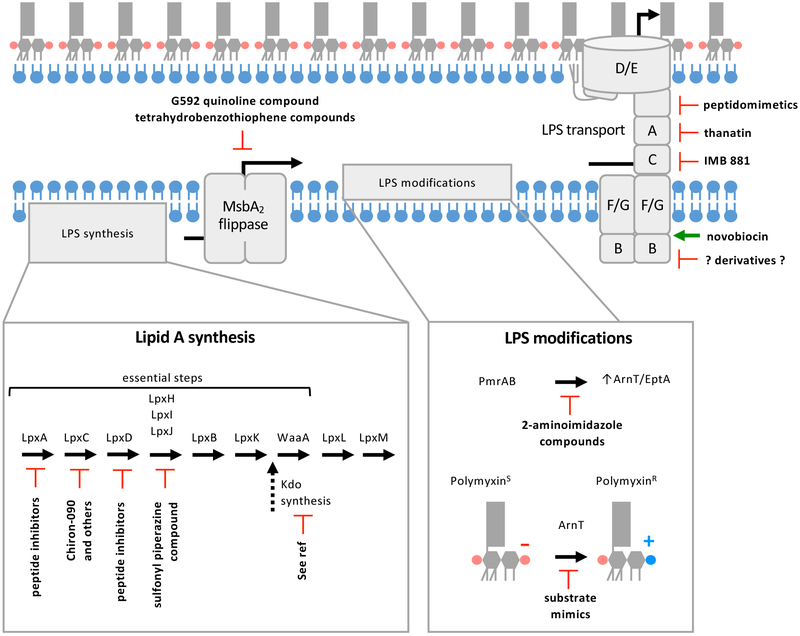
Figure 4:
Figure 4:. Summary of therapeutic strategies to target LPS biogenesis.
Compounds have been identified that inhibit (indicated by red blocked arrows) enzymes involved in lipid A synthesis, LPS flipping by MsbA2, regulators of LPS modifications, enzymes that modify LPS, and transport of LPS to the OM. The DNA gyrase novobiocin has also been demonstrated to bind the Lpt machinery and activate LPS transport (indicated by green arrow). While this activity does not inhibit growth, it does synergistically increase the efficacy of polymyxins.

References

    1. Muhlradt PF & Golecki JR Asymmetrical distribution and artifactual reorientation of lipopolysaccharide in the outer membrane bilayer of Salmonella typhimurium. European journal of biochemistry 51, 343–352 (1975). - PubMed
    1. Nikaido H & Vaara M Molecular basis of bacterial outer membrane permeability. Microbiological reviews 49, 1–32 (1985). - PMC - PubMed
    1. Whitfield C & Trent MS Biosynthesis and export of bacterial lipopolysaccharides. Annual review of biochemistry 83, 99–128, doi: 10.1146/annurev-biochem-060713-035600 (2014). - DOI - PubMed
    1. Muhlradt PF, Menzel J, Golecki JR & Speth V Outer membrane of salmonella. Sites of export of newly synthesised lipopolysaccharide on the bacterial surface. European journal of biochemistry 35, 471–481 (1973). - PubMed
    1. Osborn MJ, Gander JE & Parisi E Mechanism of assembly of the outer membrane of Salmonella typhimurium. Site of synthesis of lipopolysaccharide. The Journal of biological chemistry 247, 3973–3986 (1972). - PubMed

Publication types

MeSH terms