


Muscle and Systemic Molecular Responses to a Single Flywheel Based Iso-Inertial Training Session in Resistance-Trained Men
- PMID: 31143128
- PMCID: PMC6521220
- DOI: 10.3389/fphys.2019.00554
Muscle and Systemic Molecular Responses to a Single Flywheel Based Iso-Inertial Training Session in Resistance-Trained Men
Abstract
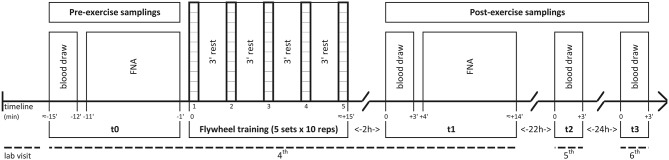
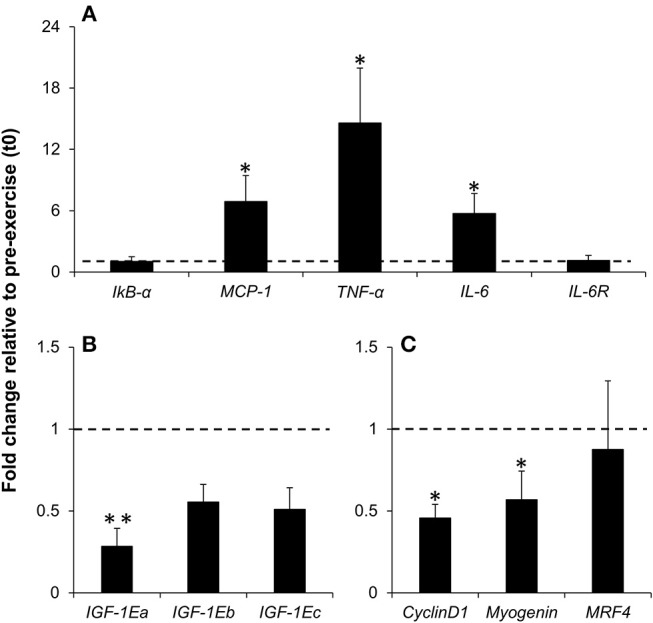
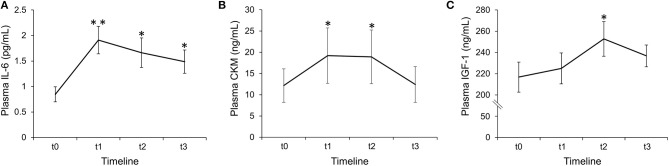
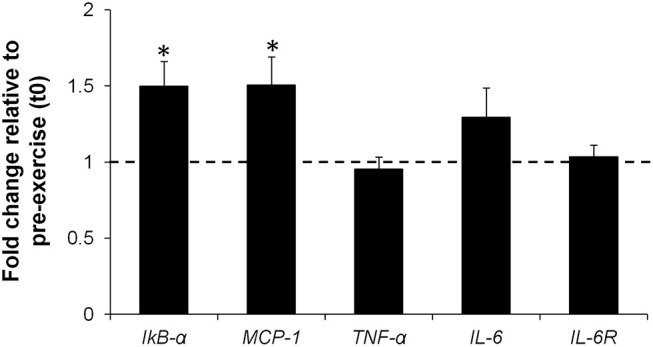
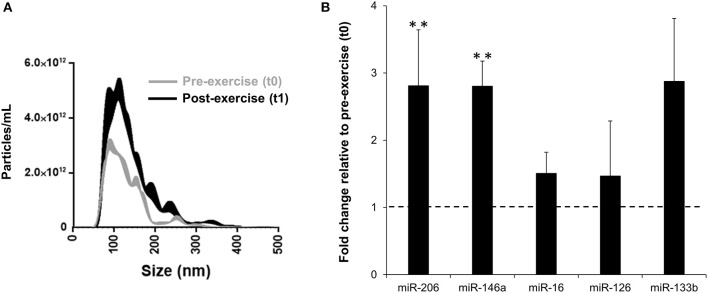
Growing evidence points to the effectiveness of flywheel (FW) based iso-inertial resistance training in improving physical performance capacities. However, molecular adaptations induced by FW exercises are largely unknown. Eight resistance-trained men performed 5 sets of 10 maximal squats on a FW device. Muscle biopsies (fine needle aspiration technique) and blood samples were collected before (t0), and 2 h (t1) after FW exercise. Blood samples were additionally drawn after 24 h (t2) and 48 h (t3). Paired samples t-tests revealed significant increases, at t1, of mRNA expression of the genes involved in inflammation, in both muscle (MCP-1, TNF-α, IL-6) and peripheral blood mononuclear cells (IkB-α, MCP-1). Circulating extracellular vesicles (EVs) and EV-encapsulated miRNA levels (miR-206, miR-146a) significantly increased at t1 as well. Conversely, muscle mRNA level of genes associated with muscle growth/remodeling (IGF-1Ea, cyclin D1, myogenin) decreased at t1. One-way repeated measure ANOVAs, with Bonferroni corrected post-hoc pairwise comparisons, revealed significant increases in plasma concentrations of IL-6 (t1; t2; t3) and muscle creatine kinase (t1; t2), while IGF-1 significantly increased at t2 only. Our findings show that, even in experienced resistance trained individuals, a single FW training session modifies local and systemic markers involved in late structural remodeling and functional adaptation of skeletal muscle.
Keywords: circulating miRNAs; extracellular vesicles; growth factors; inflammation; iso-inertial exercise.
Figures
References
-
- Annibalini G., Lucertini F., Agostini D., Vallorani L., Gioacchini A., Barbieri E., et al. . (2017). Concurrent aerobic and resistance training has anti-inflammatory effects and increases both plasma and leukocyte levels of IGF-1 in late middle-aged type 2 diabetic patients. Oxid. Med. Cell. Longev. 2017:3937842. 10.1155/2017/3937842 - DOI - PMC - PubMed
Associated data
LinkOut - more resources
Full Text Sources
Research Materials
Miscellaneous
