


Prospects for the Use of Whey for Polyhydroxyalkanoate (PHA) Production
- PMID: 31143164
- PMCID: PMC6520646
- DOI: 10.3389/fmicb.2019.00992
Prospects for the Use of Whey for Polyhydroxyalkanoate (PHA) Production
Abstract
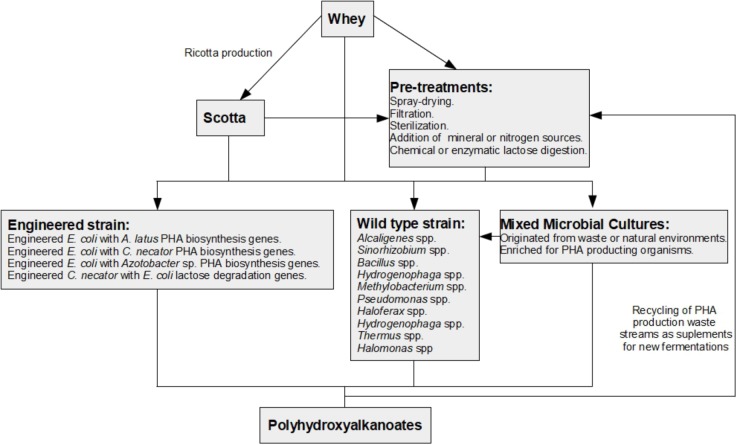
Plastic production and accumulation have devastating environmental effects, and consequently, the world is in need of environmentally friendly plastic substitutes. In this context, polyhydroxyalkanoates (PHAs) appear to be true alternatives to common plastics because they are biodegradable and biocompatible and can be biologically produced. Despite having comparable characteristics to common plastics, extensive PHA use is still hampered by its high production cost. PHAs are bacterial produced, and one of the major costs associated with their production derives from the carbon source used for bacterial fermentation. Thus, several industrial waste streams have been studied as candidate carbon sources for bacterial PHA production, including whey, an environmental contaminant by-product from the dairy industry. The use of whey for PHA production could transform PHA production into a less costly and more environmentally friendly process. However, the efficient use of whey as a carbon source for PHA production is still hindered by numerous issues, including whey pre-treatments and PHA producing strain choice. In this review, current knowledge on using whey for PHA production were summarized and new ways to overcome the challenges associated with this production process were proposed.
Keywords: PHA; PHB; bioplastics; environment; lactose; polyhydroxyalkanoate; whey.
Figures
References
-
- Ahn W. S., Park S. J., Lee S. Y. (2001). Production of poly (3-hydroxybutyrate) from whey by cell recycle fed-batch culture of recombinant Escherichia coli. Biotechnol. Lett. 23 235–240.
-
- Akaraonye E., Keshavarz T., Roy I. (2010). Production of polyhydroxyalkanoates: the future green materials of choice. J. Chem. Technol. Biotechnol. 85 732–743. 10.1002/jctb.2392 - DOI
Publication types
LinkOut - more resources
Full Text Sources
Other Literature Sources
