Review
. 2020 Mar;139(3):277-290.
doi: 10.1007/s00439-019-02031-7. Epub 2019 May 30.

Autophagy in aging and longevity

Affiliations
Review

Autophagy in aging and longevity

Shi Q Wong et al. Hum Genet. 2020 Mar.

Abstract

Our understanding of the process of autophagy and its role in health and diseases has grown remarkably in the last two decades. Early work established autophagy as a general bulk recycling process which involves the sequestration and transport of intracellular material to the lysosome for degradation. Currently, autophagy is viewed as a nexus of metabolic and proteostatic signalling that can determine key physiological decisions from cell fate to organismal lifespan. Here, we review the latest literature on the role of autophagy and lysosomes in stress response and longevity. We highlight the connections between autophagy and metabolic processes, the network associated with its regulation, and the links between autophagic dysfunction, neurodegenerative diseases, and aging.


Conflict of interest statement

Conflict of interest

The authors declare no conflict of interest.

Figures
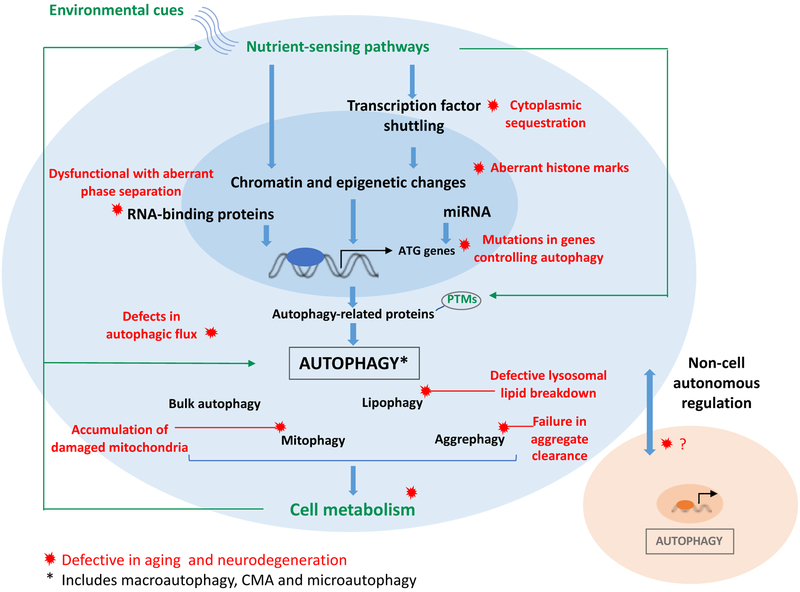
Figure 1.
Figure 1.. Interplay between autophagy, metabolism and aging
Environmental cues influence nutrient-sensing pathways such as mTOR, AMPK, and insulin signalling in cells which modulate the expression of genes involved in autophagy by transcriptional and epigenetic regulation as well as by direct post-translational modification (PTM) of autophagy related (ATG) proteins. Functional autophagy, including its bulk and selective forms, ensures efficient organelle and macromolecular degradation and recycling which further impacts cell metabolism and homeostasis. Metabolic pathways feedback to nutrient-sensing pathways and autophagy regulation. In aging and neurodegeneration, defects (red) in several steps of autophagy regulation and execution lead to accumulation of damaged organelles and protein aggregates that adversely affect cell metabolism and homeostasis. This further exacerbates defective autophagy resulting in a vicious cycle that ends in cell death and neuronal loss. Emerging research also highlights non-cell autonomous, inter-tissue communication of autophagic status. Autophagy regulation is central to metabolism and aging and is a strong target for pharmacological strategies against age-related and neurodegenerative diseases.

References

    1. Artal-Martinez de Narvajas A, Gomez TS, Zhang JS, Mann AO, Taoda Y, Gorman JA, Herreros-Villanueva M, Gress TM, Ellenrieder V, Bujanda L, Kim DH, Kozikowski AP, Koenig A, Billadeau DD (2013) Epigenetic regulation of autophagy by the methyltransferase G9a. Mol Cell Biol 33: 3983–93. - PMC - PubMed
    1. Ashkenazi A, Bento CF, Ricketts T, Vicinanza M, Siddiqi F, Pavel M, Squitieri F, Hardenberg MC, Imarisio S, Menzies FM, Rubinsztein DC (2017) Polyglutamine tracts regulate beclin 1-dependent autophagy. Nature 545: 108–11. - PMC - PubMed
    1. Bagherniya M, Butler AE, Barreto GE, Sahebkar A (2018) The effect of fasting or calorie restriction on autophagy induction: A review of the literature. Ageing Res Rev 47: 183–97. - PubMed
    1. Bordone L, Guarente L (2005) Calorie restriction, SIRT1 and metabolism: understanding longevity. Nat Rev Mol Cell Biol 6: 298–305. - PubMed
    1. Bowman CJ, Ayer DE, Dynlacht BD (2014) Foxk proteins repress the initiation of starvation-induced atrophy and autophagy programs. Nat Cell Biol 16: 1202–14. - PMC - PubMed
