. 2019 Oct;41(5):619-630.
doi: 10.1007/s11357-019-00074-2. Epub 2019 May 29.

Nicotinamide mononucleotide (NMN) treatment attenuates oxidative stress and rescues angiogenic capacity in aged cerebromicrovascular endothelial cells: a potential mechanism for the prevention of vascular cognitive impairment

Affiliations

Nicotinamide mononucleotide (NMN) treatment attenuates oxidative stress and rescues angiogenic capacity in aged cerebromicrovascular endothelial cells: a potential mechanism for the prevention of vascular cognitive impairment

Tamas Kiss et al. Geroscience. 2019 Oct.

Abstract

Age-related impairment of angiogenesis likely has a critical role in cerebromicrovascular rarefaction and development of vascular cognitive impairment and dementia (VCID) in the elderly. Recently, we demonstrated that aging is associated with NAD+ depletion in the vasculature and that administration of NAD+ precursors exerts potent anti-aging vascular effects, rescuing endothelium-mediated vasodilation in the cerebral circulation and improving cerebral blood supply. The present study was designed to elucidate how treatment with nicotinamide mononucleotide (NMN), a key NAD+ intermediate, impacts age-related impairment of endothelial angiogenic processes. Using cerebromicrovascular endothelial cells (CMVECs) isolated from young and aged F344xBN rats, we demonstrated that compared with young cells, aged CMVECs exhibit impaired proliferation, cellular migration (measured by a wound-healing assay using electric cell-substrate impedance sensing [ECIS] technology), impaired ability to form capillary-like structures, and increased oxidative stress. NMN treatment in aged CMVECs significantly improved angiogenic processes and attenuated H2O2 production. We also found that pre-treatment with EX-527, a pharmacological inhibitor of SIRT1, prevented NMN-mediated restoration of angiogenic processes in aged CMVECs. Collectively, we find that normal cellular NAD+ levels are essential for normal endothelial angiogenic processes, suggesting that age-related cellular NAD+ depletion and consequential SIRT1 dysregulation may be a potentially reversible mechanism underlying impaired angiogenesis and cerebromicrovascular rarefaction in aging. We recommend that pro-angiogenic effects of NAD+ boosters should be considered in both preclinical and clinical studies.

Keywords: Endothelial dysfunction; Microcirculation; NAD+ precursor; Senescence; Vascular contributions to cognitive impairment and dementia.


Figures
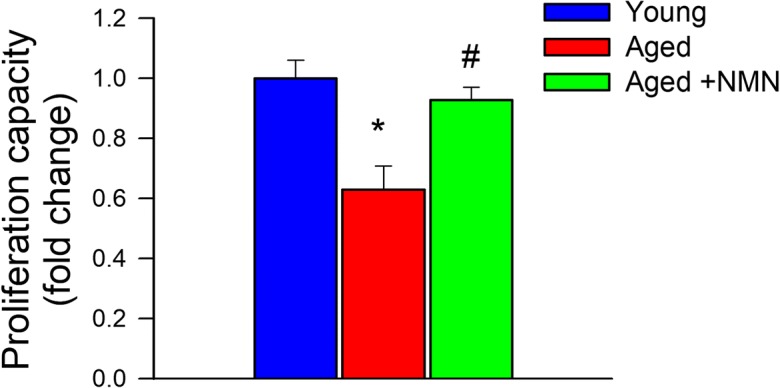
Fig. 1
Fig. 1
NMN treatment significantly increases proliferation capacity of aged CMVECs. Cell proliferation capacity of CMVECs isolated from aged F344xBN rats is impaired as compared with that of cells isolated from young F344xBN rats, and it is significantly improved by treatment with NMN. Cell proliferation capacity was assessed in primary CMVECs stimulated with VEGF (100 ng/mL) using the flow cytometry–based Guava CellGrowth assay (see “Materials and Methods”). The inverse of the fluorescence intensity of the indicator dye CFSE was used as an index of proliferation capacity of the cells. Data are plotted as means ± S.E.M. (n = 6 in each group); *p < 0.05 vs. control, #p < 0.05 vs. aged
Fig. 2
Fig. 2
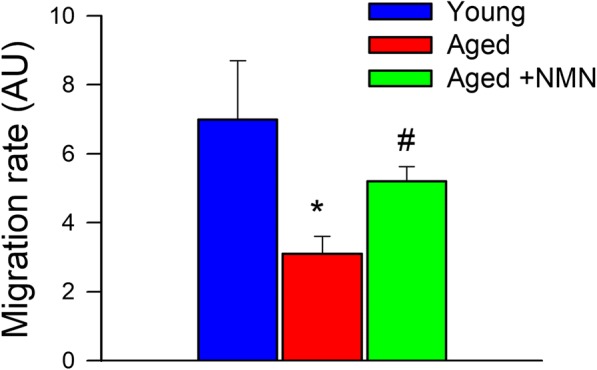
NMN treatment significantly increases migration capacity of aged CMVECs. Migration capacity of CMVECs isolated from aged F344xBN rats is impaired as compared with that of cells isolated from young F344xBN rats, and it is significantly improved by treatment with NMN. VEGF (100 ng/mL)-stimulated cell migration was monitored by electric cell-substrate impedance sensing (ECIS) technology in a wound-healing assay (see “Materials and Methods”). In brief, time course of resistance recovery after wounding (electric pulse of 5 mA for 20 s at 60 kHz) was monitored at 4000 Hz. The time to reach 50% resistance recovery (corresponding to 50% confluence on the active electrode) was determined for each group, and this parameter and the known physical dimensions of the electrode were used to calculate the migration rate. Bar graph depicts the summary data for migration rate in each group. Data are plotted as means ± S.E.M. (n = 5 in each group); *p < 0.05 vs. young control, #p < 0.05 vs. aged
Fig. 3
Fig. 3
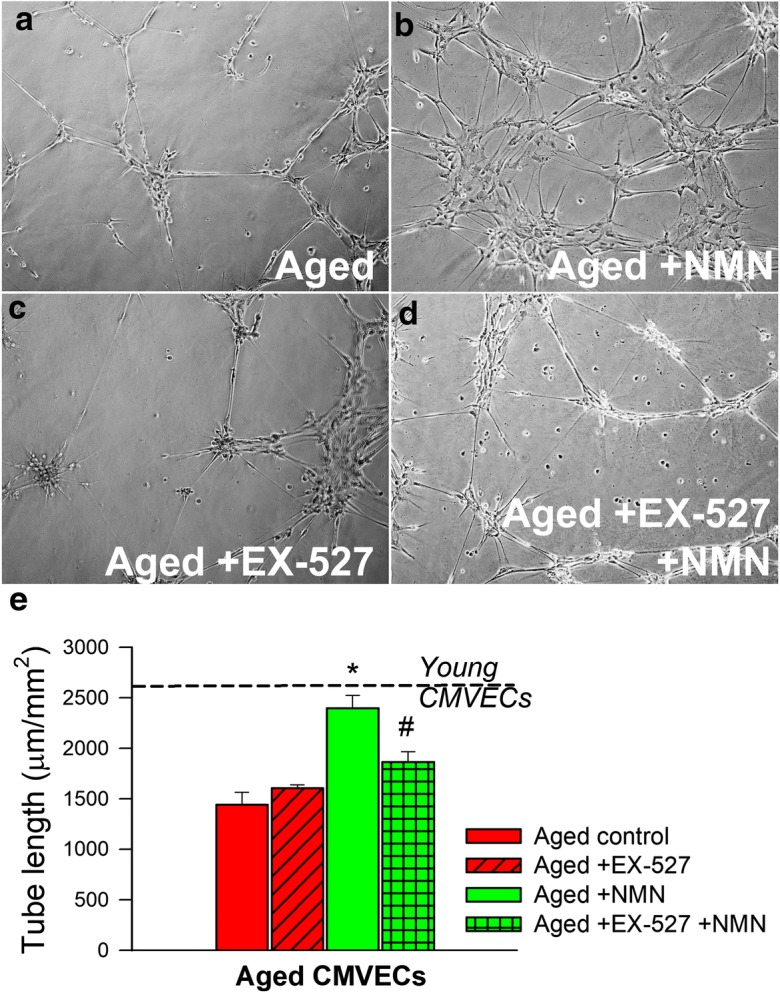
NMN treatment significantly improves the tube formation ability of aged CMVECs. Tube formation ability of CMVECs isolated from aged F344xBN rats is impaired as compared with that of cells isolated from young F344xBN rats (dashed line), and it is significantly improved by NMN treatment. Inhibition of SIRT1 by EX-524 significantly impairs the ability of NMN-treated aged CMVECs to form capillary-like structures, suggesting that the protective effects of NMN are mediated by sirtuin activation. CMVECs were plated on Geltrex matrix–coated wells, and tube formation was induced by treating cells with VEGF (100 ng/mL, for 24 h). Representative examples of capillary-like structures are shown on panels a, b, c, d. Summary data, expressed as total tube length per total area scanned (μm tube/mm2), are shown in panel e. Data are means ± S.E.M. (n = 5 in each group); *p < 0.05 vs. aged control, #p < 0.05 vs. aged + NMN
Fig. 4
Fig. 4
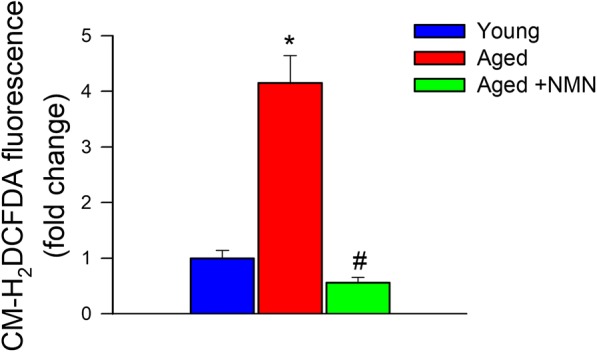
NMN treatment significantly attenuates oxidative stress in aged CMVECs. Cellular peroxide production is significantly increased in cultured primary CMVECs derived from aged F344xBN rats as compared with cells isolated from young F344xBN rats, and it is significantly attenuated by treatment with NMN. Cellular peroxide production was assessed by measuring CM-H2DCFDA fluorescence using a flow cytometry–based approach. Data are plotted as means ± S.E.M. (n = 6 in each group); *p < 0.05 vs. control, #p < 0.05 vs. aged

References

    1. Bach MH, Sadoun E, Reed MJ. Defects in activation of nitric oxide synthases occur during delayed angiogenesis in aging. Mech Ageing Dev. 2005;126(4):467–473. - PubMed
    1. Banki E, Sosnowska D, Tucsek Z, Gautam T, Toth P, Tarantini S, Tamas A, Helyes Z, Reglodi D, Sonntag WE, Csiszar A, Ungvari Z. Age-related decline of autocrine pituitary adenylate cyclase-activating polypeptide impairs angiogenic capacity of rat cerebromicrovascular endothelial cells. J Gerontol A Biol Sci Med Sci. 2015;70(6):665–674. - PMC - PubMed
    1. Bentourkia M, Bol A, Ivanoiu A, Labar D, Sibomana M, Coppens A, Michel C, Cosnard G, De Volder AG. Comparison of regional cerebral blood flow and glucose metabolism in the normal brain: effect of aging. J Neurol Sci. 2000;181(1–2):19–28. - PubMed
    1. Bonkowski MS, Sinclair DA. Slowing ageing by design: the rise of NAD+ and sirtuin-activating compounds. Nat Rev Mol Cell Biol. 2016;17(11):679–690. - PMC - PubMed
    1. Csipo T, Fulop GA, Lipecz A, Tarantini S, Kiss T, Balasubramanian P, Csiszar A, Ungvari Z, Yabluchanskiy A. Short-term weight loss reverses obesity-induced microvascular endothelial dysfunction. Geroscience. 2018;40:337–346. - PMC - PubMed

Publication types

MeSH terms

Substances