Assessment of the Appropriateness of Antibiotic Prescriptions for Infection Prophylaxis Before Dental Procedures, 2011 to 2015
- PMID: 31150071
- PMCID: PMC6547109
- DOI: 10.1001/jamanetworkopen.2019.3909
Assessment of the Appropriateness of Antibiotic Prescriptions for Infection Prophylaxis Before Dental Procedures, 2011 to 2015
Abstract
Importance: Antibiotics are recommended before certain dental procedures in patients with select comorbidities to prevent serious distant site infections.
Objective: To assess the appropriateness of antibiotic prophylaxis before dental procedures using Truven, a national integrated health claims database.
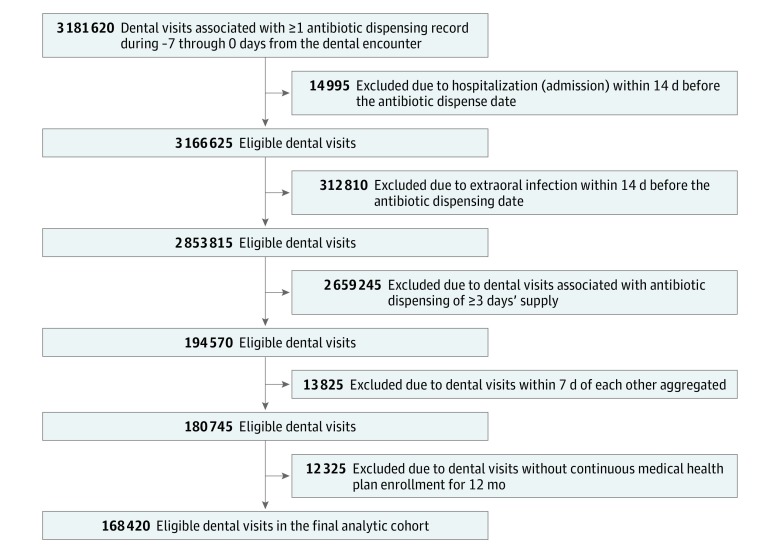
Design, setting, and participants: Retrospective cohort study. Dental visits from 2011 to 2015 were linked to medical and prescription claims from 2009 to 2015. The dates of analysis were August 2018 to January 2019. Participants were US patients with commercial dental insurance without a hospitalization or extraoral infection 14 days before antibiotic prophylaxis (defined as a prescription with ≤2 days' supply dispensed within 7 days before a dental visit).
Exposures: Presence or absence of cardiac diagnoses and dental procedures that manipulated the gingiva or tooth periapex.
Main outcomes and measures: Appropriate antibiotic prophylaxis was defined as a prescription dispensed before a dental visit with a procedure that manipulated the gingiva or tooth periapex in patients with an appropriate cardiac diagnosis. To assess associations between patient or dental visit characteristics and appropriate antibiotic prophylaxis, multivariable logistic regression was used. A priori hypothesis tests were performed with an α level of .05.
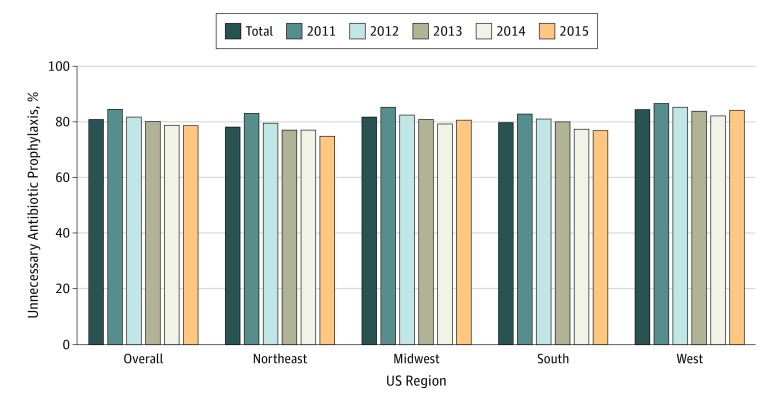
Results: From 2011 to 2015, antibiotic prophylaxis was prescribed for 168 420 dental visits for 91 438 patients (median age, 63 years; interquartile range, 55-72 years; 57.2% female). Overall, these 168 420 dental visits were associated with 287 029 dental procedure codes (range, 1-14 per visit). Most dental visits were classified as diagnostic (70.2%) and/or preventive (58.8%). In 90.7% of dental visits, a procedure was performed that would necessitate antibiotic prophylaxis in high-risk cardiac patients. Prevalent comorbidities include prosthetic joint devices (42.5%) and cardiac conditions at the highest risk of adverse outcome from infective endocarditis (20.9%). Per guidelines, 80.9% of antibiotic prophylaxis prescriptions before dental visits were unnecessary. Clindamycin was more likely to be unnecessary relative to amoxicillin (odds ratio [OR], 1.10; 95% CI, 1.05-1.15). Prosthetic joint devices (OR, 2.31; 95% CI, 2.22-2.41), tooth implant procedures (OR, 1.66; 95% CI, 1.45-1.89), female sex (OR, 1.21; 95% CI, 1.17-1.25), and visits occurring in the western United States (OR, 1.15; 95% CI, 1.06-1.25) were associated with unnecessary antibiotic prophylaxis.
Conclusion and relevance: More than 80% of antibiotics prescribed for infection prophylaxis before dental visits were unnecessary. Implementation of antimicrobial stewardship in dental practices is an opportunity to improve antibiotic prescribing for infection prophylaxis.
Conflict of interest statement
Figures
Comment in
-
Antibiotic Use in Dentistry-What We Know and Do Not Know.JAMA Netw Open. 2019 May 3;2(5):e193881. doi: 10.1001/jamanetworkopen.2019.3881. JAMA Netw Open. 2019. PMID: 31150066 No abstract available.
-
High proportion of prescriptions for antibiotic prophylaxis before dental procedures from 2011 through 2015 were not concordant with published guidelines.J Am Dent Assoc. 2019 Dec;150(12):e219. doi: 10.1016/j.adaj.2019.07.007. Epub 2019 Oct 1. J Am Dent Assoc. 2019. PMID: 31585664 No abstract available.
References
-
- Durkin MJ, Feng Q, Warren K, et al. ; Centers for Disease Control and Prevention Epicenters . Assessment of inappropriate antibiotic prescribing among a large cohort of general dentists in the United States. J Am Dent Assoc. 2018;149(5):372-381.e1. doi:10.1016/j.adaj.2017.11.034 - DOI - PMC - PubMed
-
- Wilson W, Taubert KA, Gewitz M, et al. ; American Heart Association Rheumatic Fever, Endocarditis, and Kawasaki Disease Committee; American Heart Association Council on Cardiovascular Disease in the Young; American Heart Association Council on Clinical Cardiology; American Heart Association Council on Cardiovascular Surgery and Anesthesia; Quality of Care and Outcomes Research Interdisciplinary Working Group . Prevention of infective endocarditis: guidelines from the American Heart Association: a guideline from the American Heart Association Rheumatic Fever, Endocarditis, and Kawasaki Disease Committee, Council on Cardiovascular Disease in the Young, and the Council on Clinical Cardiology, Council on Cardiovascular Surgery and Anesthesia, and the Quality of Care and Outcomes Research Interdisciplinary Working Group. Circulation. 2007;116(15):1736-1754. doi:10.1161/CIRCULATIONAHA.106.183095 - DOI - PubMed
Publication types
MeSH terms
Substances
Grants and funding
LinkOut - more resources
Full Text Sources
Medical