


Early-Life Adversity and Blunted Stress Reactivity as Predictors of Alcohol and Drug use in Persons With COMT (rs4680) Val158Met Genotypes
- PMID: 31150143
- PMCID: PMC6602827
- DOI: 10.1111/acer.14079
Early-Life Adversity and Blunted Stress Reactivity as Predictors of Alcohol and Drug use in Persons With COMT (rs4680) Val158Met Genotypes
Abstract
Background: Risk for alcoholism may be enhanced by exposure to early-life adversity (ELA) in persons with genetic vulnerabilities. We examined ELA in the presence of a common variant of the gene for the enzyme catechol-O-methyltransferase (COMT, Val158Met, rs4680) in relation to cortisol reactivity, the onset of early drinking, and experimentation with drugs.
Methods: Saliva cortisol reactivity to speech and mental arithmetic stress was measured in 480 healthy young adults (23.5 years of age, 50% females) who experienced either 0, 1, or ≥ 2 forms of ELA during childhood and adolescence, provided information on use of alcohol and recreational drugs, and were genotyped for the Val158Met polymorphism.
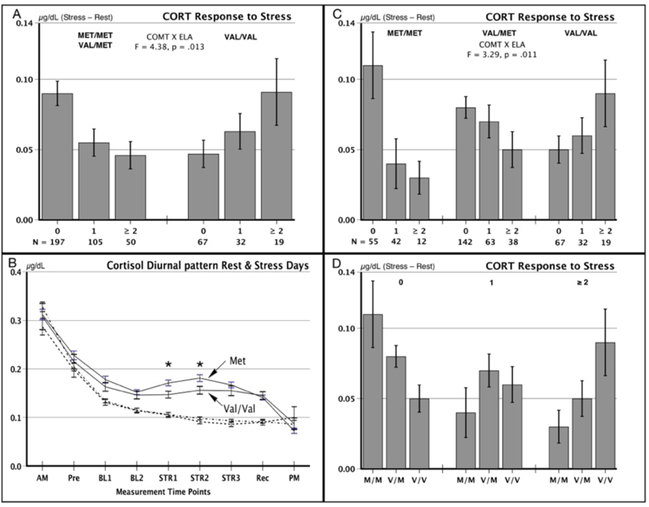
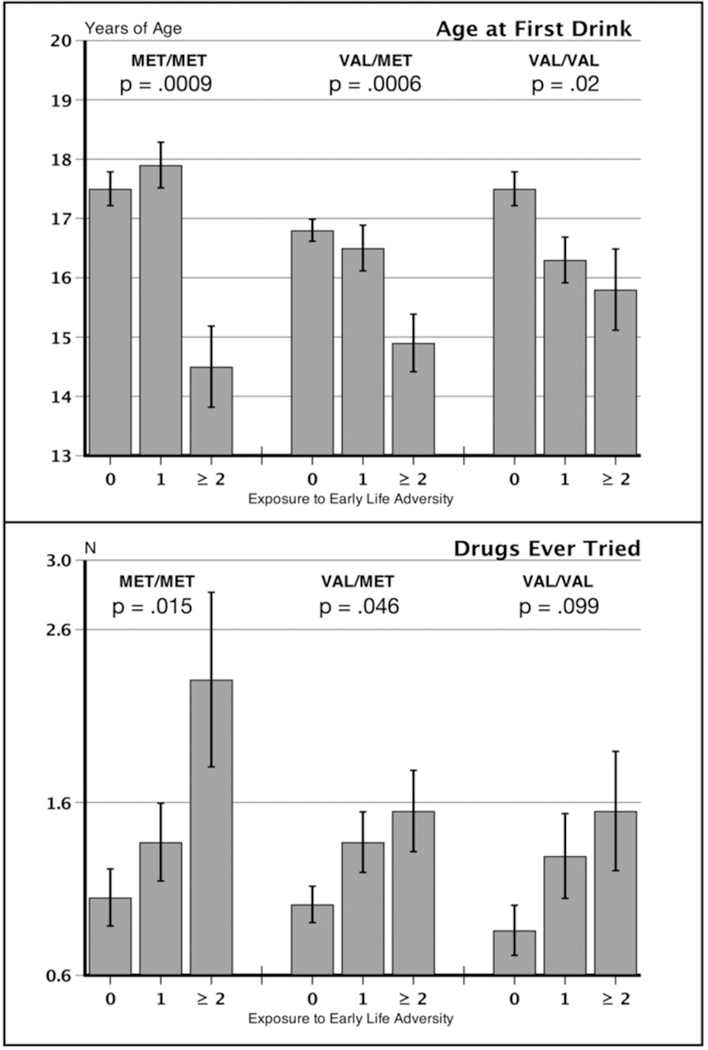
Results: ELA led to progressively smaller cortisol responses in the Met/Met and Val/Met allele groups but to progressively larger responses in Val homozygotes, F = 3.29, p = 0.011. ELA independently predicted earlier age at first drink, F = 14.2, p < 0.0001, with a larger effect in Met-allele carriers, F = 13.95, p < 0.00001, and a smaller effect in Val homozygotes, F = 4.14, p = 0.02. Similar effects were seen in recreational drug use. Cortisol reactivity was unrelated to drinking behavior or drug experimentation.
Conclusions: ELA leads to blunted stress reactivity and, independently, contributes to potentially risky drinking and drug-use behaviors in persons carrying 1 or 2 copies of the COMT 158Met allele. The results reinforce the impact of early experience on the stress axis and on risky behaviors, and they point to the 158Met allele as conveying a vulnerability to the early environment.
Keywords: Catechol-O-Methyltransferase; Cortisol; Dopamine; Drinking Behavior; Early-Life Adversity; Genotype; Stress.
© 2019 by the Research Society on Alcoholism.
Conflict of interest statement
The authors declare no conflicts of interest.
Figures
References
-
- al’Absi M (2006) Hypothalamic-Pituitary-Adrenocortical responses to psychological stress and risk for smoking relapse. Int. J. Psychophysiol 59:218–227. - PubMed
-
- Al’Absi M, Bongard S, Buchanan T, Pincomb GA, Licinio J, Lovallo WR (1997) Cardiovascular and neuroendocrine adjustment to public speaking and mental arithmetic stressors. Psychophysiology 34:266–275. - PubMed
-
- Alexander N, Klucken T, Koppe G, Osinsky R, Walter B, Vaitl D, Sammer G, Stark R, Hennig J (2012) Interaction of the serotonin transporter-linked polymorphic region and environmental adversity: increased amygdala-hypothalamus connectivity as a potential mechanism linking neural and endocrine hyperreactivity. Biol. Psychiatry 72:49–56. - PubMed
-
- American_Psychiatric_Association (1994) Diagnostic and Statistical Manual of Mental Disorders 4th (text rev.) ed., American Psychiatric Association, Washington, D.C.
Publication types
MeSH terms
Substances
Grants and funding
LinkOut - more resources
Full Text Sources
Medical
Miscellaneous
