Review
. 2019 May 30;20(11):2668.
doi: 10.3390/ijms20112668.

Regulation of Dual-Specificity Phosphatase (DUSP) Ubiquitination and Protein Stability

Affiliations
Review

Regulation of Dual-Specificity Phosphatase (DUSP) Ubiquitination and Protein Stability

Hsueh-Fen Chen et al. Int J Mol Sci. .

Abstract

Mitogen-activated protein kinases (MAPKs) are key regulators of signal transduction and cell responses. Abnormalities in MAPKs are associated with multiple diseases. Dual-specificity phosphatases (DUSPs) dephosphorylate many key signaling molecules, including MAPKs, leading to the regulation of duration, magnitude, or spatiotemporal profiles of MAPK activities. Hence, DUSPs need to be properly controlled. Protein post-translational modifications, such as ubiquitination, phosphorylation, methylation, and acetylation, play important roles in the regulation of protein stability and activity. Ubiquitination is critical for controlling protein degradation, activation, and interaction. For DUSPs, ubiquitination induces degradation of eight DUSPs, namely, DUSP1, DUSP4, DUSP5, DUSP6, DUSP7, DUSP8, DUSP9, and DUSP16. In addition, protein stability of DUSP2 and DUSP10 is enhanced by phosphorylation. Methylation-induced ubiquitination of DUSP14 stimulates its phosphatase activity. In this review, we summarize the knowledge of the regulation of DUSP stability and ubiquitination through post-translational modifications.

Keywords: dual-specificity phosphatase; mitogen-activated protein kinase; protein stability; ubiquitination.


Conflict of interest statement

The authors declare no conflict of interest. The funders had no role in the design of the study; in the collection, analyses, or interpretation of data; in the writing of the manuscript, or in the decision to publish the results.

Figures

Figure 1
Figure 1
Upon T-cell receptor (TCR) signaling, the protein arginine methyltransferase PRMT5 interacts with DUSP14 and induces its methylation on Arg17, Arg38, and Arg45 residues. Arginine-methylated DUSP14 then interacts with the ubiquitin E3 ligase TRAF2, which binds to the motif containing IAQIT residues of DUSP14 and then promotes K63-linked ubiquitination on Lys103 residue of DUSP14. Methylation and subsequent ubiquitination enhance the phosphatase activity of DUSP14. Activated DUSP14 dephosphorylates TAB1, leading to sequential inactivation of TAK1 and downstream IKK/JNK activities. Activated DUSP14 also directly dephosphorylates ERK and attenuates the ERK signaling pathway. Arrows denote activation; T bars denote inhibition.
Figure 2
Figure 2
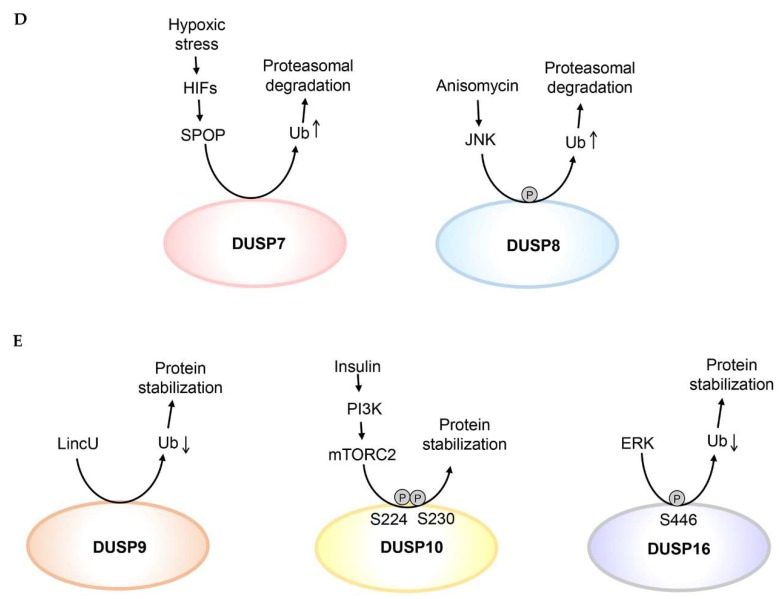
Post-translational modifications regulate DUSP protein stability. (A) Ubiquitination, oxidation, Cys258 S-glutathionylation, or Ser296/Ser323 phosphorylation of DUSP1 induces DUSP1 proteasomal degradation. Deubiquitination or phosphorylation of Ser359 and Ser364 residues enhances DUSP1 protein stability. (B) ERK induces DUSP2 protein stabilization; however, it is unclear whether ERK directly phosphorylates DUSP2. Phosphorylation of Ser386 and Ser391 residues of DUSP4 enhances its protein stability by inhibiting ubiquitin-mediated proteasomal degradation. Oxidation induces DUSP4 protein degradation. Reduced ubiquitination of DUSP5 enhances its protein stability. (C) Phosphorylation of Ser159, Ser174, or Ser197 residue induces proteasomal degradation of DUSP6. (D) Ubiquitination of DUSP7 or DUSP8 induces their proteasomal degradation. (E) Reduced ubiquitination of DUSP9 or DUSP16 enhances their protein stability. Phosphorylation of Ser224 and Ser230 residues enhances DUSP10 protein stability. Ub denotes ubiquitination of DUSPs. Oxidation indicates oxidation of DUSP1 or DUSP4.
Figure 2
Figure 2
Post-translational modifications regulate DUSP protein stability. (A) Ubiquitination, oxidation, Cys258 S-glutathionylation, or Ser296/Ser323 phosphorylation of DUSP1 induces DUSP1 proteasomal degradation. Deubiquitination or phosphorylation of Ser359 and Ser364 residues enhances DUSP1 protein stability. (B) ERK induces DUSP2 protein stabilization; however, it is unclear whether ERK directly phosphorylates DUSP2. Phosphorylation of Ser386 and Ser391 residues of DUSP4 enhances its protein stability by inhibiting ubiquitin-mediated proteasomal degradation. Oxidation induces DUSP4 protein degradation. Reduced ubiquitination of DUSP5 enhances its protein stability. (C) Phosphorylation of Ser159, Ser174, or Ser197 residue induces proteasomal degradation of DUSP6. (D) Ubiquitination of DUSP7 or DUSP8 induces their proteasomal degradation. (E) Reduced ubiquitination of DUSP9 or DUSP16 enhances their protein stability. Phosphorylation of Ser224 and Ser230 residues enhances DUSP10 protein stability. Ub denotes ubiquitination of DUSPs. Oxidation indicates oxidation of DUSP1 or DUSP4.

References

    1. Widmann C., Gibson S., Jarpe M.B., Johnson G.L. Mitogen-activated protein kinase: Conservation of a three-kinase module from yeast to human. Physiol. Rev. 1999;79:143–180. doi: 10.1152/physrev.1999.79.1.143. - DOI - PubMed
    1. Raman M., Chen W., Cobb M.H. Differential regulation and properties of MAPKs. Oncogene. 2007;26:3100–3112. doi: 10.1038/sj.onc.1210392. - DOI - PubMed
    1. Chen Y.R., Meyer C.F., Tan T.H. Persistent activation of c-Jun N-terminal kinase 1 (JNK1) in γ radiation-induced apoptosis. J. Biol. Chem. 1996;271:631–634. doi: 10.1074/jbc.271.2.631. - DOI - PubMed
    1. Chen Y.R., Wang X., Templeton D., Davis R.J., Tan T.H. The role of c-Jun N-terminal kinase (JNK) in apoptosis induced by ultraviolet C and γ radiation: Duration of JNK activation may determine cell death and proliferation. J. Biol. Chem. 1996;271:31929–31936. doi: 10.1074/jbc.271.50.31929. - DOI - PubMed
    1. MacCorkle R.A., Tan T.H. Mitogen-activated protein kinases in cell-cycle control. Cell Biochem. Biophys. 2005;43:451–461. doi: 10.1385/CBB:43:3:451. - DOI - PubMed

LinkOut - more resources