. 2019 Jun 18;116(25):12540-12549.
doi: 10.1073/pnas.1902010116. Epub 2019 May 31.

Arabidopsis ABCG28 is required for the apical accumulation of reactive oxygen species in growing pollen tubes

Affiliations

Arabidopsis ABCG28 is required for the apical accumulation of reactive oxygen species in growing pollen tubes

Thanh Ha Thi Do et al. Proc Natl Acad Sci U S A. .

Abstract

Tip-focused accumulation of reactive oxygen species (ROS) is tightly associated with pollen tube growth and is thus critical for fertilization. However, it is unclear how tip-growing cells establish such specific ROS localization. Polyamines have been proposed to function in tip growth as precursors of the ROS, hydrogen peroxide. The ABC transporter AtABCG28 may regulate ROS status, as it contains multiple cysteine residues, a characteristic of proteins involved in ROS homeostasis. In this study, we found that AtABCG28 was specifically expressed in the mature pollen grains and pollen tubes. AtABCG28 was localized to secretory vesicles inside the pollen tube that moved toward and fused with the plasma membrane of the pollen tube tip. Knocking out AtABCG28 resulted in defective pollen tube growth, failure to localize polyamine and ROS to the growing pollen tube tip, and complete male sterility, whereas ectopic expression of this gene in root hair could recover ROS accumulation at the tip and improved the growth under high-pH conditions, which normally prevent ROS accumulation and tip growth. Together, these data suggest that AtABCG28 is critical for localizing polyamine and ROS at the growing tip. In addition, this function of AtABCG28 is likely to protect the pollen tube from the cytotoxicity of polyamine and contribute to the delivery of polyamine to the growing tip for incorporation into the expanding cell wall.

Keywords: ABC transporters; AtABCG28; ROS; pollen tube growth; polyamine.


Conflict of interest statement

The authors declare no conflict of interest.

Figures
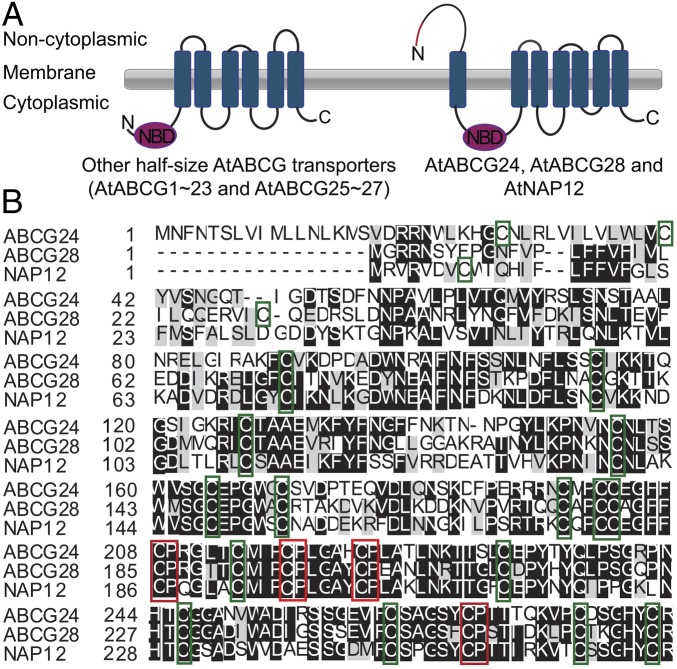
Fig. 1.
Fig. 1.
The predicted topology of the three ABCG transporters that contain many cysteine residues is different from that of other half-size ABCG transporters in A. thaliana. (A) Predicted topology of the three half-size ABCG transporters containing many cysteine residues (AtABCG24, AtABCG28, and AtNAP12; Right) and that of other half-size ABCG transporters (Left). Topology and domain organization are based on the Aramemnon database (http://aramemnon.uni-koeln.de) and SPOCTOPUS program (http://octopus.cbr.su.se/). AtABCG24, AtABCG28, and AtNAP12 are predicted to have an extra noncytoplasmic domain at the N terminus compared with other half-size ABCG transporters. The red line in the N terminus indicates the predicted signal peptide. (B) AtABCG24, AtABCG28, and AtNAP12 contain numerous thiol groups in the predicted N-terminal noncytoplasmic domains. The cysteine residues with thiol groups are boxed in green, and the cysteine–proline motifs, which are known as heme regulatory motifs, are boxed in red.
Fig. 2.
Fig. 2.
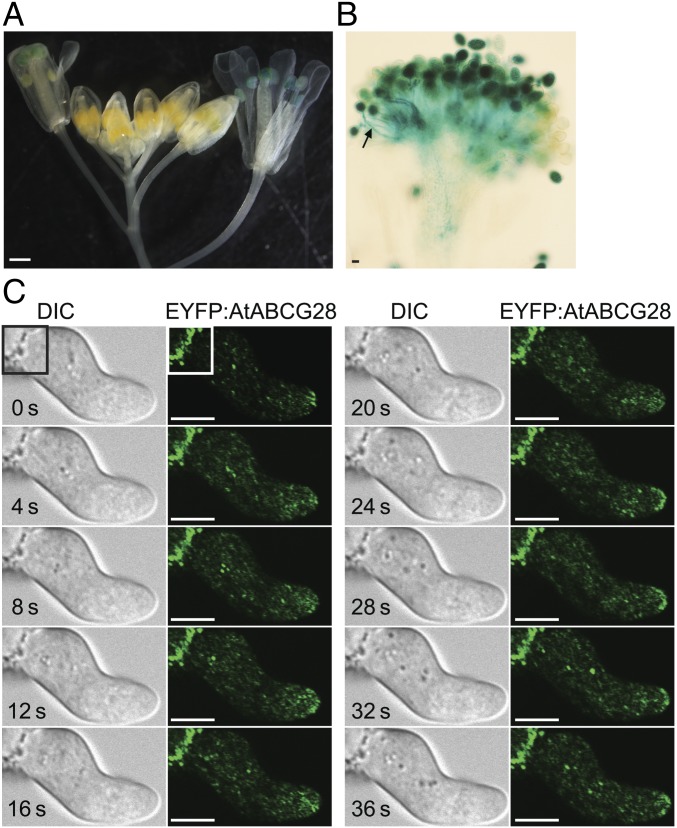
AtABCG28 is expressed specifically in mature pollen grains and localizes to the secretory vesicles at the growing pollen tube tip. (A and B) Tissue-specific expression pattern of pAtABCG28::GUS in an inflorescence stem (A) and in a pollinated pistil (B). Note that the pAtABCG28::GUS signal is apparent in anthers and pollinated pistils of the flowers at stage 12–13. [Scale bars, 100 µm (A) and 10 µm (B).] (C) Time-lapse images of EYFP:AtABCG28 pollen in the apical zone of the tube during the initial slow-growing phase. Note that the EYFP:AtABCG28 signal appears as bright dots moving toward the growing tip and transiently accumulates in the plasma membrane at t = 12, 24, 28, and 32 s. The bright fluorescence in the left corner of the image (white rectangle) is autofluorescence from the pollen coat. (Scale bars, 5 µm.)
Fig. 3.
Fig. 3.
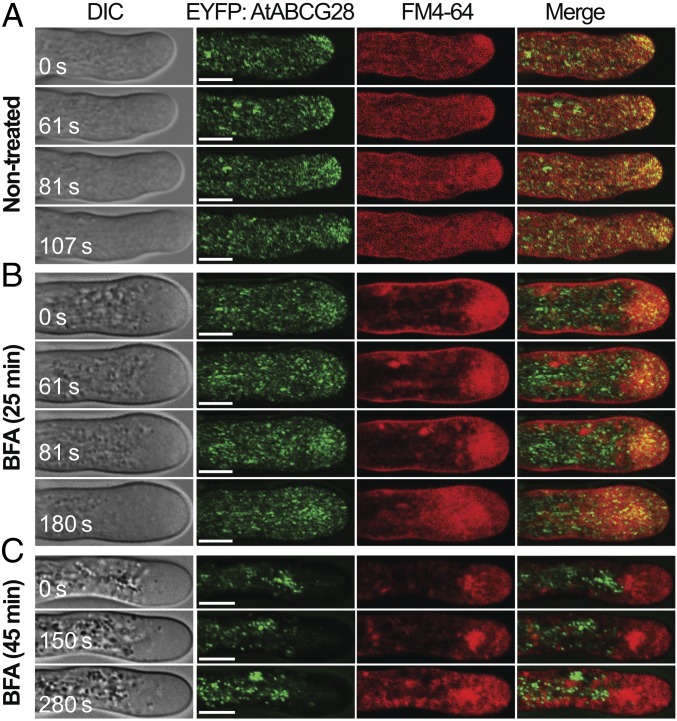
Targeting of AtABCG28 to the tip is BFA-sensitive. (A) Time-lapse images of a control, non-BFA-treated EYFP:AtABCG28 pollen tube stained with the plasma membrane and endocytic marker FM4-64. EYFP:AtABCG28 appears as green dots that move toward the apical zone during tip growth. Note that the EYFP:AtABCG28 signal colocalizes with FM4-64 at the apical zone. (B and C) Time-lapse images of BFA-treated EYFP:AtABCG28 pollen tubes stained with FM4-64. The pollen were treated with 25 µM BFA for 25 (B) or 45 (C) min, which stopped their tube growth. t = 0 s marks the beginning of the observation period. An FM4-64–stained, large BFA compartment was apparent. (B) EYFP:AtABCG28 signal was much reduced in the apex of the tube compared with the nontreated control shown in A and was found in the subapical region, where the BFA compartment was localized. (C) After 45 min of treatment with BFA, EYFP:AtABCG28 was absent from the tip and instead appeared as aggregates in the shank, and FM4-64 signal was mostly in the large BFA compartment. Images are representative of three independent experiments. (Scale bars, 5 µm.)
Fig. 4.
Fig. 4.
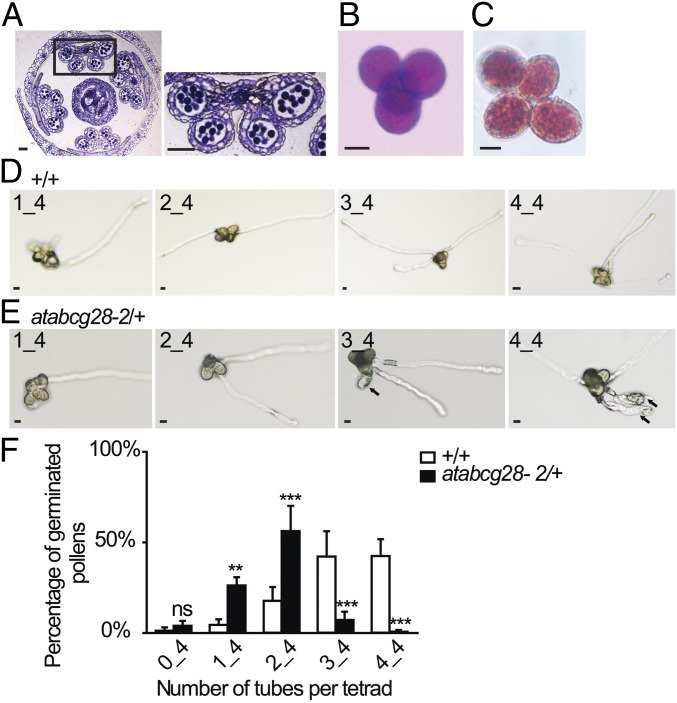
atabcg28 knockout mutant pollen develop normally but fail to produce pollen tubes. (A) A cross-section of a mature atabcg28-1/+ flower just before pollination, stained with toluidine blue. Pollen grains in the pollen sacs of atabcg28-1/+ plants appear normal. (Scale bars, 50 µm.) (B and C) Pollen viability tests of atabcg28-1/+ tetrads based on Alexander staining (B) and morphology of pollen vacuoles visualized with neutral red (C). Note no difference between pollen of different genotypes. (Scale bars, 10 µm.) (D and E) In vitro-germinated pollen tubes of wild-type (D; +/+) and atabcg28/+ (E) tetrads. Arrows indicate atabcg28 pollen tubes. (Scale bars, 5 µm.) (F) Quantitative analysis of in vitro pollen germination of the wild-type (+/+) and atabcg28/+ tetrads. Error bars are SD. Data were collected from 800 tetrads of the qrt1 background and 2,000 tetrads of atabcg28/+ in four independent experiments. Asterisks indicate statistically significant differences between the wild type and atabcg28/+, tested using two-way ANOVA with Bonferroni posttests. ns (not significant), P > 0.05; **P < 0.01; ***P < 0.001.
Fig. 5.
Fig. 5.
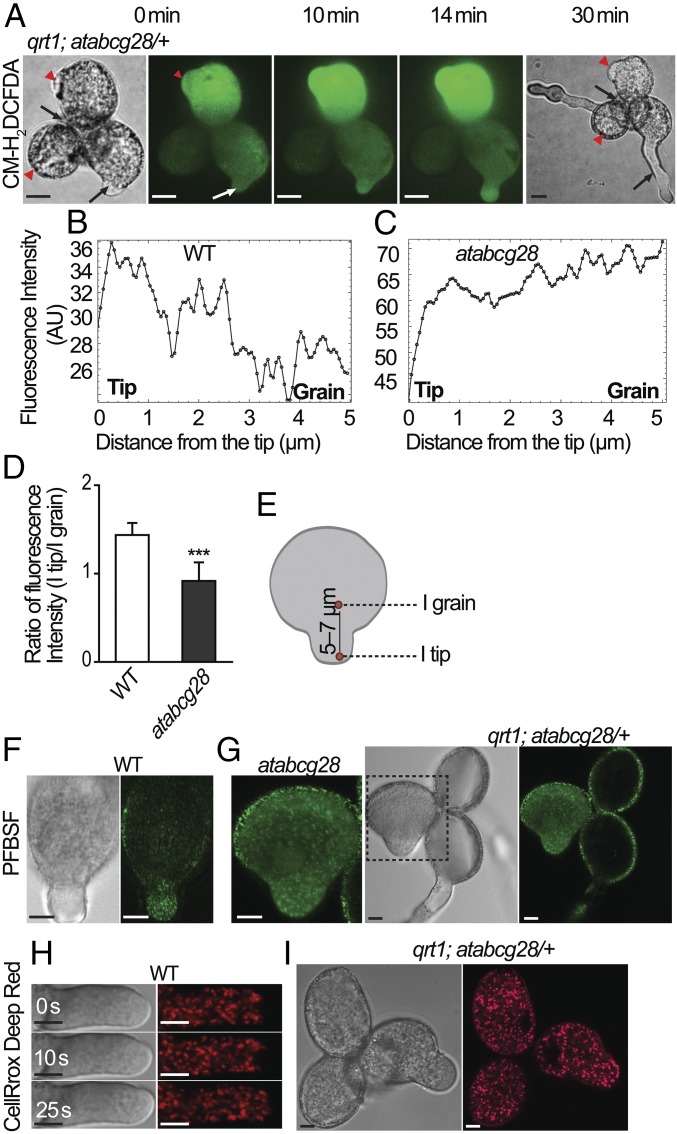
atabcg28 pollen tube has dispersed pattern of hydrogen peroxide. (A) Time-lapse images of an atabcg28/+ tetrad stained with DCFH2-DA. Red arrowheads and black arrows mark atabcg28 and wild-type pollen, respectively. Red arrowhead and white arrow at t = 0 min (the onset of observation) indicate atabcg28 and wild-type pollen, respectively, in the same focal plane. Note that the green DCFH2-DA signal is focused in the tip of the elongating wild-type pollen tube but is diffuse in atabcg28 pollen. (Scale bars, 5 µm.) (B and C) DCFH2-DA fluorescence intensity profiles along the longitudinal axis (t = 10 min image) in the wild-type (B) and atabcg28 (C) pollen tube, respectively. (D and E) Ratio of fluorescence intensity in the pollen tube tip (I tip) versus that inside the grain (5 to 7 µm from the tip, I grain) (mean ± SD). Regions in which fluorescence intensity were measured are indicated in E. A total of 10∼11 wild-type and atabcg28 pollen were analyzed in three independent experiments. atabcg28 pollen were chosen from tetrads that had two healthy wild-type pollen tubes. Asterisks denote statistical significance calculated by a by unpaired t test (***two-tailed P < 0.0001). (F and G) Hydrogen peroxide distribution in germinated wild-type (F) and atabcg28 (G) pollen stained with PFBSF. Note that the green fluorescent signal accumulated in the tip of wild-type pollen but was distributed throughout atabcg28 pollen. (H) Time-lapse images showing the distribution of hydroxyl radical and superoxide in an elongating wild-type pollen tube detected using CellRox Deep Red. Note that the red fluorescent signal of Cell ROx Deep Red is absent from the apex. (I) The distribution of hydroxyl radical and superoxide in the early stages of atabcg28/+ tetrad germination detected using CellRox Deep Red. Note that there is no difference in the fluorescence intensity and distribution pattern between the three in-focus pollen grains. (Scale bars, 5 µm.)
Fig. 6.
Fig. 6.
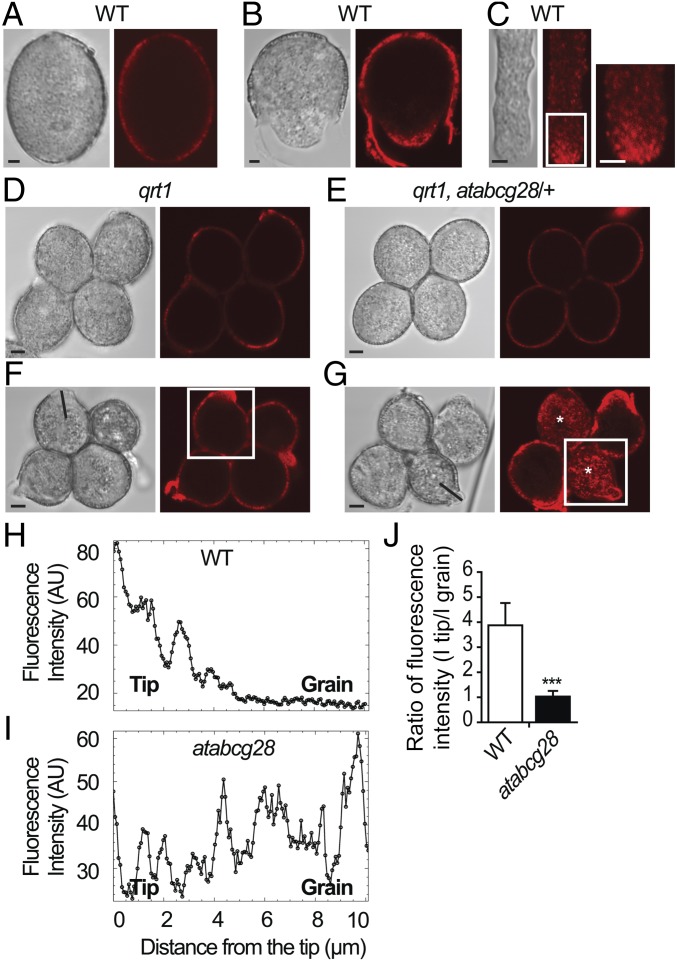
The tip-focused localization of polyamines is disrupted in atabcg28 pollen tubes. Polyamines were detected by immunostaining using an antibody that cross-reacts with Spm/Spd. (AC) Localization of Spm/Spd in the cell wall of pollen grains (A and B) and in the tips of elongating pollen tubes (B and C). Elongating pollen tubes exhibit a Spm/Spd signal in an inverted cone shape. Enlargement of boxed region (C, Inset) showing the dotted distribution of polyamine in the apical clear zone. (D, F, and H) Representative localization of Spm/Spd in the wild-type tetrads (qrt1). Pollen soon after germination without and with an emerged tube (D); a tetrad with an elongated pollen tube (F); fluorescence intensity profile measured along the pollen tube axis (H), indicated in F. Note that Spm/Spd localization is focused on the growth sites in pollen grains and tubes. (E, G, and I) Representative localizations of Spm/Spd observed in atabcg28/+ tetrads. A nongerminated atabcg28/+ tetrad exhibiting cell wall localization of Spm/Spd (E), which is indistinguishable between the wild-type and atabcg28 pollen grains; an atabcg28/+ tetrad soon after germination (G), which had two germinated wild-type pollen and two germinated atabcg28 pollen (asterisks). Fluorescence intensity profile (I) measured along the atabcg28 pollen tube axis, indicated in G. Note that Spm/Spd is dispersed throughout atabcg28 pollen grains and tubes as germination progresses. (J) Ratio of fluorescence intensity value in the tip (I tip) compared with that inside the grain region (5 to 7 µm from the tip, I grain) of the pollen tube (mean ± SD). Positions at which fluorescence intensity were measured are indicated in Fig. 5E. A total of 22 wild-type and atabcg28 tetrads were analyzed in three independent experiments. atacbg28 pollen were chosen from tetrads that had two healthy wild-type pollen tubes. Asterisks denote statistical significance calculated by an unpaired t test (***two-tailed P < 0.0001). (Scale bars, 2.5 µm.)
Fig. 7.
Fig. 7.
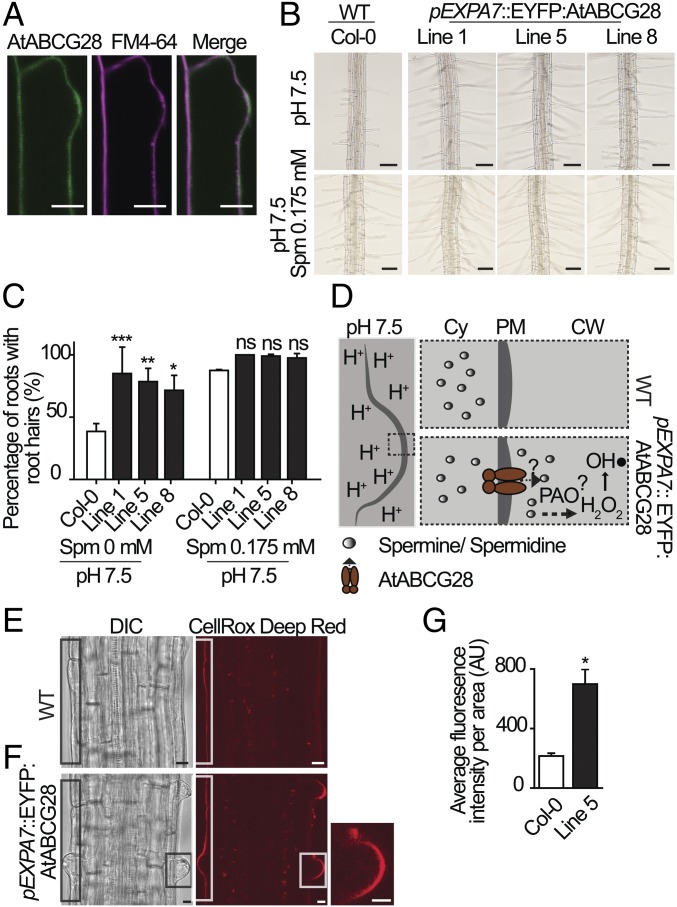
Ectopic expression of AtABCG28 improves root hair elongation at high pH. (A) Plasma membrane localization of AtABCG28 in a bulging root hair cell. The EYFP:AtABCG28 signal was higher than in other regions of the root hair when the hair bulge emerged. (Scale bars, 10 µm.) (B) Representative root hair images of the wild-type (Col-0) and three independent pEXP7::EYFP:AtABCG28 transgenic lines grown in 1/8 MS-agar medium at pH 7.5 with or without spermine (0.175 mM). (Scale bars, 100 µm.) (C) Percentage values of roots with elongated root hairs at pH 7.5 in the absence or presence of 0.175 mM spermine. Data (mean ± SD) from two independent experiments (n = 50 roots per genotype) are presented. Asterisks denote statistical significance between wild-type and transgenic lines, calculated by two-way ANOVA and Bonferroni posttests [*P < 0.05; **P < 0.01; ***P < 0.001; ns (not significant), P > 0.05]. (D) A model for the expected function of AtABCG28 in root hair growth at high pH conditions. The dashed inset is a proposed model explaining the difference in development of trichoblast cells between wild-type and transgenic plants expressing AtABCG28. At high pH, spermine and spermidine synthesized in the cytosol are secreted to the apoplast by AtABCG28 and oxidized into hydrogen peroxide (H2O2) by the activity of PAO. Hydrogen peroxide is further catalyzed into its hydroxyl radical, which loosens the cell wall and thus stimulates root hair elongation. (E and F) Representative images of ROS signal visualized with CellRox Deep Red in the differentiation zone of the Col-0 root (E) and pEXP7::EYFP:AtABCG28 line 5 (F). (F, Inset) Enlargement of hair bulge. (Scale bars, 10 µm.) (G) Relative ROS levels (mean ± SD) quantified in the wild-type (Col-0) and pEXP7:: EYFP:AtABCG28 (line 5) roots. Fourteen roots per genotype from two independent experiments were analyzed. Asterisk denotes statistical significance between wild-type and transgenic line, calculated by an unpaired t test (*two-tailed P < 0.05).
Fig. 8.
Fig. 8.
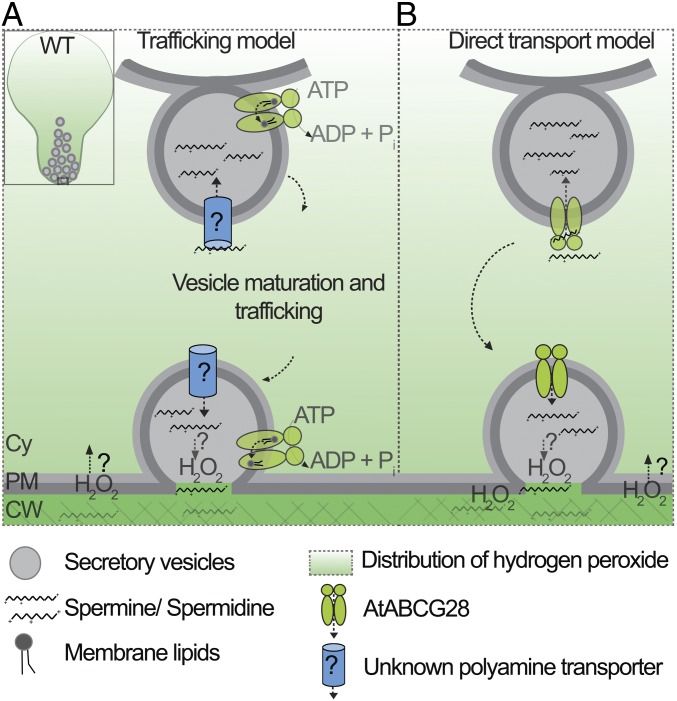
Proposed working models of AtABCG28 function during pollen tube growth. (A) Trafficking model: AtABCG28 might be involved in trafficking of the secretory vesicles to the tip of the growing pollen tube. An unknown polyamine transporter mediates Spm/Spd loading into the secretory vesicles, and AtABCG28 facilitates trafficking of Spm/Spd containing vesicles to the apical zone, possibly by transporting a so far unidentified substrate. (B) Direct transport model: AtABCG28 might directly transport Spm/Spd from the cytosol into secretory vesicles which move to the tip of the pollen tube. AtABCG28-mediated loading of Spm/Spd molecules into the secretory vesicles protects the cytosol from the cytotoxicity of polyamines. Sequestered Spm/Spd are oxidized, producing H2O2, or released into the apoplast, where H2O2 is generated during pollen tube growth. Cy, cytosol; SV, secretory vesicle; PM, plasma membrane.

References

    1. Halliwell B., Reactive species and antioxidants. Redox biology is a fundamental theme of aerobic life. Plant Physiol. 141, 312–322 (2006). - PMC - PubMed
    1. Neill S., Desikan R., Hancock J., Hydrogen peroxide signalling. Curr. Opin. Plant Biol. 5, 388–395 (2002). - PubMed
    1. Mangano S., Juárez S. P. D., Estevez J. M., ROS regulation of polar growth in plant cells. Plant Physiol. 171, 1593–1605 (2016). - PMC - PubMed
    1. Semighini C. P., Harris S. D., Regulation of apical dominance in Aspergillus nidulans hyphae by reactive oxygen species. Genetics 179, 1919–1932 (2008). - PMC - PubMed
    1. Coelho S. M., Brownlee C., Bothwell J. H., A tip-high, Ca(2+) -interdependent, reactive oxygen species gradient is associated with polarized growth in fucus serratus zygotes. Planta 227, 1037–1046 (2008). - PubMed

Publication types

MeSH terms

Substances

LinkOut - more resources