


Do treatment effects of a web-based cognitive behavioral therapy for insomnia intervention differ for users with and without pain interference? A secondary data analysis
- PMID: 31152334
- PMCID: PMC6885103
- DOI: 10.1007/s10865-019-00065-w
Do treatment effects of a web-based cognitive behavioral therapy for insomnia intervention differ for users with and without pain interference? A secondary data analysis
Abstract
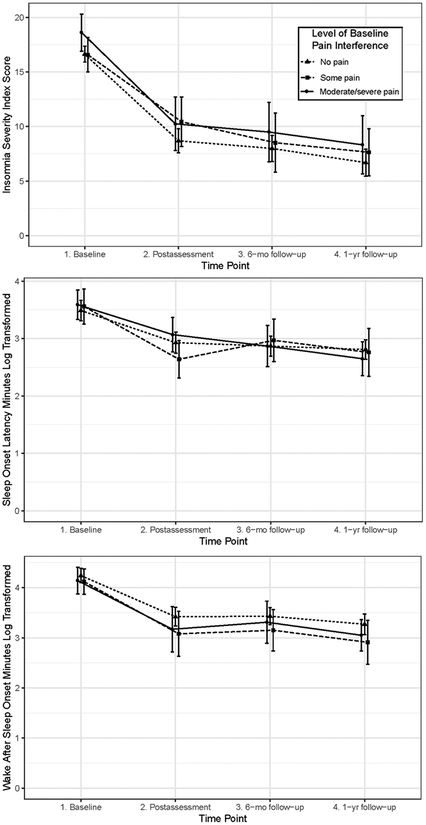
Cognitive-behavioral therapy for insomnia (CBT-I) shows treatment benefits among individuals with pain interference; however, effects of Internet-delivered CBT-I for this population are unknown. This secondary analysis used randomized clinical trial data from adults assigned to Internet-delivered CBT-I to compare changes in sleep by pre-intervention pain interference. Participants (N = 151) completed the Insomnia Severity Index (ISI) and sleep diaries [sleep onset latency (SOL); wake after sleep onset (WASO)] at baseline, post-assessment, 6- and 12-month follow-ups. Linear mixed-effects models showed no differences between pain interference groups (no, some, moderate/severe) for changes from baseline to any follow-up timepoint for ISI (p = .72) or WASO (p = .88). There was a small difference in SOL between those reporting some versus no or moderate/severe pain interference (p = .04). Predominantly comparable and sustained treatment benefits for both those with and without pain interference suggest that Internet-delivered CBT-I is promising for delivering accessible care to individuals with comorbid pain and insomnia.
Keywords: Cognitive behavioral therapy; Comorbidity; Insomnia; Internet; Pain interference.
Conflict of interest statement
Conflicts: Shaffer, Camacho, Lord, Chow, Palermo, Law, and Ingersoll have no conflicts of interest to disclose. Thorndike and Ritterband report having equity ownership in BeHealth Solutions, LLC, a company that develops and makes available products related to the research reported in this article. Specifically, BeHealth Solutions, LLC, has licensed the Sleep Healthy Using the Internet (SHUTi) program and the software platform on which it was built from the University of Virginia. The terms of this arrangement have been reviewed and approved by the University of Virginia in accord with its conflict of interest policy.
Figures
References
-
- Association A. P. (2013). Diagnostic and statistical manual of mental disorders, 5th Edition (DSM-5).
-
- Austrian JS, Kerns RD, & Reid MC (2005). Perceived Barriers to Trying Self-Management Approaches for Chronic Pain in Older Persons. Journal of the American Geriatrics Society, 53(5), 856–861. - PubMed
-
- Bastien CH, Vallières A, & Morin CM (2001). Validation of the Insomnia Severity Index as an outcome measure for insomnia research. Sleep Medicine, 2(4), 297–307. - PubMed
-
- Currie SR, Wilson KG, Pontefract AJ, & deLaplante L (2000). Cognitive behavioral treatment of insomnia secondary to chronic pain. Journal of Consulting and Clinical Psychology, 68(3), 407–416. - PubMed
Publication types
MeSH terms
Grants and funding
LinkOut - more resources
Full Text Sources
Medical
