


Use and Understanding of Anonymization and De-Identification in the Biomedical Literature: Scoping Review
- PMID: 31152528
- PMCID: PMC6658290
- DOI: 10.2196/13484
Use and Understanding of Anonymization and De-Identification in the Biomedical Literature: Scoping Review
Abstract
Background: The secondary use of health data is central to biomedical research in the era of data science and precision medicine. National and international initiatives, such as the Global Open Findable, Accessible, Interoperable, and Reusable (GO FAIR) initiative, are supporting this approach in different ways (eg, making the sharing of research data mandatory or improving the legal and ethical frameworks). Preserving patients' privacy is crucial in this context. De-identification and anonymization are the two most common terms used to refer to the technical approaches that protect privacy and facilitate the secondary use of health data. However, it is difficult to find a consensus on the definitions of the concepts or on the reliability of the techniques used to apply them. A comprehensive review is needed to better understand the domain, its capabilities, its challenges, and the ratio of risk between the data subjects' privacy on one side, and the benefit of scientific advances on the other.
Objective: This work aims at better understanding how the research community comprehends and defines the concepts of de-identification and anonymization. A rich overview should also provide insights into the use and reliability of the methods. Six aspects will be studied: (1) terminology and definitions, (2) backgrounds and places of work of the researchers, (3) reasons for anonymizing or de-identifying health data, (4) limitations of the techniques, (5) legal and ethical aspects, and (6) recommendations of the researchers.
Methods: Based on a scoping review protocol designed a priori, MEDLINE was searched for publications discussing de-identification or anonymization and published between 2007 and 2017. The search was restricted to MEDLINE to focus on the life sciences community. The screening process was performed by two reviewers independently.
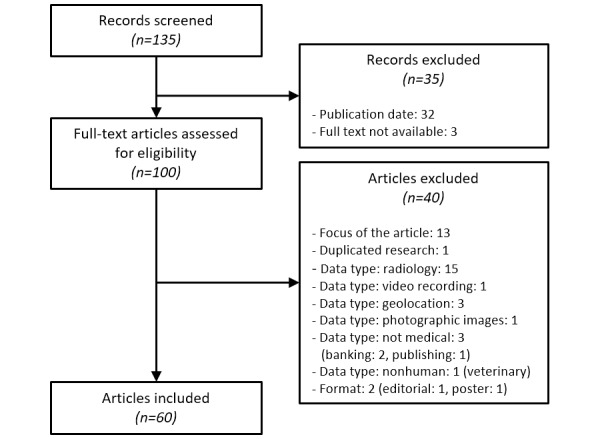
Results: After searching 7972 records that matched at least one search term, 135 publications were screened and 60 full-text articles were included. (1) Terminology: Definitions of the terms de-identification and anonymization were provided in less than half of the articles (29/60, 48%). When both terms were used (41/60, 68%), their meanings divided the authors into two equal groups (19/60, 32%, each) with opposed views. The remaining articles (3/60, 5%) were equivocal. (2) Backgrounds and locations: Research groups were based predominantly in North America (31/60, 52%) and in the European Union (22/60, 37%). The authors came from 19 different domains; computer science (91/248, 36.7%), biomedical informatics (47/248, 19.0%), and medicine (38/248, 15.3%) were the most prevalent ones. (3) Purpose: The main reason declared for applying these techniques is to facilitate biomedical research. (4) Limitations: Progress is made on specific techniques but, overall, limitations remain numerous. (5) Legal and ethical aspects: Differences exist between nations in the definitions, approaches, and legal practices. (6) Recommendations: The combination of organizational, legal, ethical, and technical approaches is necessary to protect health data.
Conclusions: Interest is growing for privacy-enhancing techniques in the life sciences community. This interest crosses scientific boundaries, involving primarily computer science, biomedical informatics, and medicine. The variability observed in the use of the terms de-identification and anonymization emphasizes the need for clearer definitions as well as for better education and dissemination of information on the subject. The same observation applies to the methods. Several legislations, such as the American Health Insurance Portability and Accountability Act (HIPAA) and the European General Data Protection Regulation (GDPR), regulate the domain. Using the definitions they provide could help address the variable use of these two concepts in the research community.
Keywords: anonymisation; anonymization; confidentiality; data protection; de-identification; deidentification; privacy; pseudonymization; scoping review; secondary use.
©Raphaël Chevrier, Vasiliki Foufi, Christophe Gaudet-Blavignac, Arnaud Robert, Christian Lovis. Originally published in the Journal of Medical Internet Research (http://www.jmir.org), 31.05.2019.
Conflict of interest statement
Conflicts of Interest: CL is Editor-in-Chief for JMIR Medical Informatics.
Figures


References
-
- Final NIH Statement on Sharing Research Data. Bethesda, MD: National Institutes of Health; 2003. Feb 26, [2019-01-24]. https://grants.nih.gov/grants/guide/notice-files/NOT-OD-03-032.html .
-
- Institute of Medicine (IOM) Sharing Clinical Trial Data: Maximizing Benefits, Minimizing Risk. Washington, DC: The National Academies Press; 2015. - PubMed
-
- Safran C, Bloomrosen M, Hammond WE, Labkoff S, Markel-Fox S, Tang PC, Detmer DE, Expert Panel Toward a national framework for the secondary use of health data: An American Medical Informatics Association White Paper. J Am Med Inform Assoc. 2007;14(1):1–9. doi: 10.1197/jamia.M2273. http://europepmc.org/abstract/MED/17077452 M2273 - DOI - PMC - PubMed
-
- Dukes P, Clement-Stoneham G. Data Sharing Policy. Version 2.2. London, UK: Medical Research Council; 2016. Sep, [2018-02-13]. https://www.mrc.ac.uk/documents/pdf/mrc-data-sharing-policy/
Publication types
MeSH terms
LinkOut - more resources
Full Text Sources
Molecular Biology Databases
