. 2019 Sep;157(3):884-887.e3.
doi: 10.1053/j.gastro.2019.05.058. Epub 2019 May 30.

Noninvasive Detection of High-Risk Adenomas Using Stool-Derived Eukaryotic RNA Sequences as Biomarkers

Collaborators, Affiliations

Noninvasive Detection of High-Risk Adenomas Using Stool-Derived Eukaryotic RNA Sequences as Biomarkers

Erica K Barnell et al. Gastroenterology. 2019 Sep.
No abstract available

Keywords: Early Cancer Detection; High-Risk Adenoma; Precision Oncology; Stool RNA.


Conflict of interest statement

Potential Competing Interests

These authors disclose the following: Erica Barnell, Yiming Kang, Andrew Barnell, Katie Campbell, and Elizabeth Wurtzler are inventors of the intellectual property owned by Geneoscopy. Erica Barnell, Yiming Kang, and Andrew Barnell are owners of Geneoscopy. Aadel Chaudhuri is a scientific advisor for Geneoscopy. Andrew Barnell, Elizabeth Wurtzler, and Kimberly Kruse are employees of Geneoscopy. Aadel Chaudhuri is a scientific advisor/consultant for Roche Sequencing Solutions and Tempus Labs, has received speaker honoraria and travel support from Varian Medical Systems, Roche Sequencing Solutions and Foundation Medicine, receives research support from Roche Sequencing Solutions, has served as a consultant for Tempus Labs and for Oscar Health, and is an inventor of intellectual property licensed to Biocognitive Labs. The remaining authors disclose no conflicts.

Figures
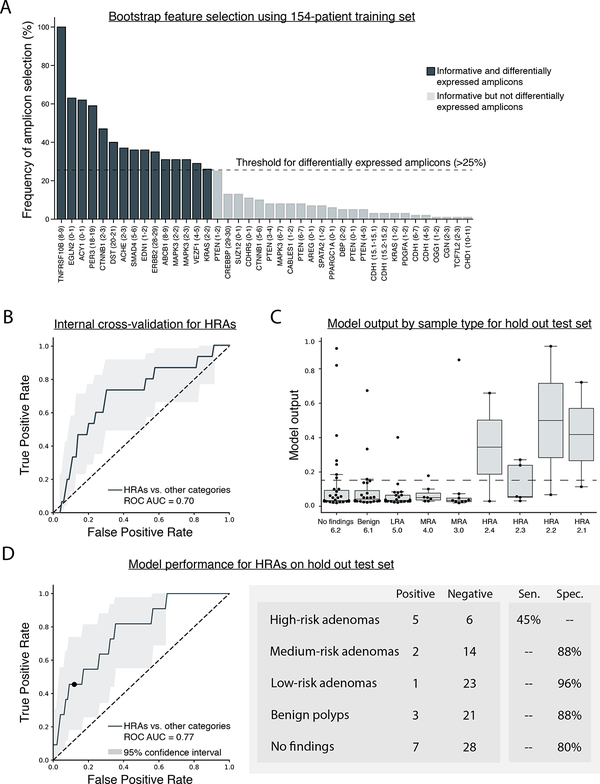
Figure 1.
Figure 1.. Eligible feature selection using bootstrapping of the training set (n = 154 samples) and model performance for the detection of HRAs based on 10-fold internal cross-validation and performance on a prospective hold out test set (n = 110 samples).
A) Transcripts used in the custom amplicon panel (n = 639 amplicons) were selected based on previously conducted research and differentially expressed amplicons were identified using 100-fold bootstrapping of the 154-patient training set. If an amplicon was observed in at least 25% of all 100 splits (bootstrap threshold), then it was considered differentially expressed and was eligible as a feature for the final model. Each column represents a single amplicon denoted by the HUGO gene name with exon location of forward and reverse probes. In total, 15 amplicons on 14 unique genes were selected as differentially expressed. B) 10-fold internal cross-validation was performed using the training set (n = 154 samples), 15 differentially expressed amplicons, and raw GAPDH values. The ROC curve shows model performance whereby high-risk adenomas (HRAs) were considered positive and other findings (medium-risk adenomas, low-risk adenomas, benign polyps, no findings on a colonoscopy) were considered negative. C) Box plots show model output for each sample, parsed by sample type, for the prospective hold out test set (n = 110 samples). Sample type is ascending based on lesion severity (i.e., No finding 6.2 = least severe, HRA 2.1 = most severe) (see Supplementary Table 1). Each dot represents a single sample employed in the analysis. The box encases the first and third quartile of the dataset, the bar within the box represents the median value. Whiskers represent 1.5 times the interquartile range and values that extend beyond the length of the whiskers were considered outliers. The dashed line represents the threshold defined by internal cross-validation performance (0.1415) D) An ordinal regression model was created using the training set (n = 154 samples) and all 16 eligible features. The ordinal regression model was employed on the prospective hold out test set (n = 110 samples) to determine model performance. High-risk adenomas (HRAs) were considered positive and other findings (medium-risk adenomas, low-risk adenomas, benign polyps, no findings on a colonoscopy) were considered negative. Sensitivity is shown for HRAs and specificity is shown for all other findings. Each sample in the training set (n = 154) and hold out test set (n = 110) was from a unique donor. Abbreviations: ROC – receiver operator characteristic; AUC – area under the curve; Sen. – sensitivity; Spec. – specificity; LRA – low-risk adenoma; MRA – medium-risk adenoma; HRA – high-risk adenoma.

Comment in

  • Toward a Stool mRNA-Based Assay for Detection of Colorectal Cancer Lesions.
    Beaulieu JF, Herring E. Beaulieu JF, et al. Gastroenterology. 2020 Feb;158(3):793. doi: 10.1053/j.gastro.2019.10.033. Epub 2019 Nov 5. Gastroenterology. 2020. PMID: 31704301 No abstract available.
  • Reply.
    Barnell EK, Kang Y, Wurtzler EM, Griffith M, Chaudhuri AA, Griffith OL. Barnell EK, et al. Gastroenterology. 2020 Feb;158(3):793-794. doi: 10.1053/j.gastro.2019.11.023. Epub 2019 Nov 16. Gastroenterology. 2020. PMID: 31743736 No abstract available.

References

    1. Siegel RL, Miller KD & Jemal A Cancer statistics, 2018. CA Cancer J. Clin 68, 7–30 (2018 - PubMed
    1. Inadomi JM Screening for Colorectal Neoplasia. N. Engl. J. Med 376, 149–156 (2017). - PubMed
    1. Imperiale TF et al. Multitarget Stool DNA Testing for Colorectal-Cancer Screening. N. Engl. J. Med 370,1287–1297 (2014). - PubMed
    1. Screening for Colorectal Neoplasia. N. Engl. J. Med 376, 1598–1600 (2017). - PubMed
    1. Xi X et al. RNA Biomarkers: Frontier of Precision Medicine for Cancer. Noncoding RNA 3, (2017). - PMC - PubMed

Publication types
