


Evidence of New Endemic Clusters of Human T-Cell Leukemia Virus (HTLV) Infection in Bahia, Brazil
- PMID: 31156570
- PMCID: PMC6528468
- DOI: 10.3389/fmicb.2019.01002
Evidence of New Endemic Clusters of Human T-Cell Leukemia Virus (HTLV) Infection in Bahia, Brazil
Abstract
Background: Salvador, Bahia (northeastern Brazil), has been identified as the epicenter of Human T-cell leukemia virus Human T-cell leukemia virus (HTLV) type 1 infection in the country. This study aims to estimate the rate of HTLV infection and the geographical distribution of this virus in this state.
Methods: All HTLV tests (chemiluminescence/ELISA assays/Western Blotting) performed in the Central Laboratory of Public Health of Bahia (LACEN) from 2004 to 2013 were included. Data was extracted from LACEN's database using high volume extract, transformation and load throughput. Infection rate was expressed as the number of infected individuals per 100,000 inhabitants considering municipalities grouped in microregions and/or mesoregions as the unit of analysis.
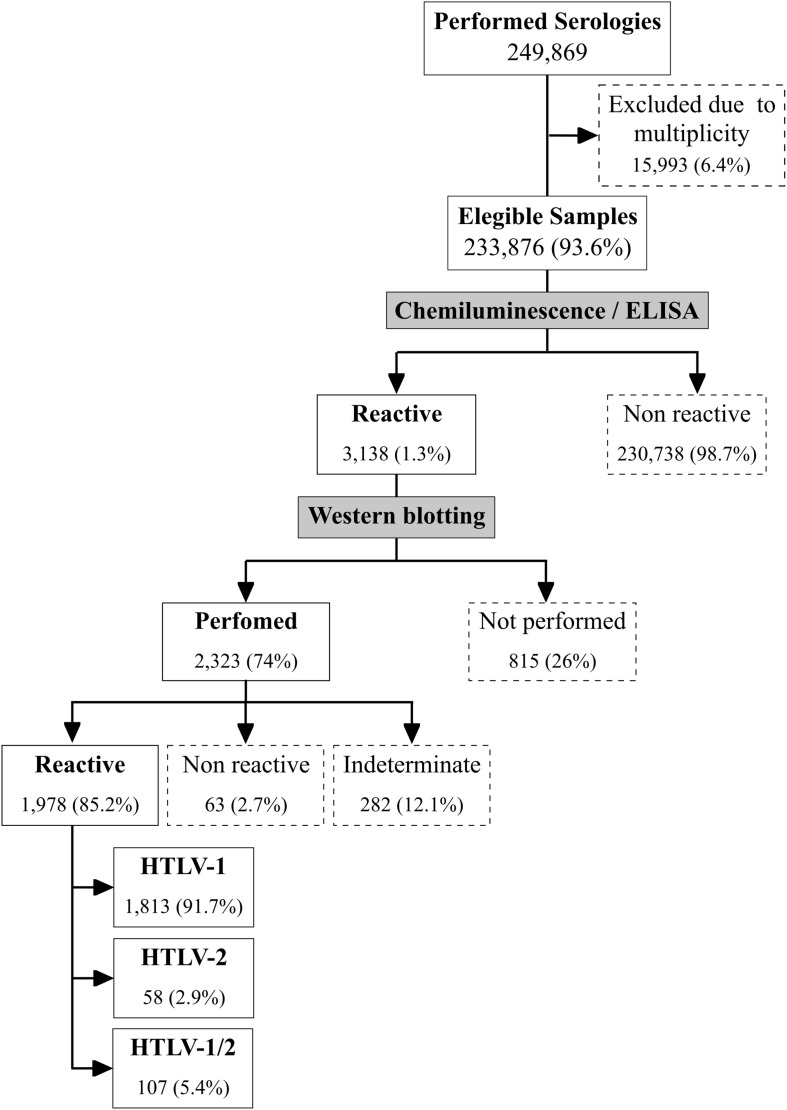
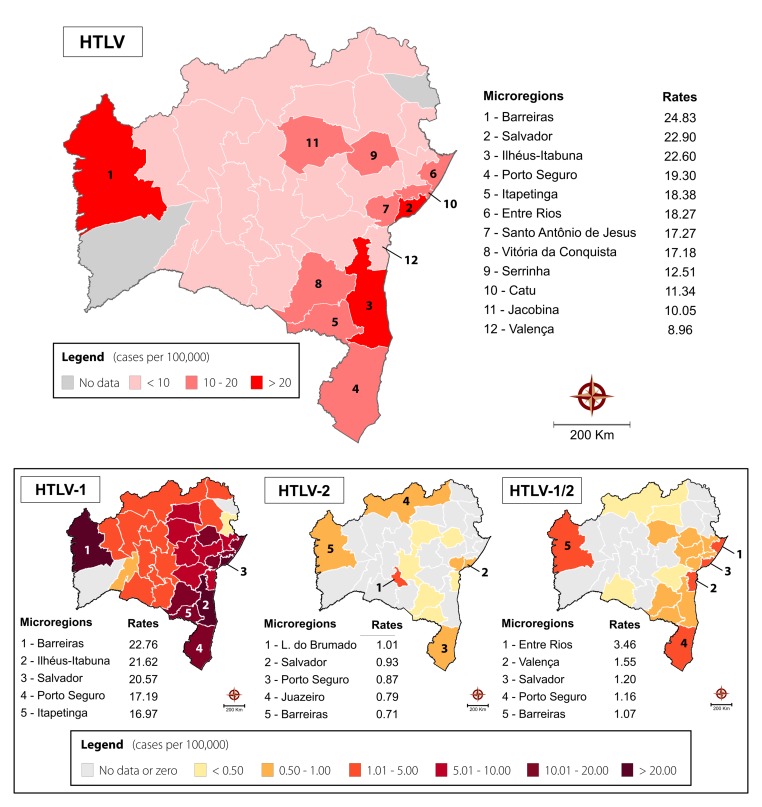
Results: A total of 233,876 individuals were evaluated. Individuals were from 394 out of 417 municipalities of Bahia (94.5%). HTLV chemiluminescence/ELISA assay was found to be reactive for 3,138 individuals from whom 2,323 had WB results (1,978 positives, 62 negative and 282 indeterminate). Out of 1978 reactive samples, 1,813 (91.7%) were positive for HTLV-1, 58 (2.9%) for HTLV-2 and 107 (5.4%) were for both HTLV-1 and HTLV-2. The cumulative mean rate of HTLV-positive cases in Bahia was 14.4 per 100,000 inhabitants. Three microregions presented rates >20 HTLV-positive cases/100,000 inhabitants: Barreiras (24.83 cases per 100,000 inhabitants), Salvador (22.90 cases per 100,000 inhabitants), and Ilhéus-Itabuna (22.60 cases per 100,000 inhabitants).
Conclusion: HTLV infection is disseminated in the state of Bahia, with an overall moderate rate of infection. Further studies should be conducted to characterize the epidemiological and clinical profile of HTLV-infected individuals better and to propose effective prevention measures.
Keywords: Bahia; HTLV; clusters; epidemiology; spatial distribution.
Figures
References
-
- Alcantara L. C.Jr., Van Dooren S., Goncalves M. S., Kashima S., Costa M. C., Santos F. L., et al. (2003). Globin haplotypes of human T-cell lymphotropic virus type I-infected individuals in Salvador, Bahia, Brazil, suggest a post-Columbian African origin of this virus. J. Acquir. Immune Defic. Syndr. 33 536–542. 10.1097/00126334-200308010-00016 - DOI - PubMed
-
- Azevedo E. S., Fortuna C. M., Silva K. M., Sousa M. G., Machado M. A., Lima A. M., et al. (1982). Spread and diversity of human populations in Bahia, Brazil. Hum. Biol. 54 329–341. - PubMed
-
- Boa-Sorte N., Purificacao A., Amorim T., Assuncao L., Reis A., Galvao-Castro B. (2014). Dried blood spot testing for the antenatal screening of HTLV, HIV, syphilis, toxoplasmosis and hepatitis B and C: prevalence, accuracy and operational aspects. Braz. J. Infect. Dis. 18 618–624. 10.1016/j.bjid.2014.05.009 - DOI - PMC - PubMed
LinkOut - more resources
Full Text Sources
