. 2019 May 15:10:1060.
doi: 10.3389/fmicb.2019.01060. eCollection 2019.

Bacterial Community Dynamics in an Oyster Hatchery in Response to Probiotic Treatment

Affiliations

Bacterial Community Dynamics in an Oyster Hatchery in Response to Probiotic Treatment

Rebecca J Stevick et al. Front Microbiol. .

Abstract

Larval oysters in hatcheries are susceptible to diseases caused by bacterial pathogens, including Vibrio spp. Previous studies have shown that daily addition of the probiotic Bacillus pumilus RI06-95 to water in rearing tanks increases larval survival when challenged with the pathogen Vibrio coralliilyticus. We propose that the presence of probiotics causes shifts in bacterial community structure in rearing tanks, leading to a net decrease in the relative abundance of potential pathogens. During three trials spanning the 2012-2015 hatchery seasons, larvae, tank biofilm, and rearing water samples were collected from control and probiotic-treated tanks in an oyster hatchery over a 12-day period after spawning. Samples were analyzed by 16S rRNA sequencing of the V4 or V6 regions followed by taxonomic classification, in order to determine bacterial community structures. There were significant differences in bacterial composition over time and between sample types, but no major effect of probiotics on the structure and diversity of bacterial communities (phylum level, Bray-Curtis k = 2, 95% confidence). Probiotic treatment, however, led to a higher relative percent abundance of Oceanospirillales and Bacillus spp. in water and oyster larvae. In the water, an increase in Vibrio spp. diversity in the absence of a net increase in relative read abundance suggests a likely decrease in the abundance of specific pathogenic Vibrio spp., and therefore lower chances of a disease outbreak. Co-occurrence network analysis also suggests that probiotic treatment had a systemic effect on targeted members of the bacterial community, leading to a net decrease in potentially pathogenic species.

Keywords: 16S rRNA sequencing analysis; Crassostrea virginica; Vibrio; larvae; microbiome; oyster hatchery; probiotics.


Figures
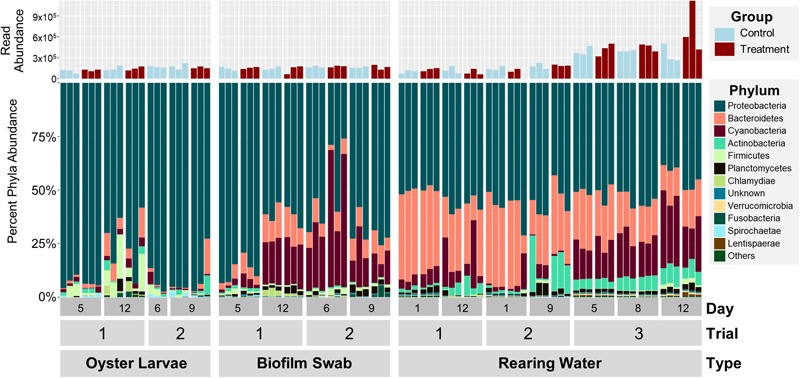
FIGURE 1
FIGURE 1
Percent abundances of the 12 most abundant phyla in oyster larvae, biofilm swab, and rearing water samples from all 3 trials based on 16S rRNA amplicon sequencing data (bottom). The total abundance of quality filtered sequencing reads is shown in the bar graph (top). The 12 dominant phyla include Actinobacteria, Bacteroidetes, Cyanobacteria, Deferribacteres, Firmicutes, Fusobacteria, Lentisphaerae, Planctomycetes, Proteobacteria, Spirochaetae, Verrucomicrobia, and Unknown. Note: there are no treated oyster larvae samples from Trial 2, Day 6.
FIGURE 2
FIGURE 2
Simpson’s index of diversity of bacterial communities by sample (larvae, swab, and water) and trial (n = 3 tanks). No significant differences in diversity were found between control (light blue) and treatment (dark red) within each sample type and trial. Bacterial community diversity significantly increased over time in larvae and swab samples from Trial 1, and water samples from Trials 2 and 3. Diversity in water was significantly higher in Trial 3 than Trials 1 and 2. Note: there are no treated oyster larvae samples from Trial 2, Day 6.
FIGURE 3
FIGURE 3
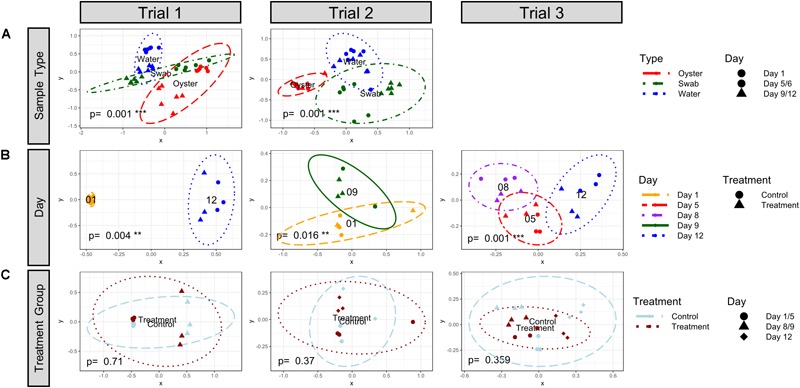
NMDS plot visualization of Bray-Curtis beta-diversity (k = 2) at the Order level by (A) sample type, (B) sampling day, and (C) treatment. The ellipse lines show the 95% confidence interval (standard deviation). p-values indicate significance of grouping with adonis2 Permutational Multivariate Analysis of Variance Using Distance Matrices test. (A) The different types of samples are indicated by colors (Oyster, dashed red; Swab, dashdot green; and Water, dotted blue) and the days are indicated by symbols (Timepoint 1, circle; Timepoint 2, triangle). The water and oyster communities were significantly distinct from each other in both trials. (B) The sampling timepoints are indicated by colors (1, longdash yellow; 5, shortdash red; 8, dashdot purple; 9, solid green; and 12, dotted blue) and the treatment group is indicated by symbols (control, circle; probiotic treatment, triangle). The water community was significantly different between timepoints. (C) The treatment group is indicated by colors (control, light blue dashed; probiotic treatment, dark red dotted) and sampling timepoints are indicated by symbols. No significant differences in community structure in water from control and probiotic-treated tanks was detected when samples from all timepoints were analyzed together.
FIGURE 4
FIGURE 4
Effect of probiotic treatment on relative percent read abundance of (A) Bacillales and (B) Oceanospirillales in water. Number of reads in treated (dark red) and control (light blue) samples (n = 3 tanks per treatment) are represented for each sampling day and trial. (A) Bacillales was relatively significantly higher in the treated than the control water after 5 days of treatment, and (B) Oceanospirillales were consistently more abundant in probiotic-treated tank rearing water, and decreased with time. p < 0.05, ∗∗p < 0.01, ∗∗∗p < 0.001.
FIGURE 5
FIGURE 5
Effect of treatment, time, and sample type on Simpson’s Index of Diversity for Vibrionales (A, boxplots), total Vibrionales relative percent read abundance (B, bar graph), and culturable Vibrio plate counts (C, bar graph). Representative data from Trial 1 (n = 3 tanks per treatment). Note different scales for (B) and (C). p < 0.05, ∗∗p < 0.01, ∗∗∗p < 0.001.
FIGURE 6
FIGURE 6
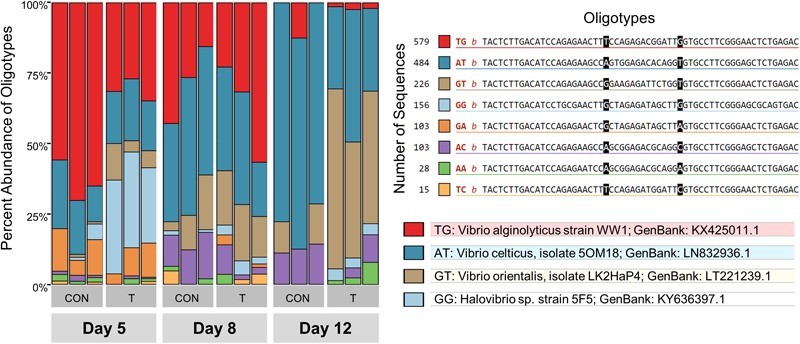
Vibrio spp. oligotypes in Control (CON) and Treatment (T) water samples on Days 5, 8, and 12 from Trial 3. These 8 oligotypes were generated from changes in positions 23 and 37 in a total of 1727 sequences, represented with the 2 letter abbreviations in the legend. The taxonomy of the 4 most abundant oligotypes is shown. Vibrio oligotypes showed differences in succession of species over time between control and treatment rearing water.
FIGURE 7
FIGURE 7
Co-occurrence network analysis based on Bray-Curtis dissimilarity metric (max distance = 0.5, Order level) for water samples from Trial 3 (n = 3 tanks per treatment and day, total of 18). Taxa that change in the same way share an edge; nodes that have edges occur in the same proportions and in the same samples. Darker blue circle nodes indicate taxa that occur in the Control significantly more than Treated water samples. White nodes have equal occurrence in treated and control water samples. Darker red diamond nodes indicated taxa that occur in the Treated significantly more than Control water samples.

References

    1. Andrews S. (2010). FASTQC. A Quality Control Tool for High Throughput Sequence Data. Available at: http://www.bioinformatics.babraham.ac.uk/projects/fastqc/ (accessed September 15, 2014).
    1. Asmani K., Petton B., Le Grand J., Mounier J., Robert R., Nicolas J. L. (2016). Establishment of microbiota in larval culture of Pacific oyster, Crassostrea gigas. Aquaculture 464 434–444. 10.1016/j.aquaculture.2016.07.020 - DOI
    1. Baldwin B. S. (1995). Selective particle ingestion by oyster larvae (Crassostrea virginica) feeding on natural seston and cultured algae. Mar. Biol. 123 95–107. 10.1007/BF00350328 - DOI
    1. Barberán A., Bates S. T., Casamayor E. O., Fierer N. (2012). Using network analysis to explore co-occurrence patterns in soil microbial communities. ISME J. 6 343–351. 10.1038/ismej.2011.119 - DOI - PMC - PubMed
    1. Beaz-Hidalgo R., Balboa S., Romalde J. L., Figueras M. J. (2010a). Diversity and pathogenecity of vibrio species in cultured bivalve molluscs. Environ. Microbiol. Rep. 2 34–43. 10.1111/j.1758-2229.2010.00135.x - DOI - PubMed