. 2019 May 16:10:1068.
doi: 10.3389/fmicb.2019.01068. eCollection 2019.

Co-cultivation of Trichoderma asperellum GDFS1009 and Bacillus amyloliquefaciens 1841 Causes Differential Gene Expression and Improvement in the Wheat Growth and Biocontrol Activity

Affiliations

Co-cultivation of Trichoderma asperellum GDFS1009 and Bacillus amyloliquefaciens 1841 Causes Differential Gene Expression and Improvement in the Wheat Growth and Biocontrol Activity

Valliappan Karuppiah et al. Front Microbiol. .

Abstract

In an effort to balance the demands of plant growth promoting and biological control agents in a single product, the technology on the co-cultivation of two microbes, Trichoderma asperellum GDFS1009 and Bacillus amyloliquefaciens 1841 has been developed and demonstrated its effectiveness in synergistic interactions and its impact on the plant growth and biocontrol potential. In this study, optimization of T. asperellum and B. amyloliquefaciens growth in a single medium was carried out using response surface methodology (RSM). The optimal medium for enhanced growth was estimated as 2% yeast extract, 2% molasses and 2% corn gluten meal. T. asperellum evolved the complicated molecular mechanisms in the co-culture by the induction of BLR-1/BLR-2, VELVET, and NADPH oxidases genes. In performance with these genes, conserved signaling pathways, such as heterotrimeric G proteins and mitogen-activated protein kinases (MAPKs) had also involved in this molecular orchestration. The co-cultivation induced the expression of T. asperellum genes related to secondary metabolism, mycoparasitism, antioxidants and plant growth. On the other hand, the competition during co-cultivation induced the production of new compounds that are not detected in axenic cultures. In addition, the co-culture significantly enhanced the plant growth and protection against Fusarium graminearum. The present study demonstrated the potential of co-cultivation technology could be a used to grow the T. asperellum GDFS1009 and B. amyloliquefaciens 1841 synergistically to improve the production of mycoparasitism related enzymes, secondary metabolites, and plant growth promoting compounds to significantly enhance the plant growth and protection against plant pathogens.

Keywords: B. amyloliquefaciens; T. asperellum; biocontrol; co-cultivation; plant growth.


Figures
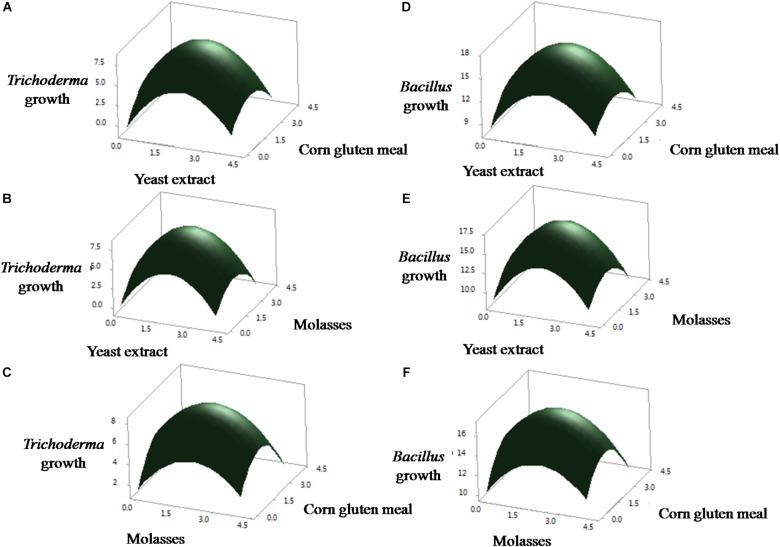
FIGURE 1
FIGURE 1
Statistical optimization of the T. asperellum and B. amyloliquefaciens growth in co-culture using RSM. (A–C) Effect of yeast extract, corn gluten meal and molasses on the growth of T. asperellum. (D–F) Effect of yeast extract, corn gluten meal and molasses on the growth of B. amyloliquefaciens.
FIGURE 2
FIGURE 2
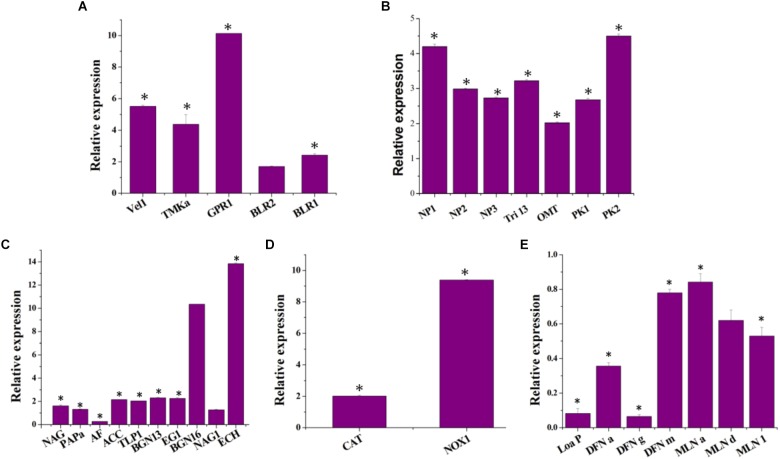
Impact of co-cultivation on the transcript levels of (A) the T. asperellum morphology related genes [Mitogen-Activated Protein Kinase (TMKa), G protein receptor 1 (GPR1), blue-light-regulated genes (BLR1 and BLR2) and ENVOY (ENV 1)], (B) secondary metabolism related genes [non-ribosomal peptide synthetase (NP1 and NP2), Putative ferrichrome synthetase (NP3), Cytochrome P450 (Tri 13) 1, O-methyl transferase (OMT) and Polyketide synthetase (PK1 and PK2)]; (C) mycoparasitism-related genes [chitinase (ech42), β-1,3-glucanase (bgn13.1), β1,6-glucanase (bgn16.1), β-1,4-glucanase (egl), N-acetyl-glucosaminidases (nag1 and nag2), aspartyl protease (Pap A), trypsin-like protease (TLP 1) and α–L–arabinofuranosidases (AF)]; and plant growth promoting enzyme [1–Aminocyclopropane–1–carboxylate (ACC) deaminase (ACC)]. (D) Anti-oxidant genes [NADPH oxidase (NOX), catalase (CAT)] and (E) genes encoding B. amyloliquefaciens macrolactin and difficidin in the co-culture [intrinsic terminators located within the polyketide synthase (PKS) gene cluster encoding for the antibiotic difficidin (dfn) (Loa P), beginning, middle and end of the difficidin operon (dfnA, dfnG, and dfnM); beginning, middle and end of the macrolactin operon (MLN a, MLN d, and MLN i)]. Data resulted from biological triplicate cultures with qPCR technical duplicates. The value in parentheses is the standard error of the mean. represent significant differences between the axenic and co-culture (P < 0.05).
FIGURE 3
FIGURE 3
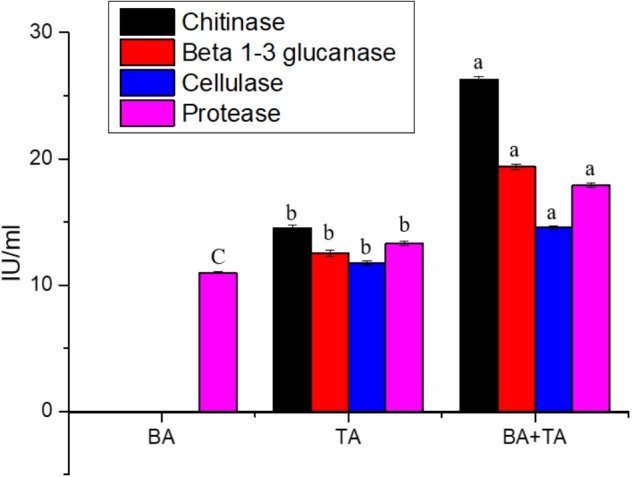
Enzyme activities associated with culture filtrates from the axenic and co-culture of T. asperellum and B. amyloliquefaciens grown on YMC medium. Results are means of five replicates for each treatment; the value in parentheses is the standard error of the mean. Different letters above the bars are significantly different (P < 0.05) based on the ANOVA.
FIGURE 4
FIGURE 4
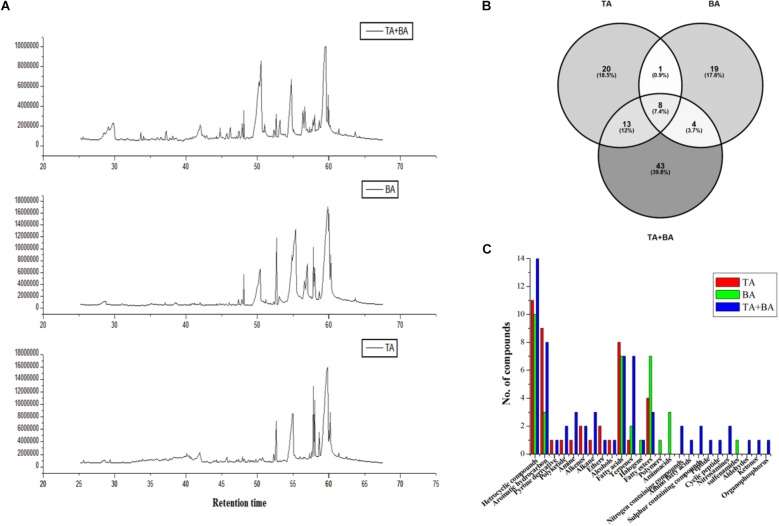
Metabolites differences between the axenic and co-culture of T. asperellum and B. amyloliquefaciens. (A) Differences in the GC MS spectrum (B) total number of metabolites detected in the axenic and co-culture (C) metabolites class differences in the axenic and co-culture.
FIGURE 5
FIGURE 5
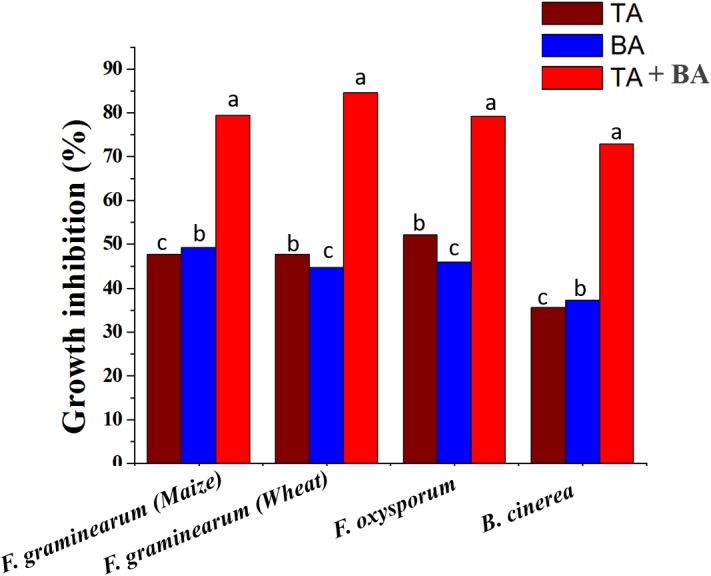
The inhibitory spectrum of axenic and co-culture of T. asperellum and B. amyloliquefaciens fermentation liquor against plant pathogenic fungi. Results are means of five replicates for each treatment; the value in parentheses is the standard error of the mean. Different letters above the bars are significantly different (P < 0.05) based on the ANOVA.
FIGURE 6
FIGURE 6
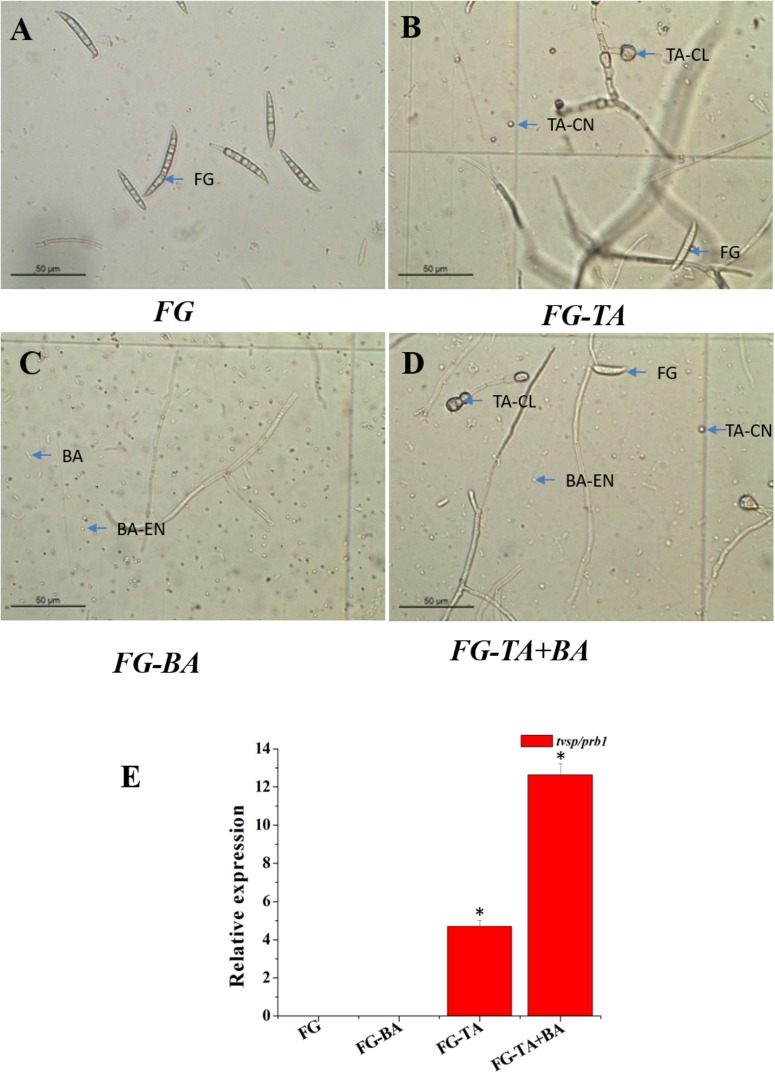
Antagonist interactions between the axenic and co-culture in stimulated antagonism assay against F. graminearum (wheat head blight and root rot pathogen). (A) Spores of F. graminearum (FG). (B) Sporulation of F. graminearum (FG) in response to the axenic culture of T. asperellum (TA). (C) Sporulation of F. graminearum (FG) in response to the axenic culture of B. amyloliquefaciens (BA). (D) Sporulation of F. graminearum (FG) in response to the Co- culture of T. asperellum (TA) and B. amyloliquefaciens (BA). (E) Induction of serine protease (tvsp1/prb1) expression in a stimulated antagonism assay (RT-PCR). F. graminearum spores (FG), T. asperellum conidiospores (TA-CN), T. asperellum chlamydospores (TA-CL), B. amyloliquefaciens (BA), B. amyloliquefaciens endospores (BA-EN). represent significant differences between the axenic and co-culture (P < 0.05).
FIGURE 7
FIGURE 7
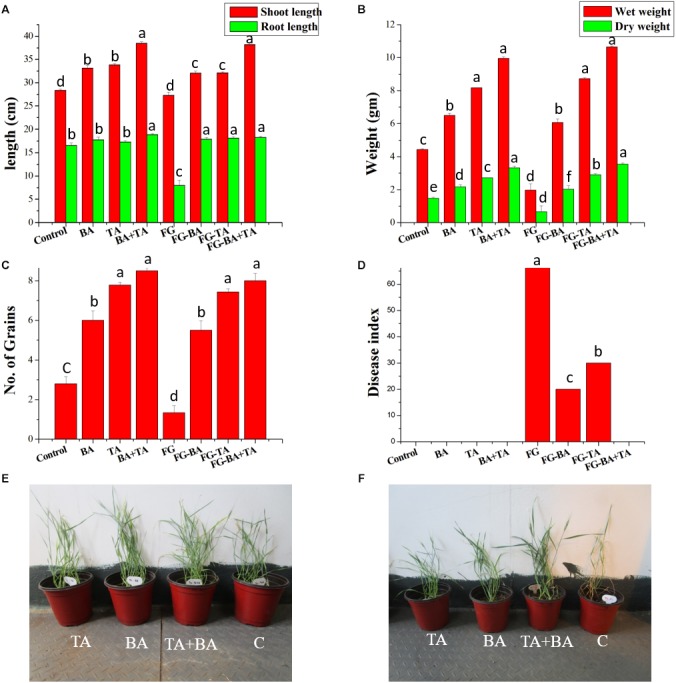
Effect of axenic and co-culture of T. asperellum and B. amyloliquefaciens on the plant growth and biological control of F. graminearum in green house conditions. (A) Shoot and root length of different treatments (B) wet and dry weight of wheat plants (C) number of grains per plant (D) disease index of F. graminearum in control and treated (E) Wheat plants grown in pots treated with TA (T. asperellum); BA (B. amyloliquefaciens) TA + BA (T. asperellum and B. amyloliquefaciens) C (control). (F) Wheat plants grown in pots containing F. graminearum treated with TA; BA; TA + BA; C (control). Results are means of five replicates for each treatment; the value in parentheses is the standard error of the mean. Different letters above the bars are significantly different (P < 0.05) based on the ANOVA.

References

    1. Abdelmohsen U. R., Grkovic T., Balasubramanian S., Kamel M. S., Quinn R. J., Hentschel U. (2015). Elicitation of secondary metabolism in actinomycetes. Biotechnol. Adv. 33 798–811. 10.1016/j.biotechadv.2015.06.003 - DOI - PubMed
    1. Baiyee B., Pornsuriya C., Ito S.-I., Sunpapao A. (2019). Trichoderma spirale T76-1 displays biocontrol activity against leaf spot on lettuce (Lactuca sativa L.) caused by Corynespora cassiicola or Curvularia aeria. Biol. Control 129 195–200.
    1. Bazafkan H., Dattenböck C., Stappler E., Beier S., Schmoll M. (2017). Interrelationships of VEL1 and ENV1 in light response and development in Trichoderma reesei. PLoS One 12:e0175946. 10.1371/journal.pone.0175946 - DOI - PMC - PubMed
    1. Benoit I., Van Den Esker M. H., Patyshakuliyeva A., Mattern D. J., Blei F., Zhou M., et al. (2015). Bacillus subtilis attachment to Aspergillus niger hyphae results in mutually altered metabolism. Environ. Microbiol. 17 2099–2113. 10.1111/1462-2920.12564 - DOI - PubMed
    1. Brunner K., Omann M., Pucher M. E., Delic M., Lehner S. M., Domnanich P., et al. (2008). Trichoderma G protein-coupled receptors: functional characterisation of a cAMP receptor-like protein from Trichoderma atroviride. Curr. Genet. 54 283–299. 10.1007/s00294-008-0217-7 - DOI - PMC - PubMed

LinkOut - more resources