


Exploring the Immunological Mechanisms Underlying the Anti-vascular Endothelial Growth Factor Activity in Tumors
- PMID: 31156623
- PMCID: PMC6530399
- DOI: 10.3389/fimmu.2019.01023
Exploring the Immunological Mechanisms Underlying the Anti-vascular Endothelial Growth Factor Activity in Tumors
Abstract
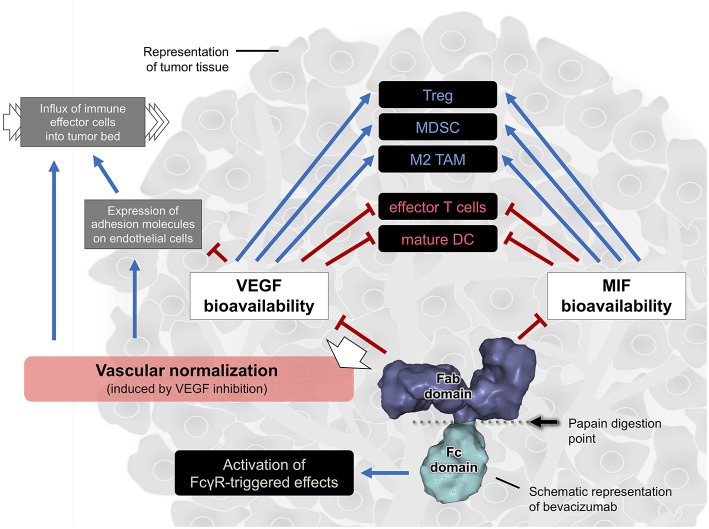
Several studies report the key role of the vascular endothelial growth factor (VEGF) signaling on angiogenesis and on tumor growth. This has led to the development of a number of VEGF-targeted agents to treat cancer patients by disrupting the tumor blood vessel supply. Of them, bevacizumab, an FDA-approved humanized monoclonal antibody against VEGF, is the most promising. Although the use of antibodies targeting the VEGF pathway has shown clinical benefits associated with a reduction in the tumor blood vessel density, the inhibition of VEGF-driven vascular effects is only part of the functional mechanism of these therapeutic agents in the tumor ecosystem. Compelling reports have demonstrated that VEGF confers, in addition to the activation of angiogenesis-related processes, immunosuppressive properties in tumors. It is also known that structural remodeling of the tumor blood vessel bed by anti-VEGF approaches affect the influx and activation of immune cells into tumors, which might influence the therapeutic results. Besides that, part of the therapeutic effects of antiangiogenic antibodies, including their role in the tumor vascular network, might be triggered by Fc receptors in an antigen-independent manner. In this mini-review, we explore the role of VEGF inhibitors in the tumor microenvironment with focus on the immune system, discussing around the functional contribution of both bevacizumab's Fab and Fc domains to the therapeutic results and the combination of bevacizumab therapy with other immune-stimulatory settings, including adjuvant-based vaccine approaches.
Keywords: Fc receptors; angiogenesis; bevacizumab; immune-modulation; immunity; vascular endothelial growth factor.
Figures
References
Publication types
MeSH terms
Substances
LinkOut - more resources
Full Text Sources
