Consequence of delegating medication-related tasks from physician to clinical pharmacist in an acute admission unit: an analytical study
- PMID: 31156957
- PMCID: PMC6451524
- DOI: 10.1136/ejhpharm-2016-000990
Consequence of delegating medication-related tasks from physician to clinical pharmacist in an acute admission unit: an analytical study
Abstract
Objectives: Studies have shown that medication histories obtained by clinical pharmacists (CPs) are more complete, and that medication reviews by CPs reduce healthcare costs, drug-related readmissions and emergency readmissions. The aim of this study was to identify the consequences of delegating medication-related tasks from physicians to CPs.
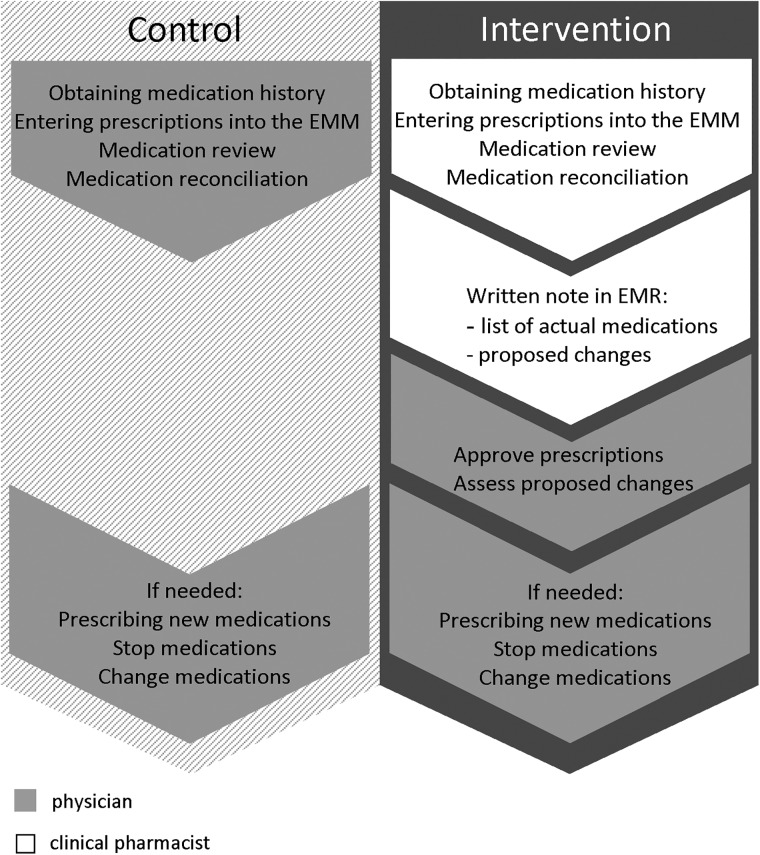
Methods: An analytical study based on data from a prospective cluster randomised trial was performed. The intervention consisted of CPs obtaining medication history, performing medication reconciliation and medication review. The physician had to approve the prescriptions and assess changes proposed by the CP. The primary outcome measure was a comparison of changes in the Electronic Medication Module (EMM) and changes proposed by CPs.
Results: 232 and 216 patients were included on control days (n=63) and intervention days (n=63). In total, 1018 changes were made in the control group (by physicians). In the intervention group 2123 changes were made, 1808 by CPs and 315 by physicians. In particular, the number of substitutions, registration of drugs and change of instructions for use (eg, administration times) differed between physicians and pharmacists. CPs made 341 written proposals in the intervention group and, of these, 22.9% (95% CI 18.7% to 27.8%) and 50.9% (95% CI 45.5% to 56.2%) were accepted by a physician at discharge from the acute admission unit (AAU) and hospital, respectively.
Conclusions: CPs updated the EMM more thoroughly than physicians, especially entering new prescriptions, substitutions and changing instructions for use. Half of the written proposals were accepted. The extent to which patients benefit from a CP intervention is unknown.
Keywords: Actue admission unit; CLINICAL PHARMACY; Medication reconciliation; medication history; medication review.
Conflict of interest statement
Competing interests: None declared.
Figures
References
-
- World Health Organization. Assuring Medication Accuracy at Transitions in Care. Patient Safety Solution 2007. http://www.who.int/patientsafety/events/07/02_05_2007/en/ (accessed 15 Oct 2014).
LinkOut - more resources
Full Text Sources
Miscellaneous