Review
. 2019 Jun 1;11(6):1251.
doi: 10.3390/nu11061251.

Slowing Down Ageing: The Role of Nutrients and Microbiota in Modulation of the Epigenome

Affiliations
Review

Slowing Down Ageing: The Role of Nutrients and Microbiota in Modulation of the Epigenome

Agnieszka Gadecka et al. Nutrients. .

Abstract

The human population is getting ageing. Both ageing and age-related diseases are correlated with an increased number of senescent cells in the organism. Senescent cells do not divide but are metabolically active and influence their environment by secreting many proteins due to a phenomenon known as senescence associated secretory phenotype (SASP). Senescent cells differ from young cells by several features. They possess more damaged DNA, more impaired mitochondria and an increased level of free radicals that cause the oxidation of macromolecules. However, not only biochemical and structural changes are related to senescence. Senescent cells have an altered chromatin structure, and in consequence, altered gene expression. With age, the level of heterochromatin decreases, and less condensed chromatin is more prone to DNA damage. On the one hand, some gene promoters are easily available for the transcriptional machinery; on the other hand, some genes are more protected (locally increased level of heterochromatin). The structure of chromatin is precisely regulated by the epigenetic modification of DNA and posttranslational modification of histones. The methylation of DNA inhibits transcription, histone methylation mostly leads to a more condensed chromatin structure (with some exceptions) and acetylation plays an opposing role. The modification of both DNA and histones is regulated by factors present in the diet. This means that compounds contained in daily food can alter gene expression and protect cells from senescence, and therefore protect the organism from ageing. An opinion prevailed for some time that compounds from the diet do not act through direct regulation of the processes in the organism but through modification of the physiology of the microbiome. In this review we try to explain the role of some food compounds, which by acting on the epigenetic level might protect the organism from age-related diseases and slow down ageing. We also try to shed some light on the role of microbiome in this process.

Keywords: ageing; epigenetic; microbiome; nutrition.


Conflict of interest statement

The authors declare no conflict of interest.

Figures
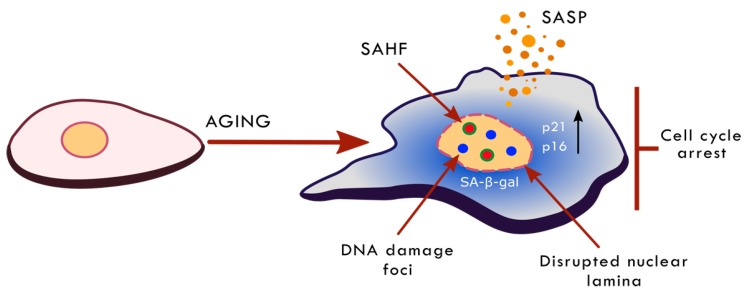
Figure 1
Figure 1
Global changes and markers of senescent cells. During ageing, the accumulation of senescent cells is often observed. Senescent cells are characterized by permanent cell cycle arrest, increased size, elevated activity of senescence associated β galactosidase (SA-β-gal) and higher levels of cell cycle inhibitors, p16 and/or p21. Moreover, senescent cells secrete various proteins such as cytokines, growth factors and proteases. This phenomenon is generally referred as senescence associated secretory phenotype (SASP). Nuclear changes are manifested by disrupted structure of nuclear lamina (for instance, due to downregulation of Lamin B1), local condensation of chromatin in the form of senescent associated heterochromatin foci (SAHF) and by DNA-SCARS (DNA segments with chromatin alterations reinforcing senescence), which form in response to DNA damage.
Figure 2
Figure 2
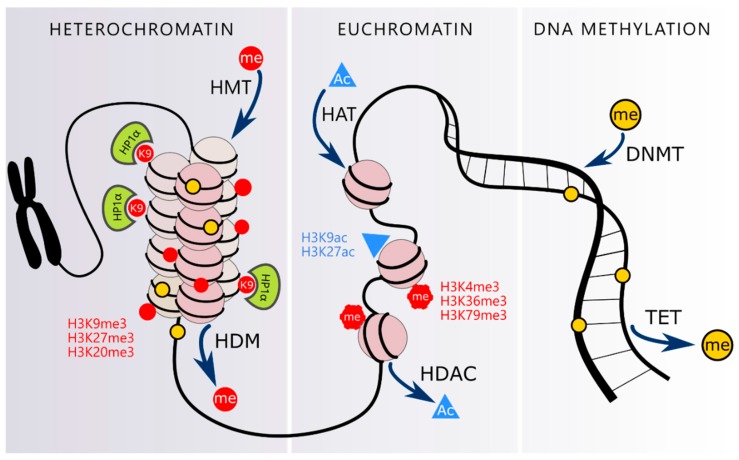
Epigenetic mechanisms shaping chromatin. Chromatin structure is precisely controlled by DNA methylation and post-translational modifications (PTMs; methylation, acetylation, etc.) deposited onto histone tails. Incorporation of methyl and acetyl group is guided by histone methyltransferases (HMTs) and histone acetyltransferases (HATs), while removal of these residues is achieved by histone demethylases (HDMs) and histone deacetylases (HDACs and Sirtuins). The action of these enzymes determines chromatin arrangement and affects gene transcription. Chromatin can adopt two distinct conformations, i.e., heterochromatin and euchromatin. Heterochromatin is a condensed and transcriptionally inactive structure, maintained mainly by methylation of lysine residues. Typical modifications include H3K27me3, H3K20me3 and H3K9me3. Euchromatin represents an open and active conformation. This structure is abundant in acetylated histones H3 and H4, and H3K4me3, H3K36me3 or H3K79me3. On the DNA level, gene expression can be regulated by methylation of cytosine residues by DNA methyltransferases (DNMTs) and oxidation of methylated cytosines by TET enzymes.
Figure 3
Figure 3
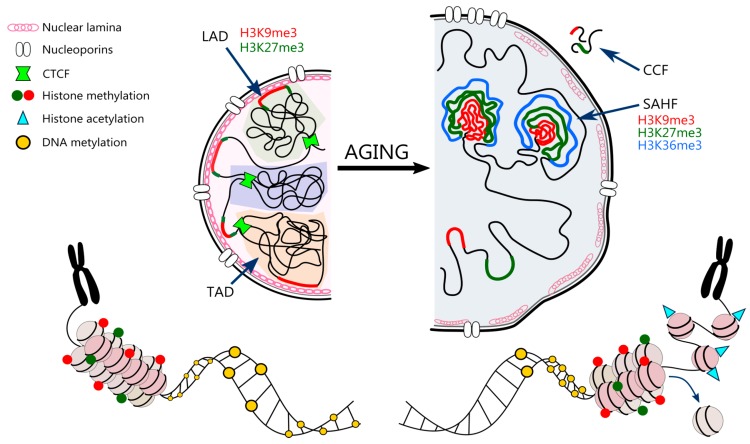
Nuclear and chromatin architecture changes in ageing and senescent cells. The nucleus of a proliferating cell contains a highly condensed chromatin enriched in methylated histones and hypermethylated DNA. The chromatin is compartmentalized into topologically associated domains (TADs) enclosed by CTCF protein and cohesin (not shown). Heterochromatic and gene-poor regions, characterized by the presence of H3K9me3 and H3K27me3, are in close contact with nuclear lamina (NL) forming lamina associated domains (LADs) contributing to the overall stabilization of the nuclear structure. During ageing/senescence DNA becomes globally hypomethylated with exception of promoters of particular genes, which may be hypermethylated. As a result, the gene expression pattern is significantly altered. Similarly, nucleosomes display a general loss of histones leading to loosely compacted euchromatin. Reduced compaction is also a result of accumulation of acetylated residues on histone tails and reduction of their methylation. OIS cells exhibit local condensation and redistribution of heterochromatin in the form of SAHFs. SAHFs emerge from detachment of heterochromatin from the nuclear lamina (due to downregulation of Lamin B1 and accumulation of dysfunctional prelamin A and progerin) and have a layered structure with a H3K9me3 rich core encircled with H3K27me3. On the outside, fragments of active chromatin are found (H3K36me3). Moreover, the local accumulation of nucleoporins prevents deposition of heterochromatin near the nuclear envelope. Disturbances in NL structure also result in cytoplasmic chromatin fragments that contain DNA and repressive histone marks.

References

    1. Naylor R.M., Baker D.J., Van Deursen J.M. Senescent cells: A novel therapeutic target for aging and age-related diseases. Clin. Pharmacol. Ther. 2013;93:105–116. doi: 10.1038/clpt.2012.193. - DOI - PMC - PubMed
    1. Franceschi C., Bonafè M., Valensin S., Olivieri F., De Luca M., Ottaviani E., De Benedictis G. Inflamm-aging. An evolutionary perspective on immunosenescence. Ann. N. Y. Acad. Sci. 2000;908:244–254. doi: 10.1111/j.1749-6632.2000.tb06651.x. - DOI - PubMed
    1. Roberts A.G., Gibbs M.E. Mechanisms and the clinical relevance of complex drug-drug interactions. Clin. Pharmacol. Adv. Appl. 2018;10:123–134. doi: 10.2147/CPAA.S146115. - DOI - PMC - PubMed
    1. Bielak-Zmijewska A., Grabowska W., Ciolko A., Bojko A., Mosieniak G., Bijoch Ł., Sikora E. The Role of Curcumin in the Modulation of Ageing. Int. J. Mol. Sci. 2019;20:1239. doi: 10.3390/ijms20051239. - DOI - PMC - PubMed
    1. Most J., Tosti V., Redman L.M., Fontana L. Calorie restriction in humans: An update. Ageing Res. Rev. 2017;39:36–45. doi: 10.1016/j.arr.2016.08.005. - DOI - PMC - PubMed