Randomized Controlled Trial
. 2019 Jun 2;11(6):1255.
doi: 10.3390/nu11061255.

Protein-Reduced Complementary Foods Based on Nordic Ingredients Combined with Systematic Introduction of Taste Portions Increase Intake of Fruits and Vegetables in 9 Month Old Infants: A Randomised Controlled Trial

Affiliations
Randomized Controlled Trial

Protein-Reduced Complementary Foods Based on Nordic Ingredients Combined with Systematic Introduction of Taste Portions Increase Intake of Fruits and Vegetables in 9 Month Old Infants: A Randomised Controlled Trial

Ulrica Johansson et al. Nutrients. .

Abstract

Abstract: Fruits and vegetables are healthy foods but under-consumed among infants and children. Approaches to increase their intake are urgently needed. This study investigated the effects of a systematic introduction of taste portions and a novel protein-reduced complementary diet based on Nordic foods on fruit and vegetable intake, growth and iron status to 9 months of age. Healthy, term infants (n = 250) were recruited and randomly allocated to either a Nordic diet group (NG) or a conventional diet group (CG). Infants were solely breast- or formula-fed at study start. From 4 to 6 months of age, the NG followed a systematic taste portions schedule consisting of home-made purées of Nordic produce for 24 days. Subsequently, the NG was supplied with baby food products and recipes of homemade baby foods based on Nordic ingredients but with reduced protein content compared to the CG. The CG was advised to follow current Swedish recommendations on complementary foods. A total of 232 participants (93%) completed the study. The NG had significantly higher intake of fruits and vegetables than the CG at 9 months of age; 225 ± 109 g/day vs. 156 ± 77 g/day (p < 0.001), respectively. Energy intake was similar, but protein intake was significantly lower in the NG (-26%, p < 0.001) compared to the CG. This lower protein intake was compensated for by higher intake of carbohydrate from fruits and vegetables. No significant group differences in growth or iron status were observed. The intervention resulted in significantly higher consumption of fruits and vegetables in infants introduced to complementary foods based on Nordic ingredients.

Keywords: Nordic diet; eating behaviour; infant feeding; repeated exposure.


Conflict of interest statement

U.J. is a doctoral student at the Umeå University Industrial Doctoral School for Research and Innovation with Semper AB as industrial sponsor. O.H. and B.L. are members of the Scientific Advisory Board of Semper AB and Hero. T.L., O.H. and B.L. have received research support from Semper AB and Hero unrelated to this research. The sponsors had no role in the conduct of the study, in the collection, analysis and interpretation of data or in the preparation or contents of the manuscript.

Figures
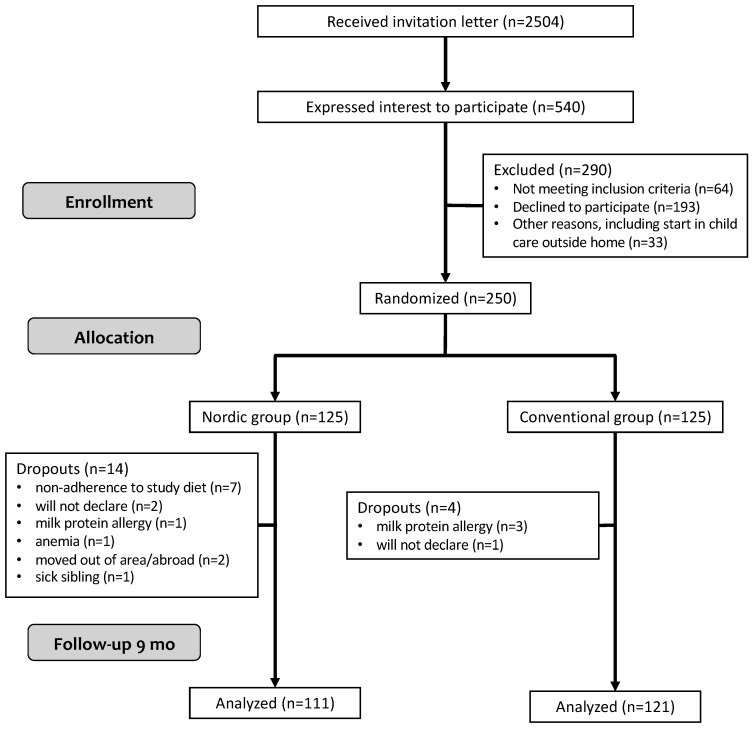
Figure 1
Figure 1
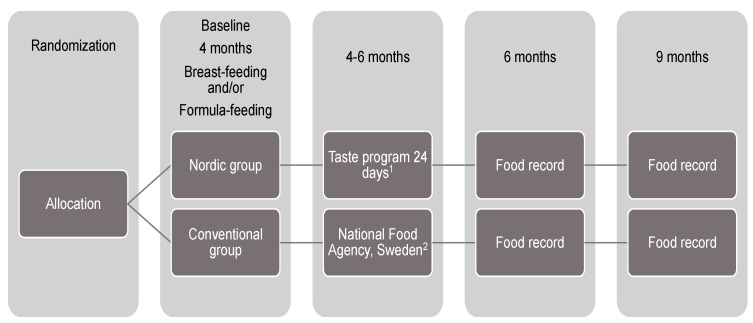
Flowchart diagram of the Optimised complementary feeding study.
Figure 2
Figure 2
Flow diagram of procedure in the Optimised complementary feeding study.1 Parents in the Nordic group were provided with home-made Nordic baby food recipes to make 4 vegetable purees and 4 fruit/berry purees which were fed to the infants three times per day on designated days of the 24-day exposure period, in total 72 exposures. 2 Parents in the Conventional group received a brochure from Sweden Food Agency; How to feed their infant during the first year. The group received no further instructions from study personnel on when or how to feed their infants.
Figure 3
Figure 3
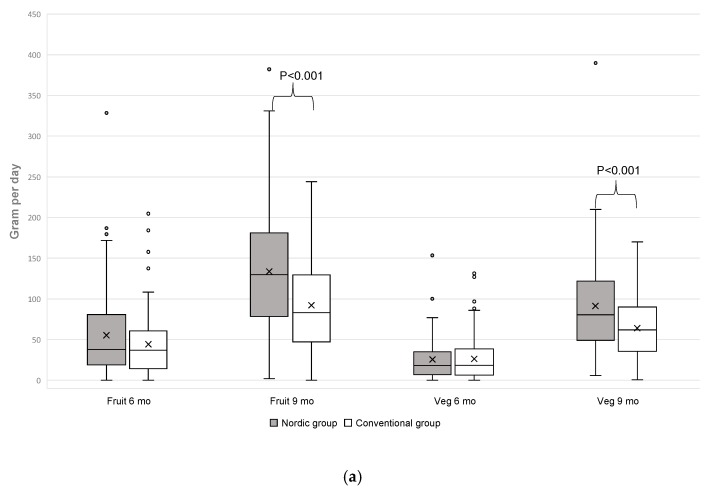
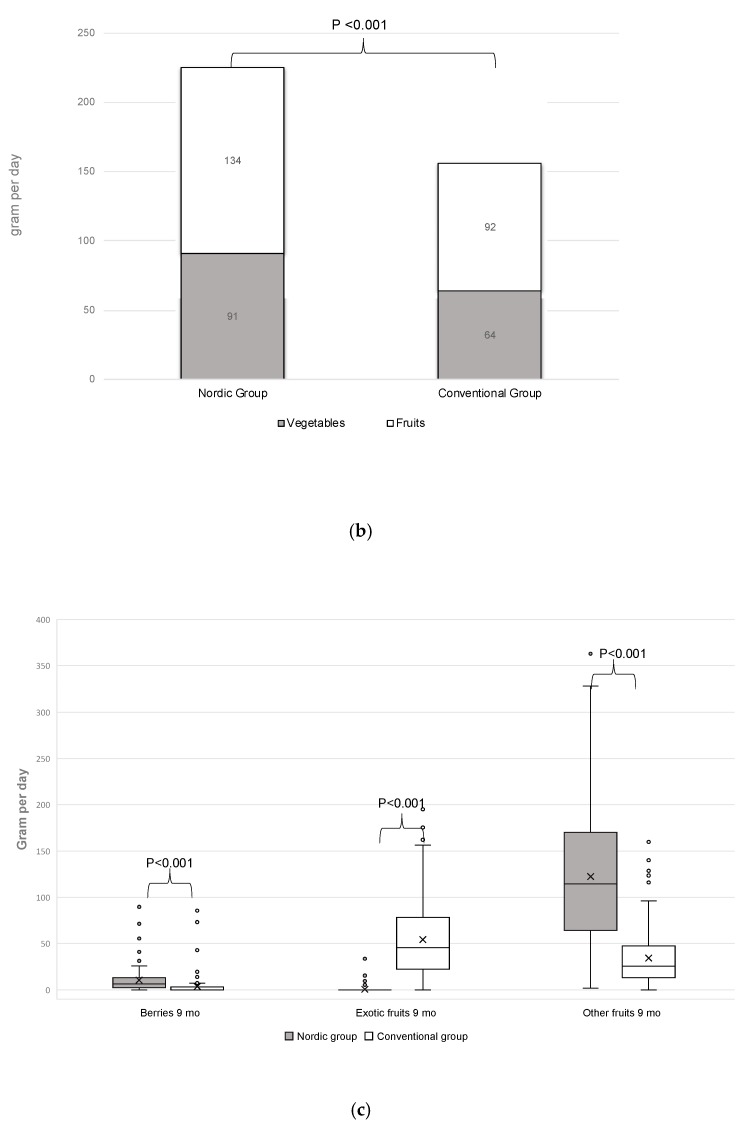
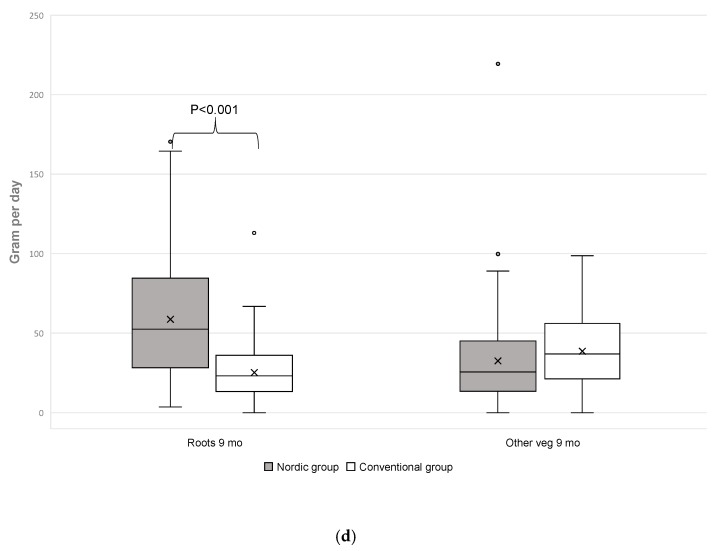
(a) Daily intake of total fruits and vegetables (g) at 6 and 9 months of age, (b) Daily mean intake of total fruits and vegetables (g) at 9 months of age, (c) Daily intake of berries, exotic fruits and other fruits at 9 months of age, (d) Daily intake of roots and other vegetables at 9 months of age. Fruits juices, vegetables juices, potatoes, chili, garlic, ginger and herbs are not included in the assessment.
Figure 3
Figure 3
(a) Daily intake of total fruits and vegetables (g) at 6 and 9 months of age, (b) Daily mean intake of total fruits and vegetables (g) at 9 months of age, (c) Daily intake of berries, exotic fruits and other fruits at 9 months of age, (d) Daily intake of roots and other vegetables at 9 months of age. Fruits juices, vegetables juices, potatoes, chili, garlic, ginger and herbs are not included in the assessment.
Figure 3
Figure 3
(a) Daily intake of total fruits and vegetables (g) at 6 and 9 months of age, (b) Daily mean intake of total fruits and vegetables (g) at 9 months of age, (c) Daily intake of berries, exotic fruits and other fruits at 9 months of age, (d) Daily intake of roots and other vegetables at 9 months of age. Fruits juices, vegetables juices, potatoes, chili, garlic, ginger and herbs are not included in the assessment.

References

    1. Mikkilä V., Räsänen L., Raitakari O.T., Pietinen P., Viikari J. Consistent dietary patterns identified from childhood to adulthood: The Cardiovascular Risk in Young Finns Study. Br. J. Nutr. 2005;93:923–931. doi: 10.1079/BJN20051418. - DOI - PubMed
    1. Craigie A.M., Lake A.A., Kelly S.A., Adamson A.J., Mathers J.C. Tracking of obesity-related behaviours from childhood to adulthood: A systematic review. Maturitas. 2011;70:266–284. doi: 10.1016/j.maturitas.2011.08.005. - DOI - PubMed
    1. Saavedra J.M., Deming D., Dattilo A., Reidy K. Lessons from the Feeding Infants and Toddlers Study in North America: What Children Eat, and Implications for Obesity Prevention. Ann. Nutr. Metab. 2013;62:27–36. doi: 10.1159/000351538. - DOI - PubMed
    1. Birch L., Savage J.S., Ventura A. Influences on the Development of Children’s Eating Behaviours: From Infancy to Adolescence. Can. J. Diet. Pract. Res. 2007;68:s1–s56. - PMC - PubMed
    1. Young B.E., Krebs N.F. Complementary Feeding: Critical Considerations to Optimize Growth, Nutrition, and Feeding Behavior. Curr. Pediatr. Rep. 2013;1:247–256. doi: 10.1007/s40124-013-0030-8. - DOI - PMC - PubMed

Publication types

Substances