. 2019 Jun 3;17(1):186.
doi: 10.1186/s12967-019-1923-2.

Identification of two microRNA signatures in whole blood as novel biomarkers for diagnosis of nasopharyngeal carcinoma

Affiliations

Identification of two microRNA signatures in whole blood as novel biomarkers for diagnosis of nasopharyngeal carcinoma

Wen Wen et al. J Transl Med. .

Abstract

Background: Early diagnosis is critical to reduce the mortality caused by nasopharyngeal carcinoma (NPC). MicroRNAs (miRNAs) are dysregulated and play important roles in carcinogenesis. Therefore, this study aimed to identify diagnostically relevant circulating miRNA signatures in patients with NPC.

Methods: Total RNA was extracted from whole blood samples obtained from 120 patients with NPC, 30 patients with head-neck tumors (HNT), and 30 healthy subjects (HSs), and examined by using a custom microarray. The expression levels of four miRNAs identified by using the microarray were validated with quantitative real-time reverse transcription polymerase chain reaction. The 120 patients with NPC and 30 HSs were randomly assigned to training group-1 and validation group-1, respectively. By using significance analysis of microarray (SAM), the specific miRNA expression profiles in whole blood from patients with NPC are obtained. By using lasso regression and adaptive boosting, a diagnostic signature was identified in training group-1, and its accuracy was verified in validation group-1. By using the same methods, another signature to distinguish patients with NPC from those with HNT and HSs was identified in training group-2 and confirmed in validation group-2.

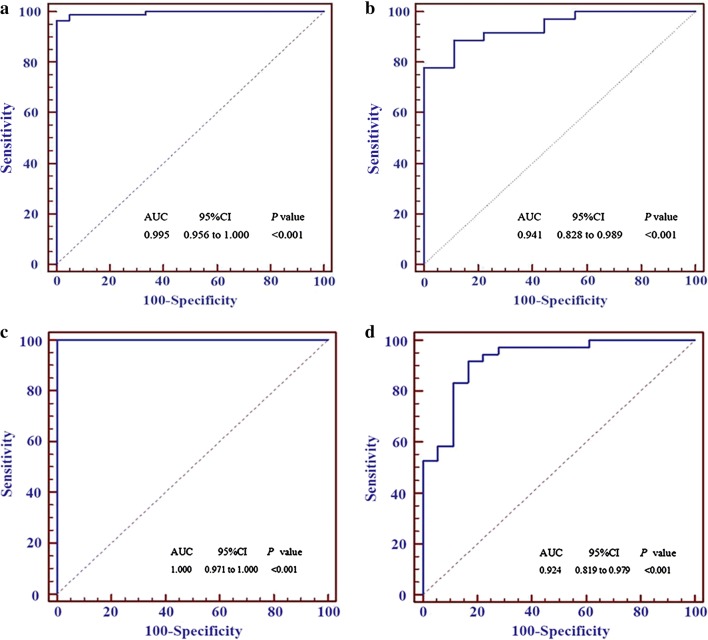
Results: There were 117 differentially expressed miRNAs (upregulated and downregulated fold change ≥ 1.5) between the patients with NPC and HSs, among which an 8-miRNA signature was identified with 96.43% sensitivity and 100% specificity [area under the curve (AUC) = 0.995] to diagnose NPC in training group-1 and 86.11% sensitivity and 88.89% specificity (AUC = 0.941) in validation group-1. Compared with traditional Epstein-Barr virus (EBV) seromarkers, this signature was more specific for NPC. Furthermore, a 16-miRNA signature to differentiate NPC from HNT and HS (HNT-HS) was established from 164 differentially expressed miRNAs, which diagnosed NPC and HNT-HS with 100% accuracy (AUC = 1.000) in training group-2 and 87.04% (AUC = 0.924) in validation group-2.

Conclusions: The present study identified two miRNA signatures for the highly accurate diagnosis and differential diagnosis of patients with NPC from HSs and patients with HNT. The identified miRNAs might represent novel serological biomarkers and potential therapeutic targets for NPC.

Keywords: Diagnostic signature; Expression profile; MicroRNA; Nasopharyngeal carcinoma.


Conflict of interest statement

The authors declare that they have no competing interests.

Figures
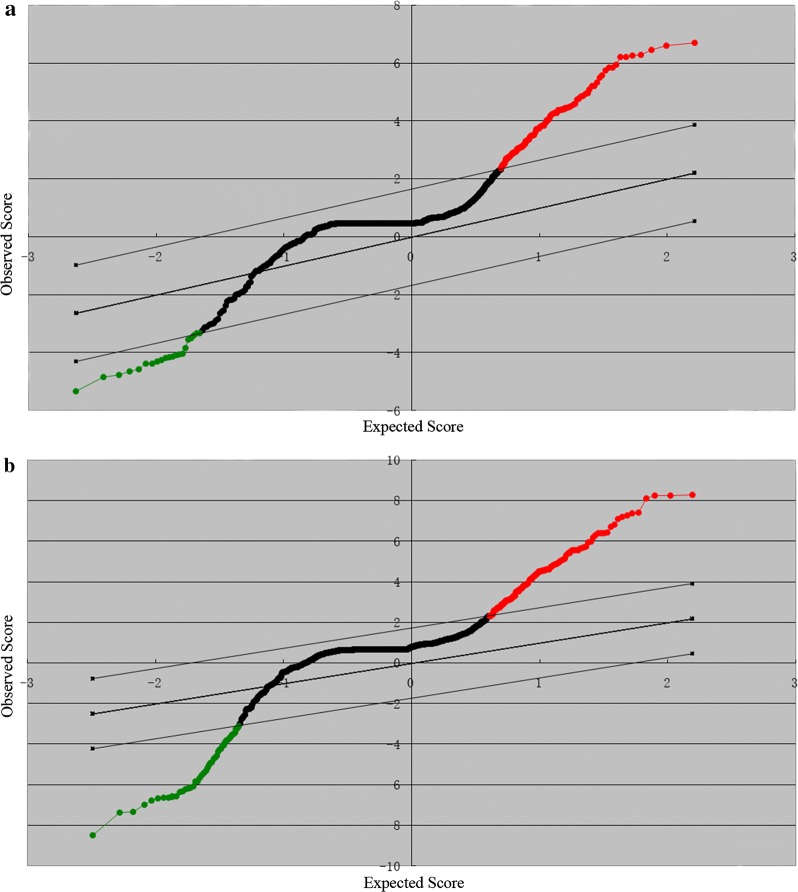
Fig. 1
Fig. 1
Scatter plot analysis for the microarray expression data of 1849 miRNAs in SAM. Red and green dots represented upregulated miRNA and downregulated miRNA respectively. a Scatter plot analysis of miRNA expression between patients with NPC and healthy subjects. b Scatter plot analysis of miRNA expression between patients with NPC and the combination of HNTs and HSs
Fig. 2
Fig. 2
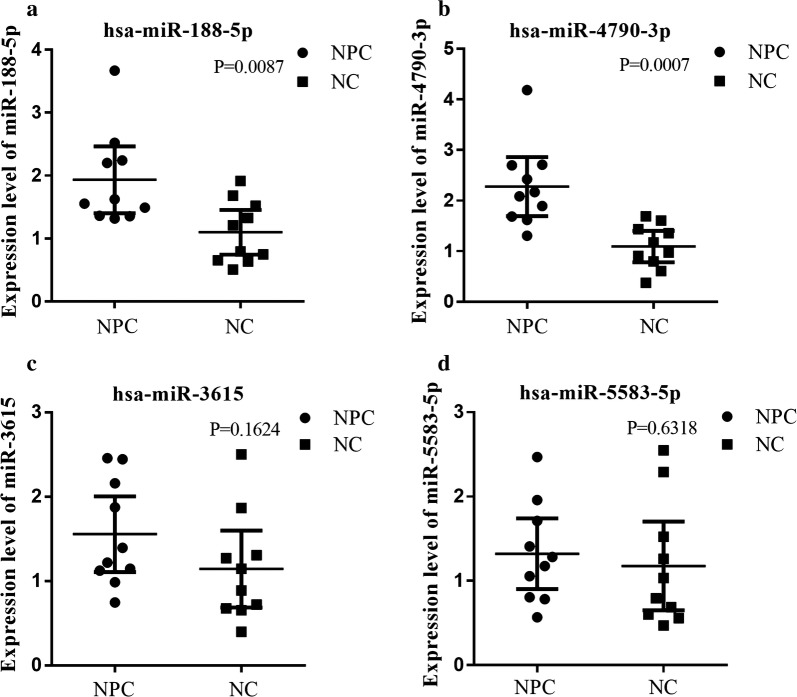
The whole blood expression levels of miRNAs examined by microarray were validated with qRT-PCR in NPC and HS. The expression levels (2−ΔΔCt values) of miR-188-5p (a), miR-4790-3p (b), miR-3615 (c), and miR-5583-5p (d) were verified by using quantitative real-time reverse transcription polymerase chain reaction (qRT-PCR) in 20 whole blood samples including 10 HSs and 10 NPC subjects. The whole-blood expression levels of miR-188-5p (a), miR-4790-3p (b) in the NPC group were significantly higher than those in the HS group (all P < 0.05), and miR-3615 (c) and miR-5583-5p (d) expression levels were higher in the NPC group than in the HS group but the difference was not significant, which were similar to the results obtained using the microarray in the NPC and HS groups. The qRT-PCR reaction of each sample was performed in triplicate and the mean values were calculated. The expression levels are presented as 2−ΔΔCt value for10 samples in each group
Fig. 3
Fig. 3
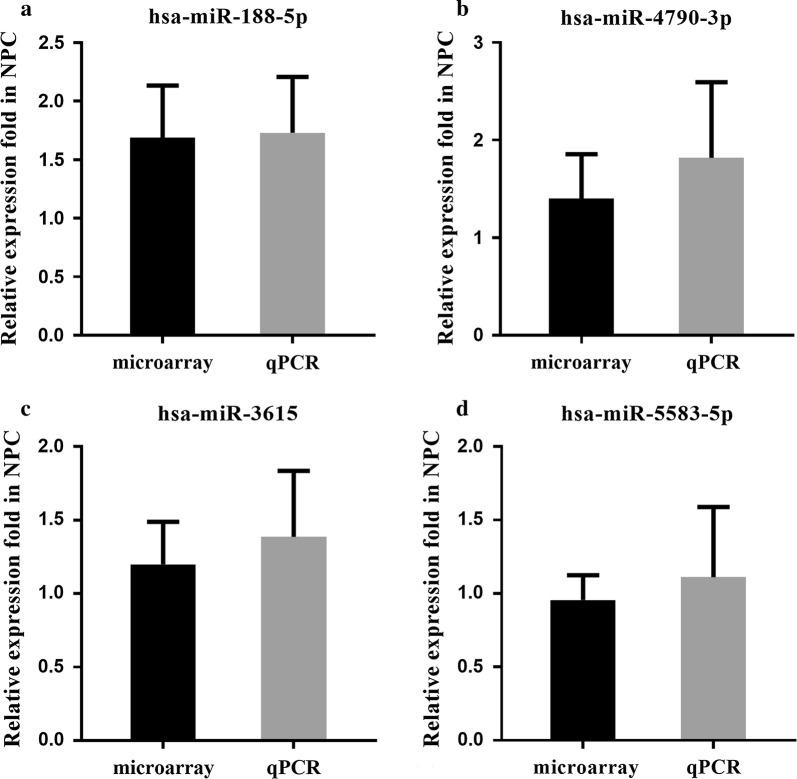
The whole blood relative expression levels of four miRNAs examined by microarray and qRT-PCR are similar in patients with NPC. By taking the mean value of the miRNA expression levels examined by using the microarray (30 samples) and quantitative real-time reverse transcription polymerase chain reaction (qRT-PCR) (10 samples) (2−ΔΔCt values) in HS samples as reference value respectively, the relative fold expression of miR-188-5p (a), miR-4790-3p (b), miR-3615 (c), and miR-5583-5p (d) examined by microarray and qRT-PCR in NPC samples were calculated based on the respective reference values and showed no significant differences (all P > 0.05), which indicated that the data obtained by the microarray is reliable
Fig. 4
Fig. 4
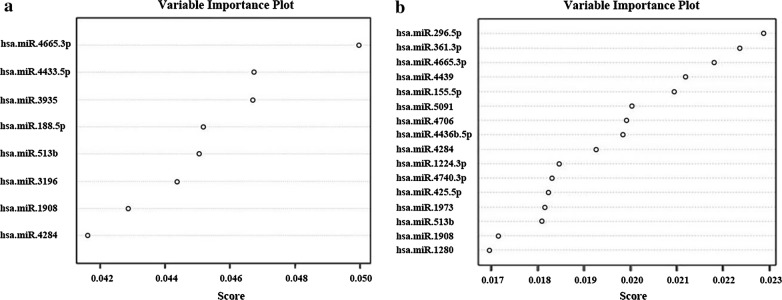
The importance ranking of every miRNA in the two diagnostic signatures. a The importance ranking of every miRNA in the 8-miRNA signature in the training group-1. b The importance ranking of every miRNA in the 16-miRNA signature in the training group-2. The higher the miRNA score, the greater significance of this miRNA in the auxiliary diagnosis of nasopharyngeal carcinoma
Fig. 5
Fig. 5
The ROC curves of the 8-miRNA and 16-miRNA signatures. a The ROC curve (blue) of the 8-miRNA signature in the training group-1. b The ROC curve (blue) of the 8-miRNA signature in the validation group-1. c The ROC curve (blue) of the 16-miRNA signature in the training group-2. d The ROC curve (blue) of theb16-miRNA signature in the validation group-2

References

    1. Lee AW, Ng WT, Chan YH, Sze H, Chan C, Lam TH. The battle against nasopharyngeal cancer. Radiother Oncol. 2012;104(3):272–278. doi: 10.1016/j.radonc.2012.08.001. - DOI - PubMed
    1. Zhang L, Chen QY, Liu H, Tang LQ, Mai HQ. Emerging treatment options for nasopharyngeal carcinoma. Drug Des Dev Ther. 2013;7:37–52. - PMC - PubMed
    1. Chen W, Zheng R, Baade PD, Zhang S, Zeng H, Bray F, Jemal A, Yu XQ, He J. Cancer statistics in China, 2015. CA Cancer J Clin. 2016;66(2):115–132. doi: 10.3322/caac.21338. - DOI - PubMed
    1. Lv JW, Huang XD, Chen YP, Zhou GQ, Tang LL, Mao YP, Li WF, Lin AH, Ma J, Sun Y. A National Study of survival trends and conditional survival in nasopharyngeal carcinoma: analysis of the national population-based surveillance epidemiology and end results registry. Cancer Res Treat. 2018;50(2):324–334. doi: 10.4143/crt.2016.544. - DOI - PMC - PubMed
    1. Chan AT, Gregoire V, Lefebvre JL, Licitra L, Hui EP, Leung SF, Felip E. Nasopharyngeal cancer: EHNS-ESMO-ESTRO clinical practice guidelines for diagnosis, treatment and follow-up. Ann Oncol. 2012;23(Suppl 7):vii83–vii85. doi: 10.1093/annonc/mds266. - DOI - PubMed

Publication types

MeSH terms