. 2019 Jun 3;10(1):2396.
doi: 10.1038/s41467-019-10248-3.

Human evolved regulatory elements modulate genes involved in cortical expansion and neurodevelopmental disease susceptibility

Affiliations

Human evolved regulatory elements modulate genes involved in cortical expansion and neurodevelopmental disease susceptibility

Hyejung Won et al. Nat Commun. .

Abstract

Modern genetic studies indicate that human brain evolution is driven primarily by changes in gene regulation, which requires understanding the biological function of largely non-coding gene regulatory elements, many of which act in tissue specific manner. We leverage chromatin interaction profiles in human fetal and adult cortex to assign three classes of human-evolved elements to putative target genes. We find that human-evolved elements involving DNA sequence changes and those involving epigenetic changes are associated with human-specific gene regulation via effects on different classes of genes representing distinct biological pathways. However, both types of human-evolved elements converge on specific cell types and laminae involved in cerebral cortical expansion. Moreover, human evolved elements interact with neurodevelopmental disease risk genes, and genes with a high level of evolutionary constraint, highlighting a relationship between brain evolution and vulnerability to disorders affecting cognition and behavior. These results provide novel insights into gene regulatory mechanisms driving the evolution of human cognition and mechanisms of vulnerability to neuropsychiatric conditions.


Conflict of interest statement

The authors declare no competing interests.

Figures
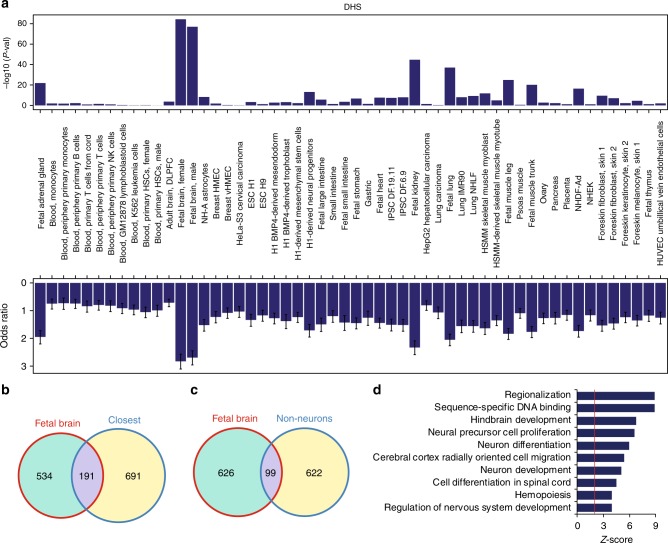
Fig. 1
Fig. 1
HARs interact with genes that regulate human brain development. a DHS enrichment of HARs in different cell/tissue types after controlling for evolutionary conservation (Methods). HSCs, hematopoietic stem cells; NK cells, natural killer cells; DLPFC, dorsolateral prefrontal cortex. P-values and odds ratio calculated by Fisher’s exact test. Error bars denote for 95% confidence intervals (CI). b Overlap between nearest genes to HARs (closest) with genes that interact with HARs in developing brain (fetal brain). c Overlap between genes that interact with HARs in developing brain (fetal brain), and non-neuronal cell types (non-neurons). Protein-coding genes were used for Venn diagrams. d Gene ontology enrichment for HAR-associated genes
Fig. 2
Fig. 2
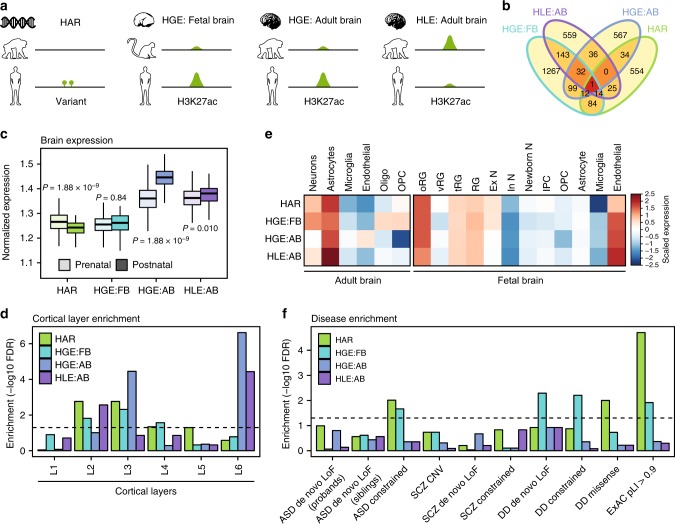
Different human evolved elements regulate distinct biological pathways. a Schematic of different classes of human evolved elements. HARs were defined as genomic regions with accelerated sequence changes in human; HGEsFB as the genomic regions with gained enhancer activity in human compared with rhesus macaque in developing brain; HGEsAB and HLEs as genomic regions with gained and lost enhancer activities in human compared with chimpanzee in adult brain, respectively. b Overlap between HAR-associated genes (HAR), HGEFB-associated genes (HGE:FB), HGEAB-associated genes (HGE:AB), and HLE-associated genes (HLE). c Normalized brain expression level of genes associated with different classes of human evolved elements in prenatal and postnatal periods. FDR-adjusted P values, one-way ANOVA and post-hoc Tukey test. n = 410 and 453 for prenatal and postnatal samples, respectively. Center, median; box = 1st–3rd quartiles (Q); lower whisker, Q1–1.5×interquartile range (IQR); upper whisker, Q3 + 1.5×IQR. d Laminar specificity of genes associated with different classes of human evolved elements. e Human evolved element-associated genes are enriched in radial glia in the developing neocortex and astrocytes in the adult PFC. Oligo, oligodendrocytes; OPC, oligodendrocyte precursor cells; RG, radial glia; oRG, outer radial glia; vRG, ventricular radial glia; tRG, truncated radial glia; Ex N, excitatory neurons; In N, inhibitory neurons; Newborn N, newborn neurons; IPC, intermediate progenitor cells. f Human evolved elements interact with neurodevelopmental disorder risk genes. Also check Supplementary Fig. 5c. OR, odds ratio; ASD, autism-spectrum disorder; SCZ, schizophrenia; DD, developmental delay; LoF, loss-of-function variation; constrained, variation in LoF variation intolerant genes (pLI > 0.9); pLI, probability that a gene is intolerant to LoF variation; ExAC, Exome Aggregation Consortium. P-values calculated by logistic regression correcting for coding sequence length
Fig. 3
Fig. 3
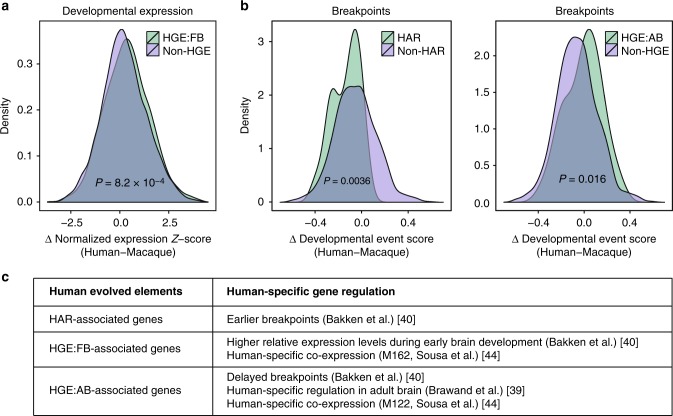
Human evolved elements mediate human-specific regulation. a HGEFB-associated genes show relative higher expression during early brain development in human compared with rhesus macaque. P-values calculated by two-sided t-tests. b HAR-associated genes show earlier breakpoints, while HGEAB-associated genes show later breakpoints. P-values calculated by two-sided Wilcoxon rank sum tests. c Distinct classes of human-evolved elements are associated with different types of human-specific gene regulation
Fig. 4
Fig. 4
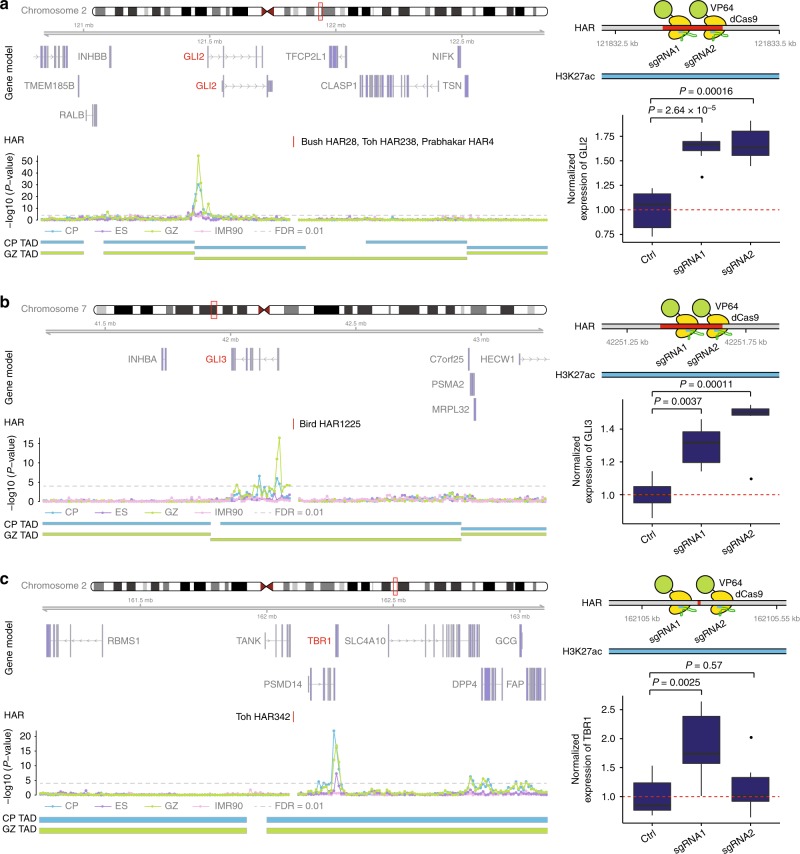
Functional validation of HAR-interacting genes. ac Left, chromatin interaction map of HARs that interact with GLI2 (a), GLI3 (b), and TBR1 (c). Gene Model is based on Gencode v19 and possible target genes are marked in red; Genomic coordinate for HARs is labeled as HAR; −log10 (P-value), significance of the interaction between HARs and each 10 kb bin, gray dotted line for FDR = 0.01; TAD borders in CP and GZ are shown. Right, targeted binding sites for two guide RNAs (gRNAs). The HAR is located in the active enhancer marks (H3K27ac) in fetal brain. Targeting dCas9-VP64 to HARs in primary human neural progenitor cells (phNPCs) results in an 30–80% increase in the expression level of putative target genes predicted by Hi-C. Normalized expression levels of putative target genes (GLI2 (a), GLI3 (b), and TBR1 (c)) relative to control (Ctrl). n = 6 (Ctrl), 8 (gRNA1), 6 (gRNA2) for GLI2; 7 (Ctrl), 6 (gRNA1 and gRNA2) for GLI3; 5 (Ctrl), 6 (gRNA1 and gRNA2) for TBR1. P-values, one-way ANOVA and post hoc Tukey test. Center, median; box = 1st–3rd quartiles (Q); lower whisker, Q1 − 1.5×interquartile range (IQR); upper whisker, Q3 + 1.5 × IQR

References

    1. King MC, Wilson AC. Evolution at two levels in humans and chimpanzees. Science. 1975;188:107–116. doi: 10.1126/science.1090005. - DOI - PubMed
    1. Bird CP, et al. Fast-evolving noncoding sequences in the human genome. Genome Biol. 2007;8:R118. doi: 10.1186/gb-2007-8-6-r118. - DOI - PMC - PubMed
    1. Bush EC, Lahn BT. A genome-wide screen for noncoding elements important in primate evolution. BMC Evol. Biol. 2008;8:17. doi: 10.1186/1471-2148-8-17. - DOI - PMC - PubMed
    1. Capra JA, Erwin GD, McKinsey G, Rubenstein JL, Pollard KS. Many human accelerated regions are developmental enhancers. Philos. Trans. R. Soc. Lond. B Biol. Sci. 2013;368:20130025. doi: 10.1098/rstb.2013.0025. - DOI - PMC - PubMed
    1. Lindblad-Toh K, et al. A high-resolution map of human evolutionary constraint using 29 mammals. Nature. 2011;478:476–482. doi: 10.1038/nature10530. - DOI - PMC - PubMed

Publication types

MeSH terms