Review
. 2019 Apr 8;10(18):4727-4741.
doi: 10.1039/c9sc01351b. eCollection 2019 May 14.

Stable cyclic (alkyl)(amino)carbene (cAAC) radicals with main group substituents

Affiliations
Review

Stable cyclic (alkyl)(amino)carbene (cAAC) radicals with main group substituents

Subrata Kundu et al. Chem Sci. .

Abstract

Isolation and characterization of stable radicals has been a long-pursued quest. While there has been some progress in this field particularly with respect to carbon, radicals involving heavier p-block elements are still considerably sparse. In this review we describe our recent successful efforts on the isolation of stable p-block element radicals particularly those involving aluminum, silicon, and phosphorus.


Figures
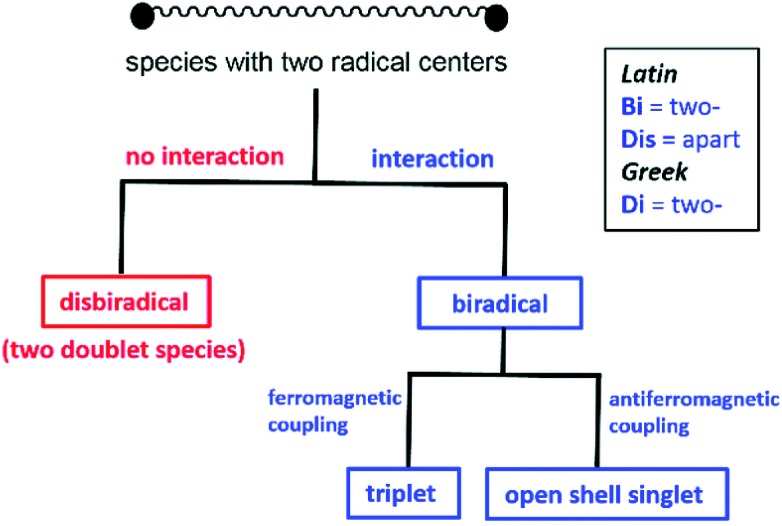
Scheme 1
Scheme 1. Definition for disbiradicals and biradicals used in this article (reproduced from ref. 13a with permission from the Royal Society of Chemistry).
Fig. 1
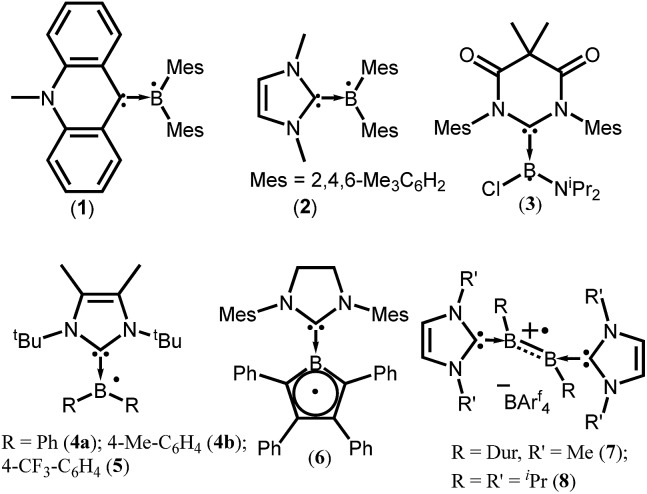
Fig. 1. NHC ligated boryl monoradicals. The arrow indicates the donor–acceptor interaction.
Fig. 2
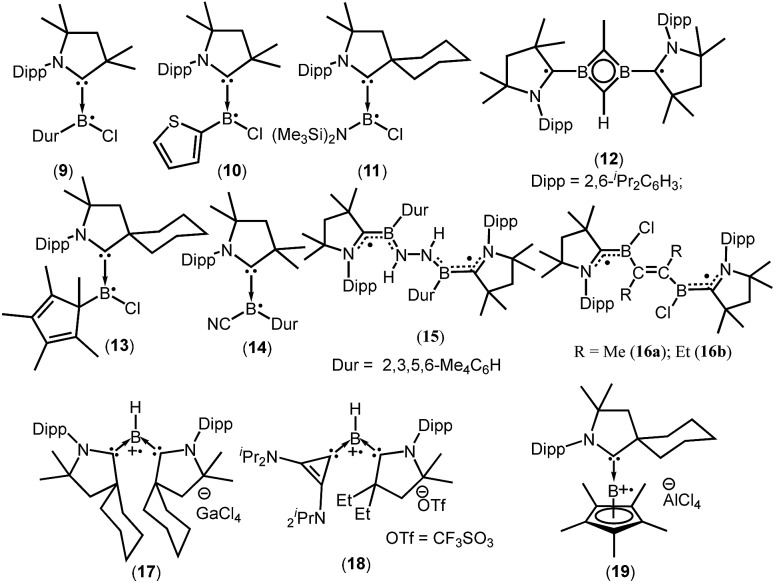
Fig. 2. cAAC ligated boryl mono- and biradicals.
Fig. 3
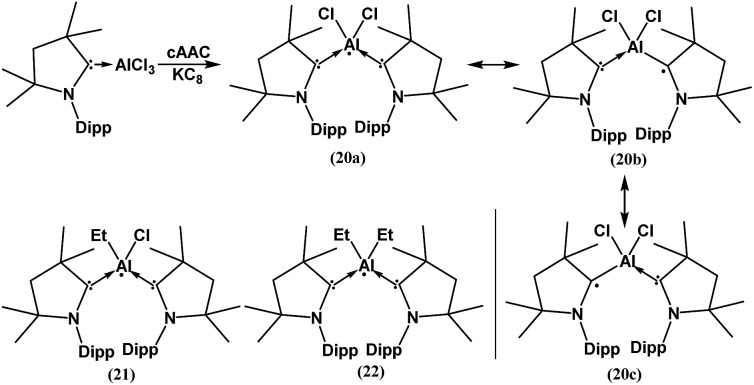
Fig. 3. cAAC-supported neutral aluminium monoradicals (20–22). As an example, a general synthesis and possible resonance structures of 20 are given.
Fig. 4
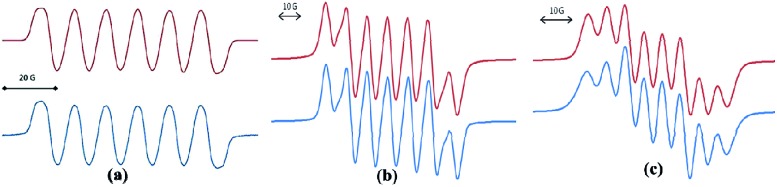
Fig. 4. Room-temperature (a) EPR spectrum of 20 simulation with (g = 2.0055), a(27Al) = 12.5 G; a(2 35,37Cl) = 1.9 G; a(2 14N) = 0.25 G; (b) EPR spectrum of compound 21 simulation with a(14N) = 4.3 G, a(27Al) = 8.3 G; (c) EPR spectrum of compound 22 at room temperature simulation with a(14N) = 4.95 G, a(27Al) = 5.2 G (Top: simulated spectrum and Bottom: experimental spectrum).
Fig. 5
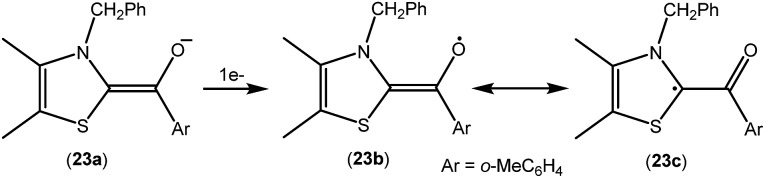
Fig. 5. Oxidation of the thiazolylidene based enolate to a carbon-radical.
Fig. 6
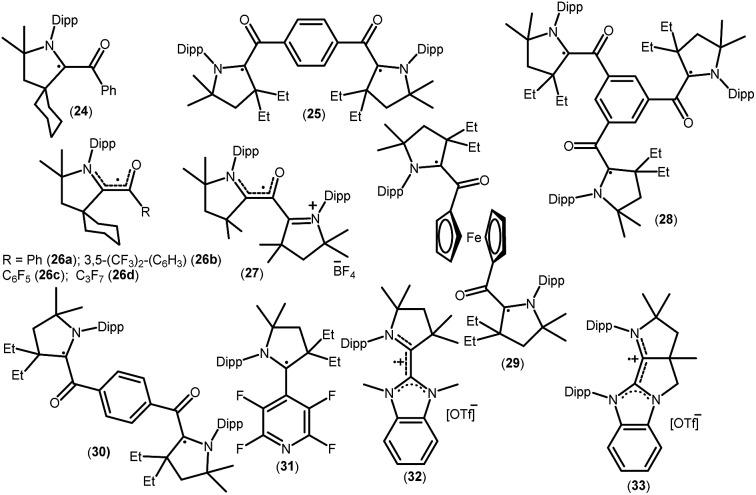
Fig. 6. cAAC-derived carbon radicals.
Fig. 7
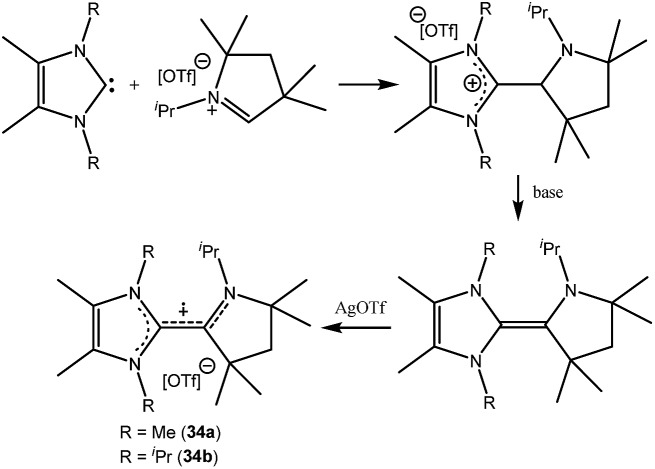
Fig. 7. Monoradical cations derived from cAACs.
Fig. 8
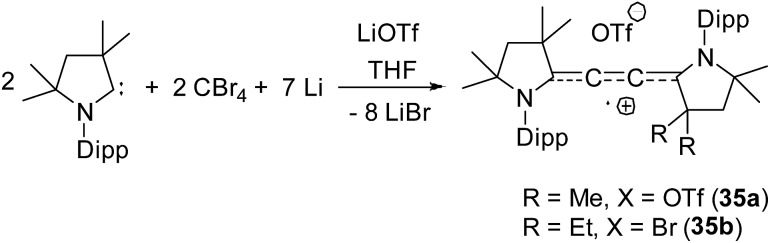
Fig. 8. Synthesis of di-cAAC stabilized C2˙+.
Fig. 9
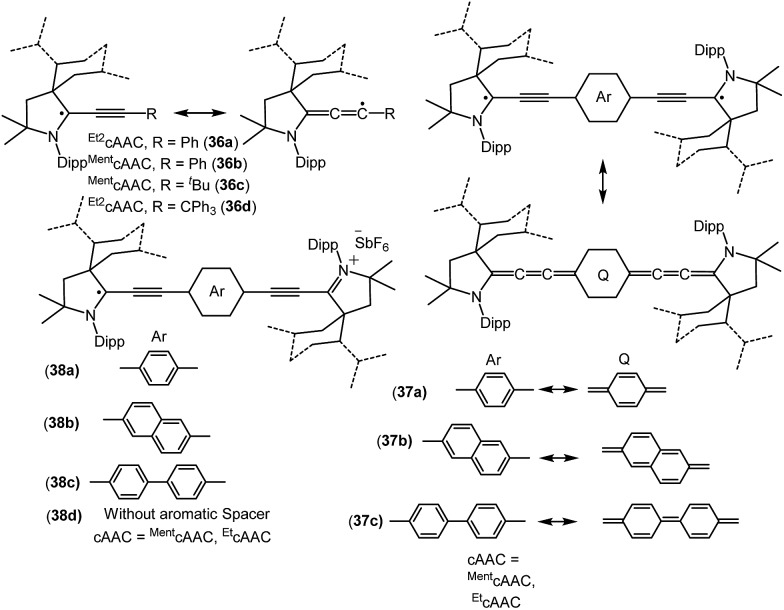
Fig. 9. cAAC stabilized mono-, di- and biradicals over extended carbon systems.
Fig. 10
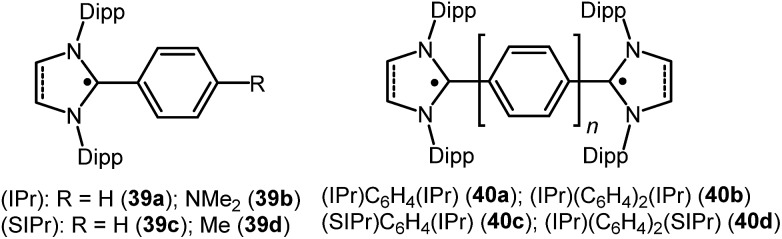
Fig. 10. NHC stabilized radicals over extended carbon systems.
Fig. 11
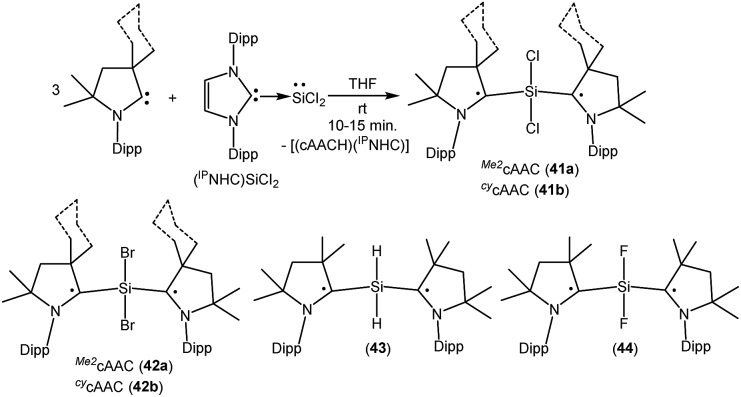
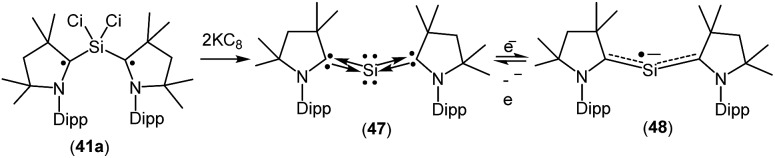
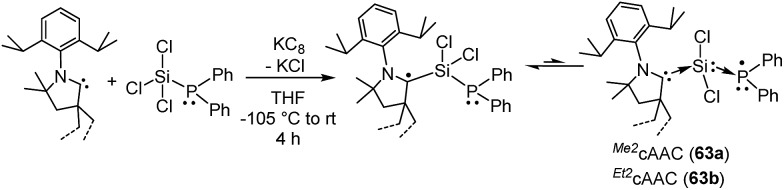
Fig. 11. cAAC coordinated SiR2 (R = Cl, Br, H, F) dis- and biradicals.
Fig. 12
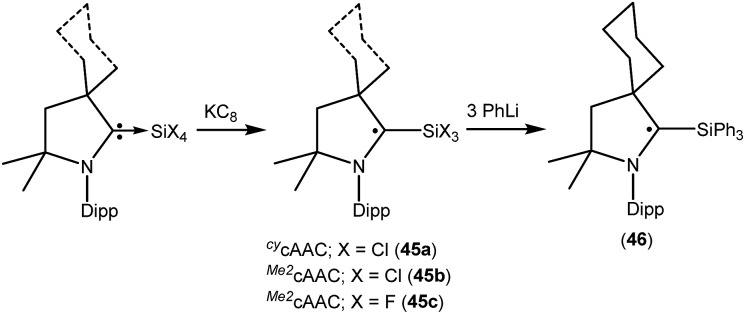
Fig. 12. Synthesis of (cAAC˙)SiR3 (R = Cl, F or Ph).
Fig. 13
Fig. 13. cAAC-stabilized siladicarbene and in situ generation of (Me2cAAC)2Si˙.
Fig. 14
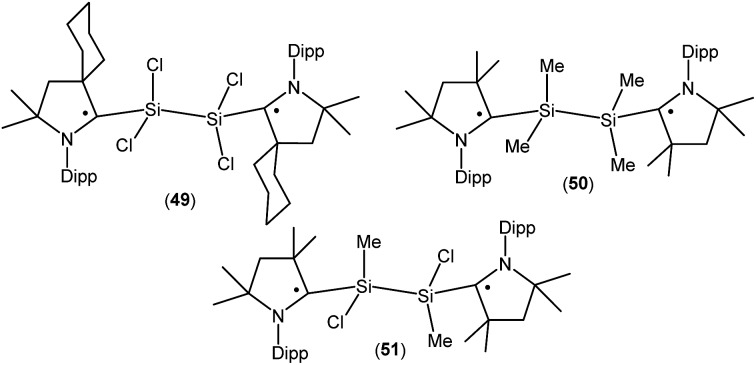
Fig. 14. Silane-bridged dis- and biradicals.
Fig. 15
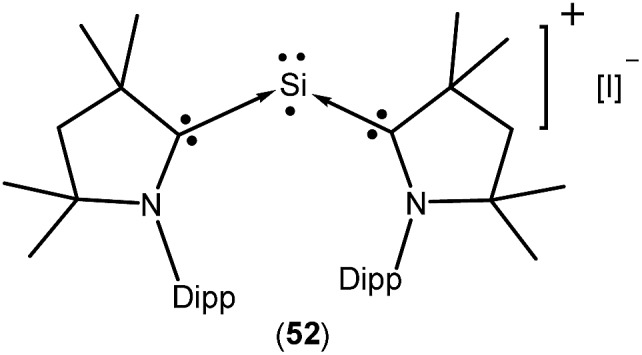
Fig. 15. cAAC-stabilized monoradical cation of Si(i).
Fig. 16
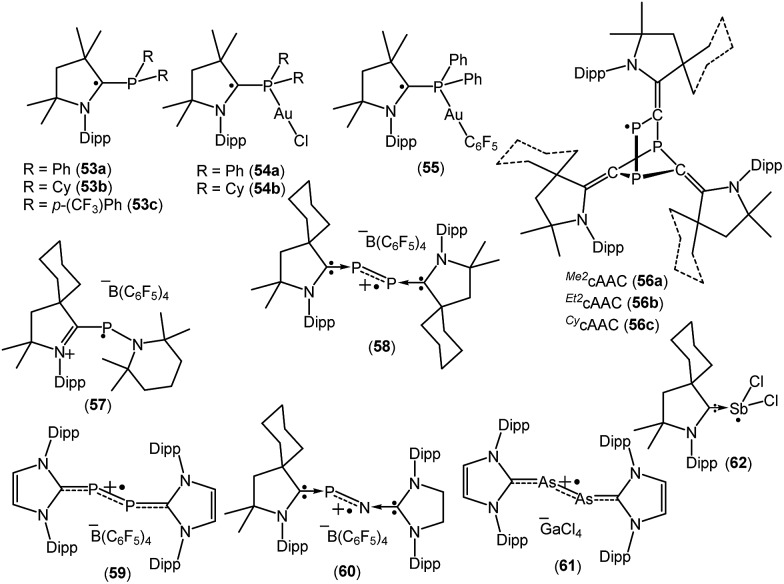
Fig. 16. cAAC stabilized group-15 radicals.
Fig. 17
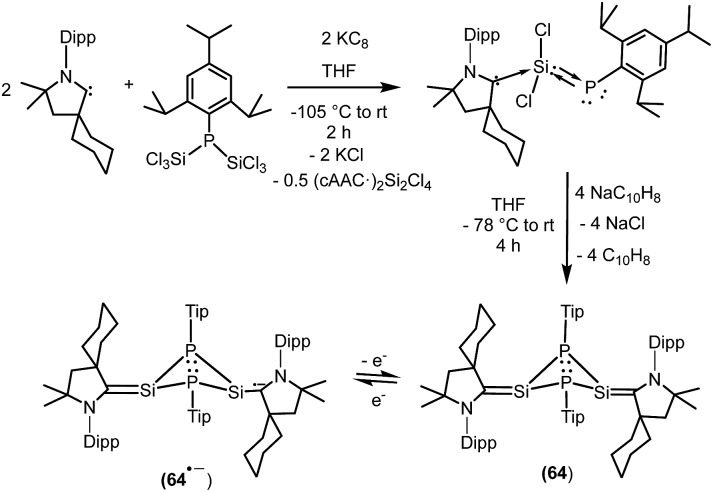
Fig. 17. Radicals of silicon and phosphorus stabilized by cAAC.
Fig. 18
Fig. 18. Radical compounds of silicon and phosphorus stabilized by cAAC.
Fig. 19
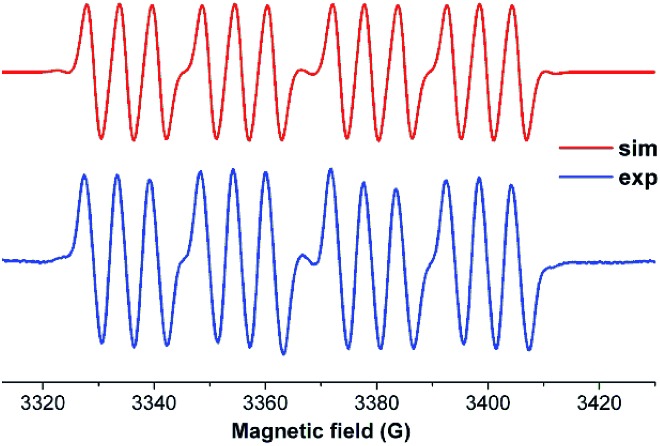
Fig. 19. EPR spectrum of radical anion [(CycAAC)Si(P-Tip)]2˙ (64˙) in toluene at 285 K.
Fig. 20
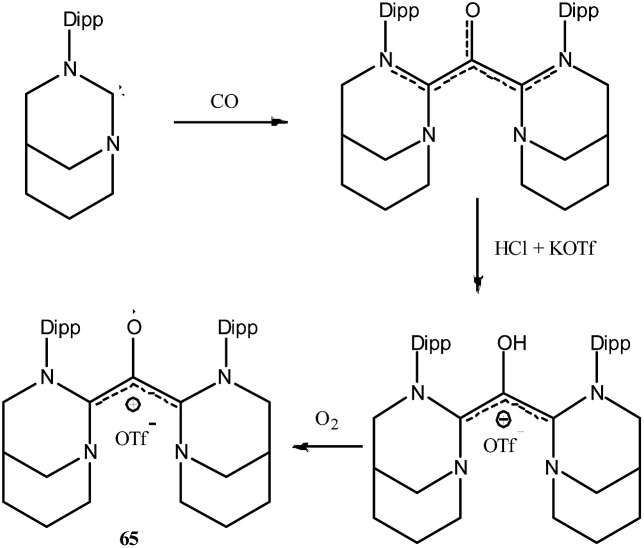
Fig. 20. Synthesis of oxyallyl radical cation 65˙+.
None
Subrata Kundu
None
Soumen Sinhababu
None
Vadapalli Chandrasekhar
None
Herbert W. Roesky

References

    1. Stable Radicals: Fundamental and Applied Aspects of Odd-Electron Compounds, ed. R. G. Hicks, Wiley, Chichester, 2010.
    1. Fossey J., Lefort D. and Serba J., Free Radicals in Organic Chemistry, John Wiley and Sons, 1995.
    1. Renaud P. and Sibi M. P., Radicals in Organic Synthesis, Wiley-VCH, 2008.
    1. Chatgilialoglu C. and Studer A., Encyclopedia of Radicals in Chemistry, Biology and Materials, Wiley-VCH, 2012.
    1. Power P. P. Chem. Rev. 2003;103:789–810. - PubMed