


Sports participation and health-related quality of life: a longitudinal observational study in children
- PMID: 31161332
- PMCID: PMC6698265
- DOI: 10.1007/s11136-019-02219-4
Sports participation and health-related quality of life: a longitudinal observational study in children
Abstract
Purpose: In this study, longitudinal associations between sports participation and health-related quality of life (HRQoL) were explored. Sports participation was operationalized as membership of a sports club, frequency of sports participation, performing individual versus team sports and performing indoor versus outdoor sports. The concept of HRQoL referred to the self-perceived enjoyment and satisfaction with one's personal health situation.
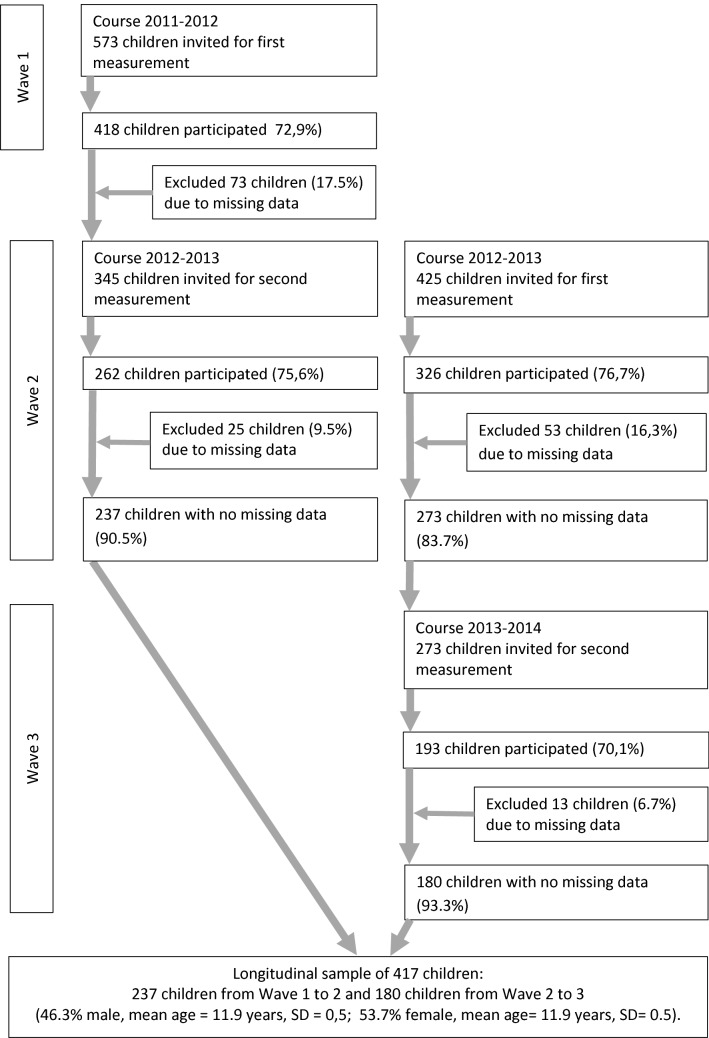
Methods: Data from 618 fourth-grade primary school children were included at baseline; 10-13 months later, 417 children (response rate 67.5%) were retained. At both time points, children reported on sports participation (Move and Sports Monitor Questionnaire-youth aged 8-12 years) and health-related quality of life (KIDSCREEN-52). Because of the clustering of children in schools, data were analysed using linear mixed models. Analyses were adjusted for sex, age, BMI, household composition, SES and frequency of sports participation.
Results: The questionnaires were fully completed by 417 children. High sports-active children showed better scores on almost all dimensions of HRQoL than moderate [difference (B) = - 1.82 (p = 0.05) to - 1.51 (p = 0.05)] or low ports-active children [difference (B) = - 3.67 (p < 0.001) to - 1.95 (p = 0.03)] and non-sports club members [difference (B) = - 5.58 (p < 0.001) to - 2.65 (p = 0.02)]. Unlike frequency, the other examined characteristics of sports participation were only to a limited extent longitudinal associated with HRQoL.
Conclusion: As frequency is more relevant than the form of sports participation, children should be encouraged to perform any kind of sports activity on a very regular base.
Keywords: Children; Frequency of sports participation; Health-related quality of life; Longitudinal associations; Outdoor sports; Team sports.
Conflict of interest statement
The authors declare that they have no conflict of interest.
Figures
References
-
- Michel G, Bisegger C, Fuhr DC, Abel T. Age and gender differences in health-related quality of life of children and adolescents in Europe: A multilevel analysis. Quality of Life Research. 2009;18(9):1147–1157. - PubMed
-
- Petersen-Ewert C, Erhart M, Ravens-Sieberer U. Assessing health-related quality of life in European children and adolescents. Neuroscience and Biobehavioral Reviews. 2011;35(8):1752–1756. - PubMed
-
- The KIDSCREEN-group Europe . The kidscreen questionnaires—quality of life questionnaires for children and adolescent—handbook. Lengerich: Pabst Science Publishers; 2006.
-
- Wilson IB, Cleary PD. Linking clinical variables with health-related quality of life: A conceptual model of patient outcomes. JAMA. 1995;273(1):59–65. - PubMed
-
- Eime RM, Young JA, Harvey JT, Charity MJ, Payne WR. A systematic review of the psychological and social benefits of participation in sport for adults: Informing development of a conceptual model of health through sport. International Journal of Behavioral Nutrition and Physical Activity. 2013;10(1):135–148. - PMC - PubMed
Publication types
MeSH terms
LinkOut - more resources
Full Text Sources
Research Materials
