. 2019 Jun 3;9(1):52.
doi: 10.1186/s13550-019-0517-6.

Comparison of the radiolabeled PSMA-inhibitor 111In-PSMA-617 and the radiolabeled GRP-R antagonist 111In-RM2 in primary prostate cancer samples

Affiliations

Comparison of the radiolabeled PSMA-inhibitor 111In-PSMA-617 and the radiolabeled GRP-R antagonist 111In-RM2 in primary prostate cancer samples

Romain Schollhammer et al. EJNMMI Res. .

Abstract

Purpose: Prostate-specific membrane antigen (PSMA) and gastrin-releasing peptide receptor (GRP-R) are expressed in prostate cancer and can be targeted with radiolabeled inhibitors and antagonists. Their performances for the initial characterization of prostatic tumors have been barely evaluated but never compared. We aimed to gather comparative preclinical data of the role of PSMA and GRP-R targeting in prostate cancer.

Procedures: We retrospectively studied 20 frozen prostatectomy samples with various metastatic risks of the D'Amico classification. Tissue samples were investigated by tissular microimaging using the radiolabeled PSMA inhibitor 111In-PSMA-617 and the radiolabeled GRP-R antagonist 111In-RM2. Bindings of the two radiopharmaceuticals were compared to histology and clinico-biological data (Gleason score, PSA values, metastatic risks).

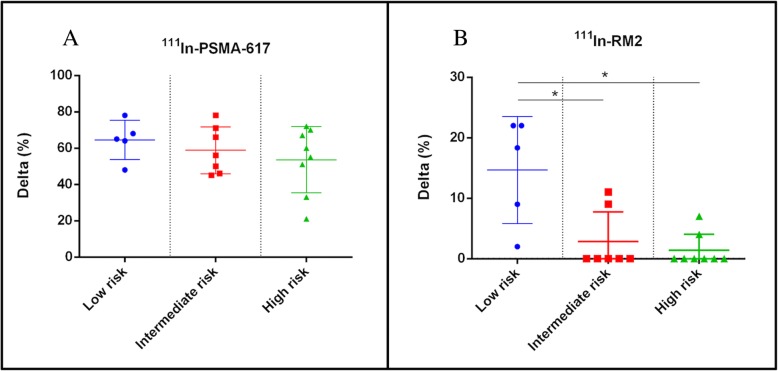
Results: Binding of 111In-PSMA-617 was high whatever the metastatic risk (p = 0.665), Gleason score (p = 0.555), or PSA value (p = 0.404) while 111In-RM2 exhibited a significantly higher binding in the low metastatic risk group (p = 0.046), in the low PSA value group (p = 0.001), and in samples with Gleason 6 score (p = 0.006).

Conclusion: PSMA and GRP-R based imaging might have complementary performances for the initial characterization of prostatic tumors. Prospective clinical studies comparing the two tracers in this setting are needed.

Keywords: GRP-R; PSMA; Prostate cancer.


Conflict of interest statement

The authors declare that they have no competing interests.

Figures

Fig. 1
Fig. 1
Comparison between 111In-RM2 (a–c) and 111In-PSMA (d–f) on a low-risk sample: radioactive signal (a, d), HES (c, f), and fusion images (b, e). The black line drawing corresponds to the tumoral area. There is good discrimination between tumor tissue and normal tissue on 111In-RM2 (tumor-to-normal ratio, TNR = 1.22) as well as on 111In-PSMA-617 (TNR = 2.09)
Fig. 2
Fig. 2
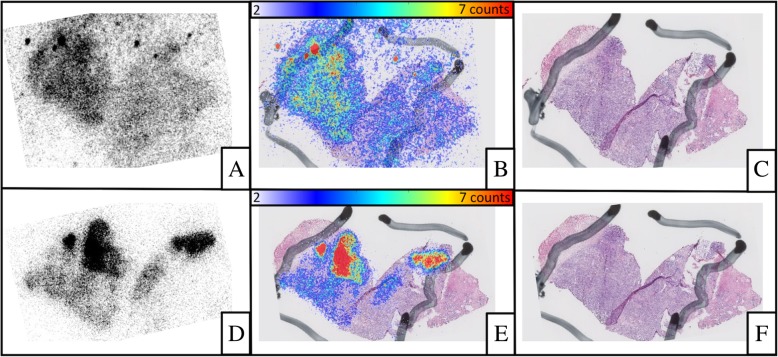
Comparison between 111In-RM2 (a–c) and 111In-PSMA (d–f) on a high-risk sample: radioactive signal (a, d), HES (c, f), and fusion images (b, e). The black line delimitation corresponds to the tumoral area. There is excellent discrimination between tumor tissue and normal tissue on 111In-PSMA-617 (TNR = 11.20), while the contrast is somewhat lower with 111In-RM2 (TNR = 1.21)
Fig. 3
Fig. 3
a 111In-RM2 binding in low-, intermediate-, and high-risk prostate cancer samples. 111In-RM2 binding is significantly higher in low metastatic risk compared to intermediate- or high-risk samples. b 111In-PSMA-617 binding in low-, intermediate-, and high-risk prostate cancer samples. Binding of 111In-PSMA-617 is high in all samples with no significant differences between groups. Non-parametric one-way ANOVA (Kruskal-Wallis test). p < 0.05 was considered significant

References

    1. Siegel RL, Miller KD, Jemal A. Cancer statistics, 2017. CA Cancer J Clin. 2017;67:7–30. doi: 10.3322/caac.21387. - DOI - PubMed
    1. Afshar-Oromieh A, Zechmann CM, Malcher A, et al. Comparison of PET imaging with a 68Ga-labelled PSMA ligand and 18F-choline-based PET/CT for the diagnosis of recurrent prostate cancer. Eur J Nucl Med Mol Imaging. 2014;41:11–20. doi: 10.1007/s00259-013-2525-5. - DOI - PMC - PubMed
    1. Eder M, Schäfer M, Bauder-Wüst U, et al. 68Ga-complex lipophilicity and the targeting property of a urea-based PSMA inhibitor for PET imaging. Bioconjug Chem. 2012;23:688–697. doi: 10.1021/bc200279b. - DOI - PubMed
    1. Morgat C, Mishra AK, Varshney R, et al. Targeting neuropeptide receptors for cancer imaging and therapy: perspectives with bombesin, neurotensin, and neuropeptide-Y receptors. J Nucl Med. 2014;55:1650–1657. doi: 10.2967/jnumed.114.142000. - DOI - PubMed
    1. Schwarzenboeck SM, Rauscher I, Bluemel C, et al. PSMA ligands for PET imaging of prostate cancer. J Nucl Med. 2017;58:1545–1552. doi: 10.2967/jnumed.117.191031. - DOI - PubMed