. 2019 Oct 15;200(8):972-981.
doi: 10.1164/rccm.201812-2383CP.

Understanding and Enhancing Sepsis Survivorship. Priorities for Research and Practice

Affiliations

Understanding and Enhancing Sepsis Survivorship. Priorities for Research and Practice

Hallie C Prescott et al. Am J Respir Crit Care Med. .

Abstract

An estimated 14.1 million patients survive sepsis each year. Many survivors experience poor long-term outcomes, including new or worsened neuropsychological impairment; physical disability; and vulnerability to further health deterioration, including recurrent infection, cardiovascular events, and acute renal failure. However, clinical trials and guidelines have focused on shorter-term survival, so there are few data on promoting longer-term recovery. To address this unmet need, the International Sepsis Forum convened a colloquium in February 2018 titled "Understanding and Enhancing Sepsis Survivorship." The goals were to identify gaps and limitations of current research and shorter- and longer-term priorities for understanding and enhancing sepsis survivorship. Twenty-six experts from eight countries participated. The top short-term priorities identified by nominal group technique culminating in formal voting were to better leverage existing databases for research, develop and disseminate educational resources on postsepsis morbidity, and partner with sepsis survivors to define and achieve research priorities. The top longer-term priorities were to study mechanisms of long-term morbidity through large cohort studies with deep phenotyping, build a harmonized global sepsis registry to facilitate enrollment in cohorts and trials, and complete detailed longitudinal follow-up to characterize the diversity of recovery experiences. This perspective reviews colloquium discussions, the identified priorities, and current initiatives to address them.

Keywords: critical illness; rehabilitation; survivorship.


Figures
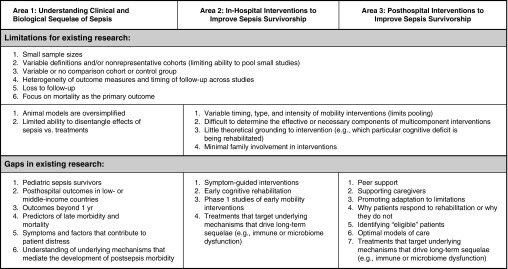
Figure 1.
Figure 1.
Key limitations and gaps of existing research.
Figure 2.
Figure 2.
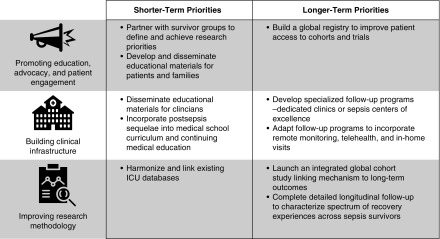
Shorter and longer-term research priorities, by theme. Building clinical infrastructure was viewed as critically important not only to meet the multifaceted needs of sepsis survivors but also to provide a concentrated venue to learn about sepsis survivors and pilot novel interventions to promote adaptation and/or recovery more efficiently.
Figure 3.
Figure 3.
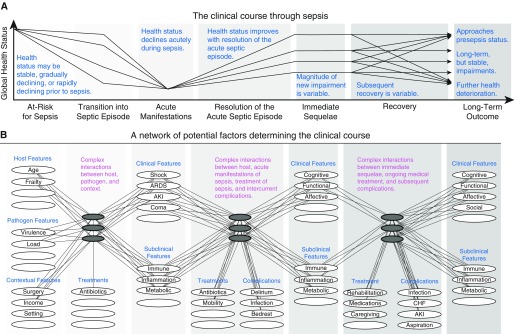
Conceptual diagram of patients’ clinical course through sepsis and underlying factors that influence an individual patient’s trajectory. There are many potential clinical courses that a patient may experience after a hospitalization for sepsis, from rapid complete recovery to recurrent complications and death. (A and B) This figure (adapted by permission from a conceptual diagram first promoted by Prescott and Angus [4]) depicts common clinical trajectories (A) and presents factors important to shaping a patient’s clinical course and long-term outcome (B). This figure draws from the Wilson-Cleary model (90), which links underlying biological factors to physical function and quality of life but extends the representation of the biological factors to demonstrate their complex and unmeasurable interactions. Observable factors, such as presenting features and clinical manifestations of disease, are presented as white ellipses, and the unmeasurable biological interactions are presented as dark gray ellipses. Not all ellipses are labeled, representing the incomplete knowledge of the factors determining clinical course. This diagram is intended to convey that innumerable factors interact in complex ways to determine a patient’s long-term outcome and that the measurable manifestations of disease cannot fully predict the evolution of a patient’s recovery, owing to the unmeasurable biological interactions at play. AKI = acute kidney injury; ARDS = acute respiratory distress syndrome; CHF = congestive heart failure.
Figure 4.
Figure 4.
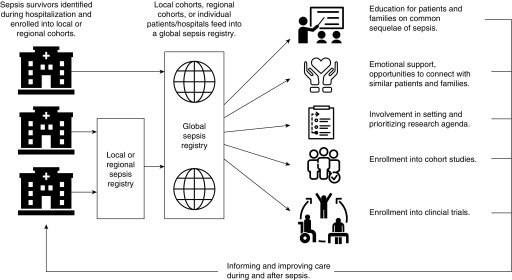
Conceptual diagram of a global sepsis registry. Although some services (education and emotional support) are ideally provided locally or regionally, they are not universally available. A global sepsis registry could provide universal opportunities for enrollment in cohorts and interventional trials, as well as safety net services for patients without local sepsis survivorship resources.

References

    1. Singer M, Deutschman CS, Seymour CW, Shankar-Hari M, Annane D, Bauer M, et al. The Third International Consensus Definitions for Sepsis and Septic Shock (Sepsis-3) JAMA. 2016;315:801–810. - PMC - PubMed
    1. Fleischmann C, Scherag A, Adhikari NKJ, Hartog CS, Tsaganos T, Schlattmann P, et al. International Forum of Acute Care Trialists. Assessment of global incidence and mortality of hospital-treated sepsis: current estimates and limitations. Am J Respir Crit Care Med. 2016;193:259–272. - PubMed
    1. Fleischmann-Struzek C, Goldfarb DM, Schlattmann P, Schlapbach LJ, Reinhart K, Kissoon N. The global burden of paediatric and neonatal sepsis: a systematic review. Lancet Respir Med. 2018;6:223–230. - PubMed
    1. Prescott HC, Angus DC. Enhancing recovery from sepsis: a review. JAMA. 2018;319:62–75. - PMC - PubMed
    1. Iwashyna TJ, Ely EW, Smith DM, Langa KM. Long-term cognitive impairment and functional disability among survivors of severe sepsis. JAMA. 2010;304:1787–1794. - PMC - PubMed

Publication types