


High-fidelity copying is not necessarily the key to cumulative cultural evolution: a study in monkeys and children
- PMID: 31161908
- PMCID: PMC6571458
- DOI: 10.1098/rspb.2019.0729
High-fidelity copying is not necessarily the key to cumulative cultural evolution: a study in monkeys and children
Abstract
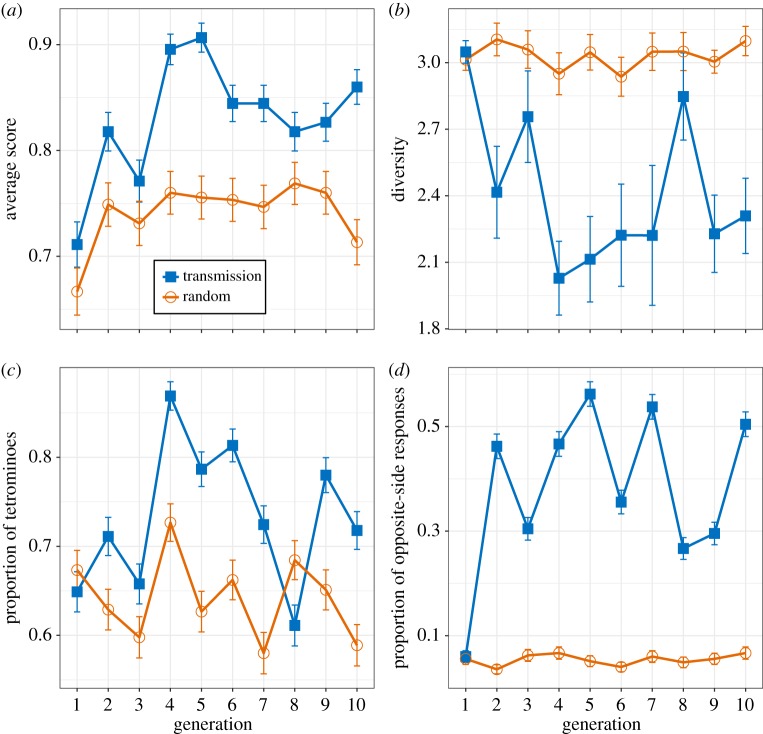
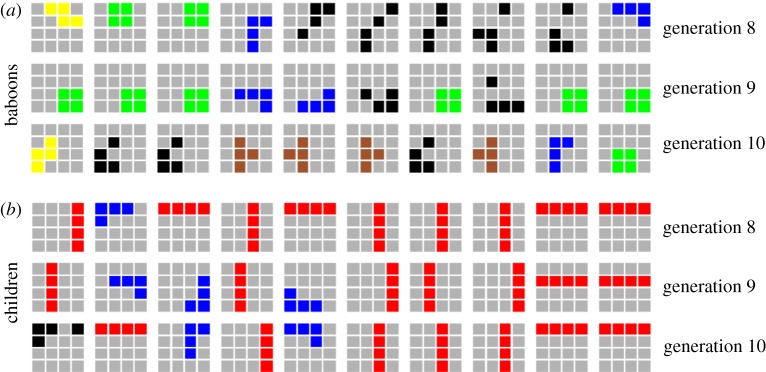
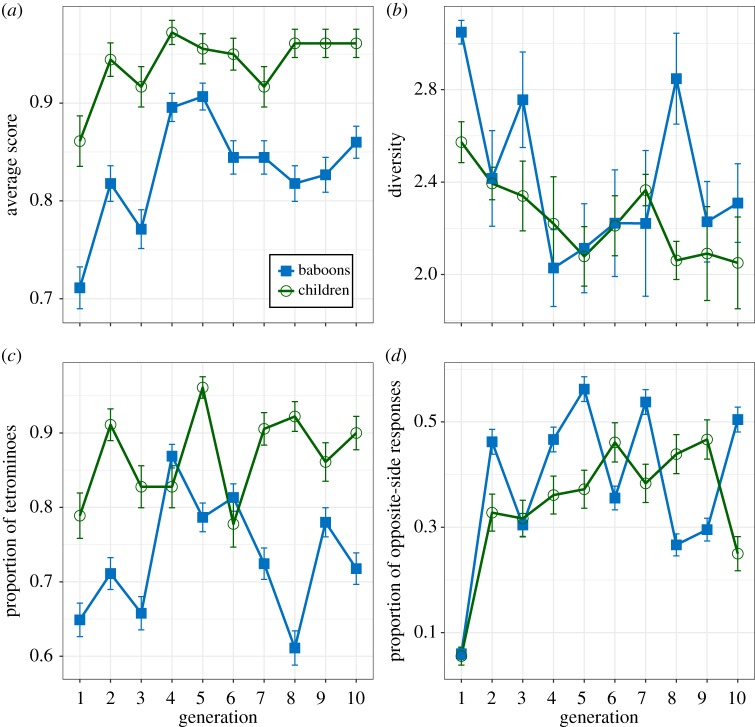
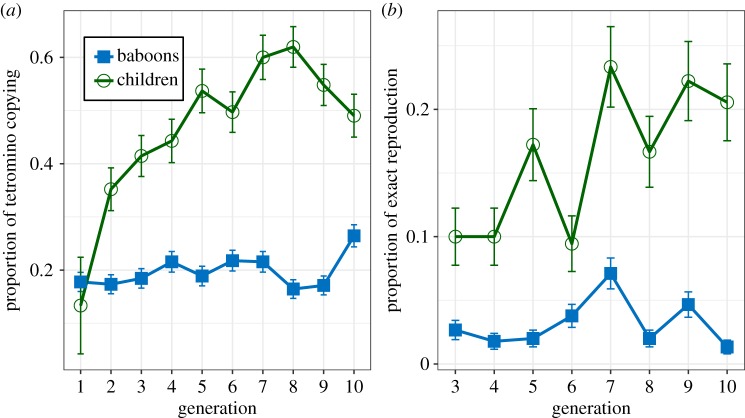
The unique cumulative nature of human culture has often been explained by high-fidelity copying mechanisms found only in human social learning. However, transmission chain experiments in human and non-human primates suggest that cumulative cultural evolution (CCE) might not necessarily depend on high-fidelity copying after all. In this study, we test whether defining properties of CCE can emerge in a non-copying task. We performed transmission chain experiments in Guinea baboons and human children where individuals observed and produced visual patterns composed of four squares on touchscreen devices. In order to be rewarded, participants had to avoid touching squares that were touched by a previous participant. In other words, they were rewarded for innovation rather than copying. Results nevertheless exhibited fundamental properties of CCE: an increase over generations in task performance and the emergence of systematic structure. However, these properties arose from different mechanisms across species: children, unlike baboons, converged in behaviour over generations by copying specific patterns in a different location, thus introducing alternative copying mechanisms into the non-copying task. In children, prior biases towards specific shapes led to convergence in behaviour across chains, while baboon chains showed signs of lineage specificity. We conclude that CCE can result from mechanisms with varying degrees of fidelity in transmission and thus that high-fidelity copying is not necessarily the key to CCE.
Keywords: comparative cognition; cumulative cultural evolution; iterated learning; primate behaviour; social learning; transmission chain.
Conflict of interest statement
We declare we have no competing interests.
Figures
References
-
- Morin O. 2013. How portraits turned their eyes upon us: visual preferences and demographic change in cultural evolution. Evol. Hum. Behav. 34, 222–229. (10.1016/j.evolhumbehav.2013.01.004) - DOI
-
- Nichols S. 2002. On the genealogy of norms: a case for the role of emotion in cultural evolution. Phil. Sci. 69, 234–255. (10.1086/341051) - DOI
-
- Keller R. 2005. On language change: the invisible hand in language. London, UK: Routledge.
Publication types
MeSH terms
Associated data
LinkOut - more resources
Full Text Sources
