. 2018 Sep 7;6(3):42.
doi: 10.3390/jintelligence6030042.

Bifactor Models for Predicting Criteria by General and Specific Factors: Problems of Nonidentifiability and Alternative Solutions

Affiliations

Bifactor Models for Predicting Criteria by General and Specific Factors: Problems of Nonidentifiability and Alternative Solutions

Michael Eid et al. J Intell. .

Abstract

The bifactor model is a widely applied model to analyze general and specific abilities. Extensions of bifactor models additionally include criterion variables. In such extended bifactor models, the general and specific factors can be correlated with criterion variables. Moreover, the influence of general and specific factors on criterion variables can be scrutinized in latent multiple regression models that are built on bifactor measurement models. This study employs an extended bifactor model to predict mathematics and English grades by three facets of intelligence (number series, verbal analogies, and unfolding). We show that, if the observed variables do not differ in their loadings, extended bifactor models are not identified and not applicable. Moreover, we reveal that standard errors of regression weights in extended bifactor models can be very large and, thus, lead to invalid conclusions. A formal proof of the nonidentification is presented. Subsequently, we suggest alternative approaches for predicting criterion variables by general and specific factors. In particular, we illustrate how (1) composite ability factors can be defined in extended first-order factor models and (2) how bifactor(S-1) models can be applied. The differences between first-order factor models and bifactor(S-1) models for predicting criterion variables are discussed in detail and illustrated with the empirical example.

Keywords: bifactor model; bifactor(S-1) model; general factor; identification; specific factors.


Conflict of interest statement

The authors declare no conflict of interest.

Figures
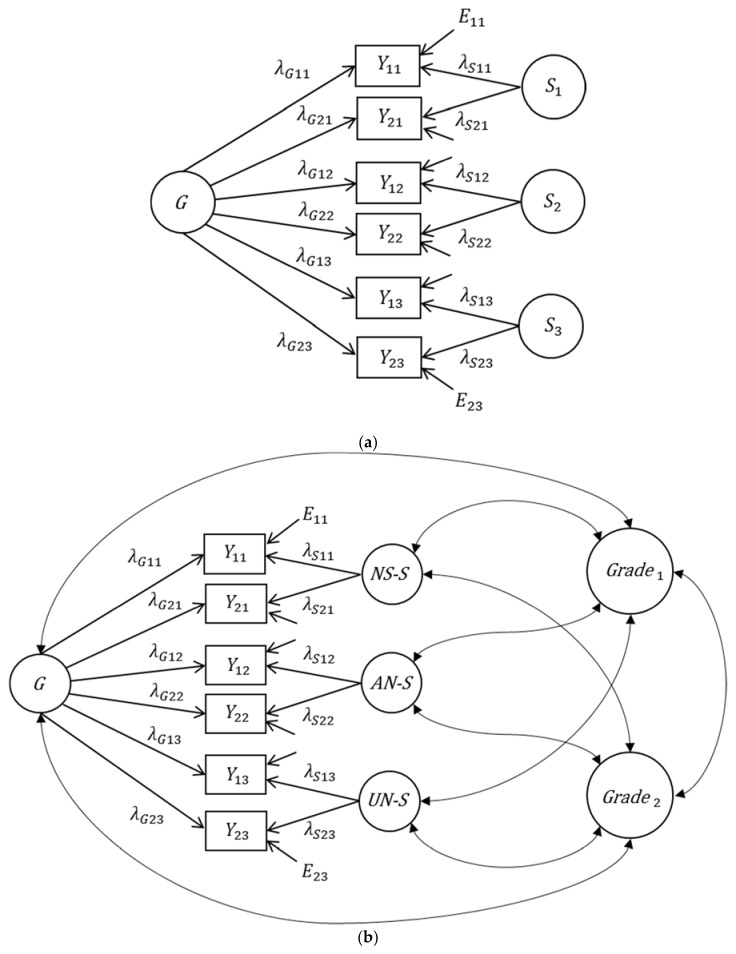
Figure 1
Figure 1
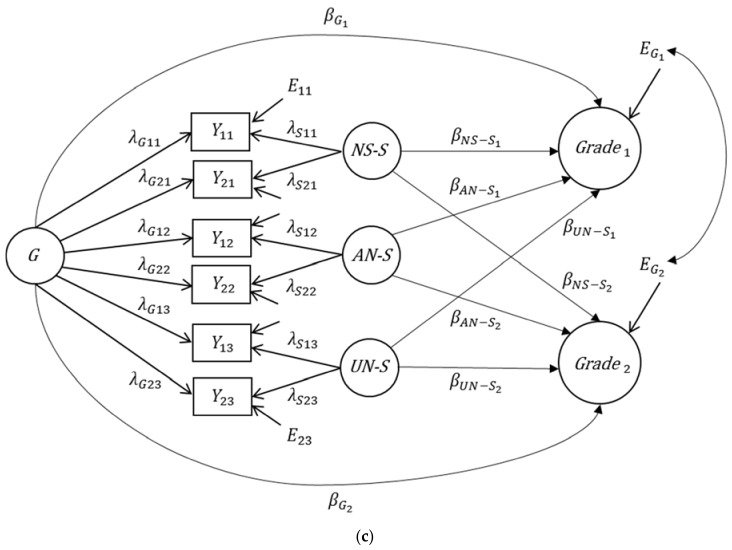
Bifactor model and its extensions to criterion variables. (a) Bifactor model without criterion variables, (b) bifactor model with correlating criterion variables (grades), and (c) multiple latent regression bifactor model. The factors of the extended models depicted refer to the empirical application. G: general factor, Sk: specific factors; NS-S: specific factor number series, AN-S: specific factor verbal analogies, UN-S: specific factor unfolding. Eik: measurement error variables, EG1/EG2: residuals, λ: loading parameters, β: regression coefficients, i: indicator, k: facet.
Figure 1
Figure 1
Bifactor model and its extensions to criterion variables. (a) Bifactor model without criterion variables, (b) bifactor model with correlating criterion variables (grades), and (c) multiple latent regression bifactor model. The factors of the extended models depicted refer to the empirical application. G: general factor, Sk: specific factors; NS-S: specific factor number series, AN-S: specific factor verbal analogies, UN-S: specific factor unfolding. Eik: measurement error variables, EG1/EG2: residuals, λ: loading parameters, β: regression coefficients, i: indicator, k: facet.
Figure 2
Figure 2
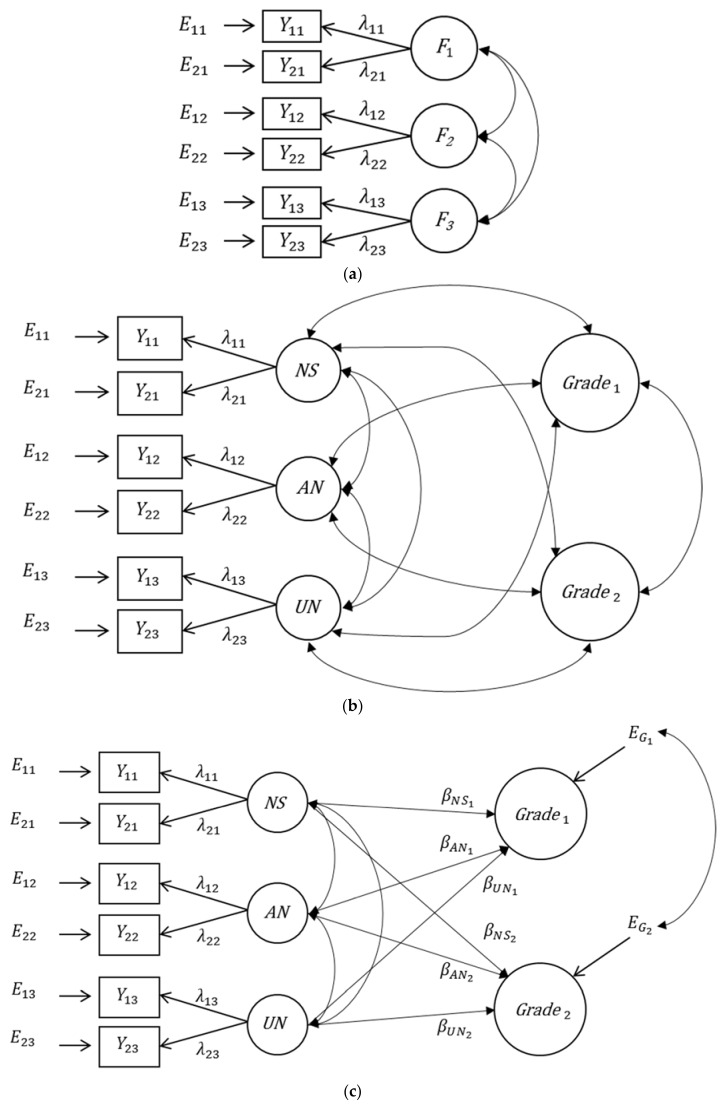
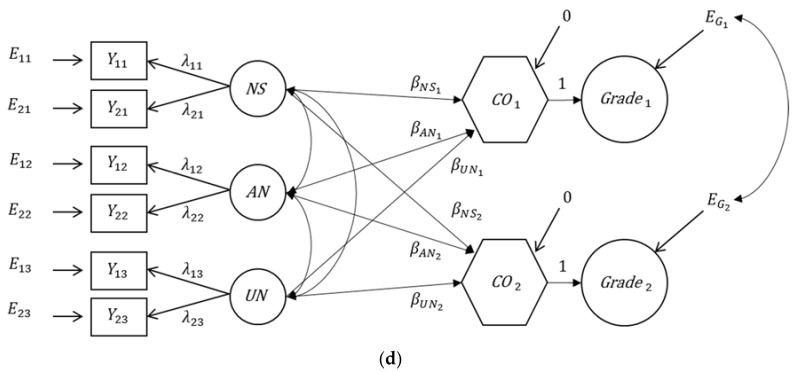
Modell with correlated first-order factors. (a) Model without criterion variables, (b) model with correlating criterion variables, (c) multiple latent regression model, and (d) multiple latent regression model with composite factors. Fk: facet factors, Eik: measurement error variables, NS: facet factor number series, AN: facet factor verbal analogies, UN: facet factor unfolding, CO1/CO2: composite factors, EG1/EG2: residuals λ: loading parameters, β: regression coefficients, i: indicator, k: facet.
Figure 2
Figure 2
Modell with correlated first-order factors. (a) Model without criterion variables, (b) model with correlating criterion variables, (c) multiple latent regression model, and (d) multiple latent regression model with composite factors. Fk: facet factors, Eik: measurement error variables, NS: facet factor number series, AN: facet factor verbal analogies, UN: facet factor unfolding, CO1/CO2: composite factors, EG1/EG2: residuals λ: loading parameters, β: regression coefficients, i: indicator, k: facet.
Figure 3
Figure 3
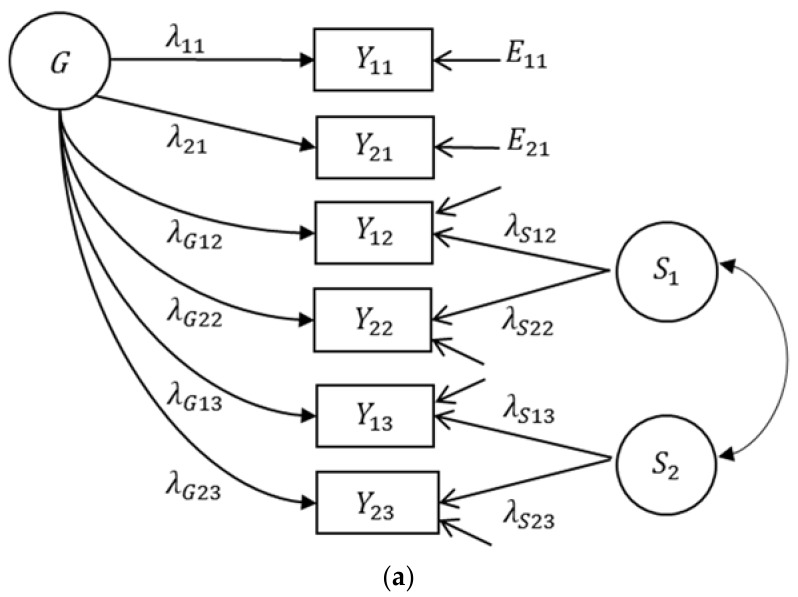
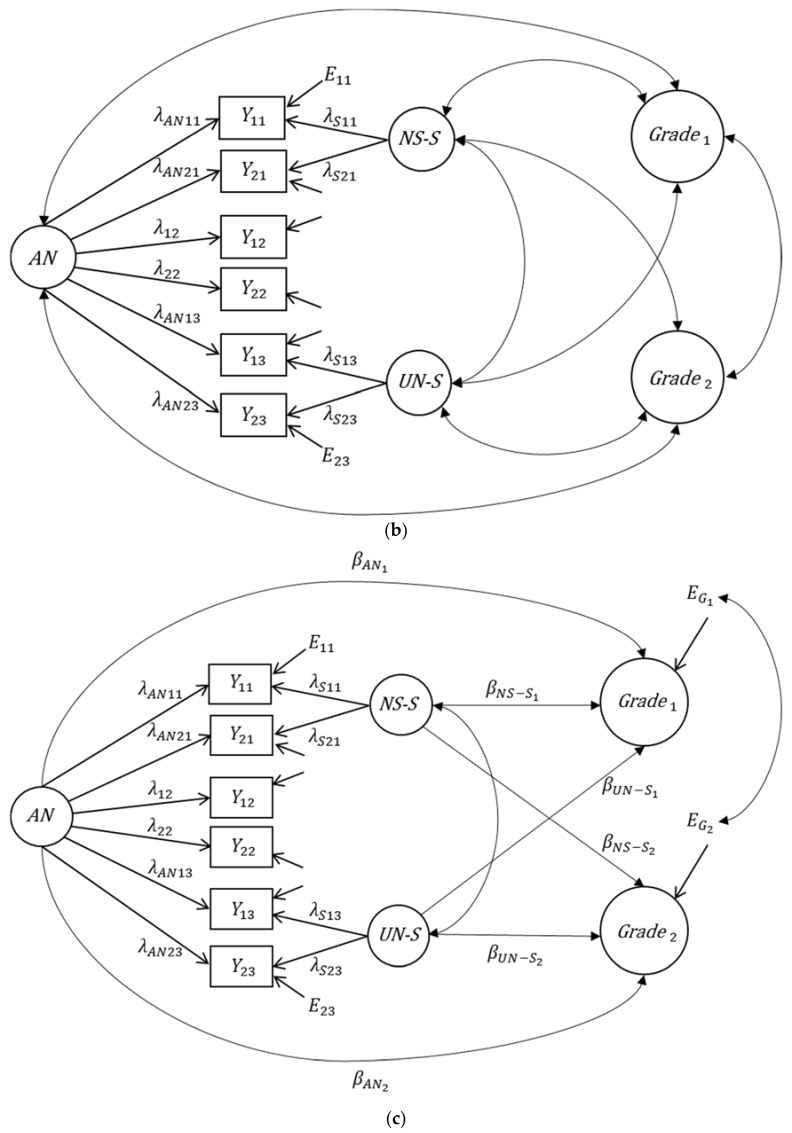
Bifactor(S-1) model and its extensions to criterion variables. (a) Bifactor(S-1) model without criterion variables, (b) bifactor(S-1) model with correlating criterion variables (grades), and (c) multiple latent regression bifactor(S-1) model. The factors of the extended models depicted refer to the empirical application. G: general factor, Sk: specific factors; NS-S: specific factor number series, AN-S: specific factor verbal analogies, UN-S: specific factor unfolding. Eik: measurement error variables, EG1/EG2: residuals, λ: loading parameters, β: regression coefficients, i: indicator, k: facet.
Figure 3
Figure 3
Bifactor(S-1) model and its extensions to criterion variables. (a) Bifactor(S-1) model without criterion variables, (b) bifactor(S-1) model with correlating criterion variables (grades), and (c) multiple latent regression bifactor(S-1) model. The factors of the extended models depicted refer to the empirical application. G: general factor, Sk: specific factors; NS-S: specific factor number series, AN-S: specific factor verbal analogies, UN-S: specific factor unfolding. Eik: measurement error variables, EG1/EG2: residuals, λ: loading parameters, β: regression coefficients, i: indicator, k: facet.

References

    1. Spearman C. General Intelligence objectively determined and measured. Am. J. Psychol. 1904;15:201–293. doi: 10.2307/1412107. - DOI
    1. Gustafsson J.E., Balke G. General and specific abilities as predictors of school achievement. Multivar. Behav. Res. 1993;28:407–434. doi: 10.1207/s15327906mbr2804_2. - DOI - PubMed
    1. Kuncel N.R., Hezlett S.A., Ones D.S. Academic performance, career potential, creativity, and job performance: Can one construct predict them all? J. Pers. Soc. Psychol. 2004;86:148–161. doi: 10.1037/0022-3514.86.1.148. - DOI - PubMed
    1. Kell H.J., Lang J.W.B. Specific abilities in the workplace: More important than g? J. Intell. 1993;5:13. doi: 10.3390/jintelligence5020013. - DOI - PMC - PubMed
    1. Carretta T.R., Ree M.J. General and specific cognitive and psychomotor abilities in personnel selection: The prediction of training and job performance. Int. J. Sel. Assess. 2000;8:227–236. doi: 10.1111/1468-2389.00152. - DOI

LinkOut - more resources