


Feedstock Reagents in Metal-Catalyzed Carbonyl Reductive Coupling: Minimizing Preactivation for Efficiency in Target-Oriented Synthesis
- PMID: 31162793
- PMCID: PMC6764920
- DOI: 10.1002/anie.201905532
Feedstock Reagents in Metal-Catalyzed Carbonyl Reductive Coupling: Minimizing Preactivation for Efficiency in Target-Oriented Synthesis
Abstract
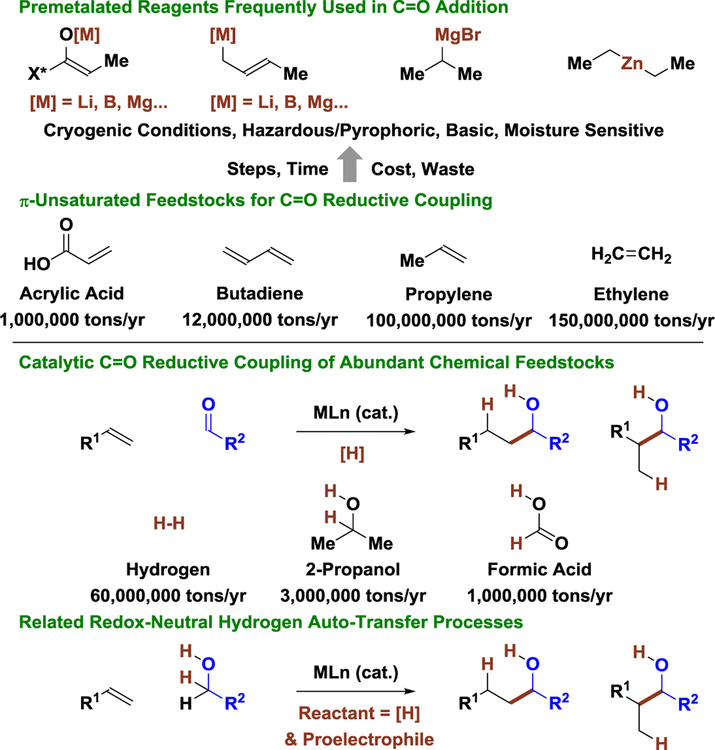
Use of abundant feedstock pronucleophiles in catalytic carbonyl reductive coupling enhances efficiency in target-oriented synthesis. For such reactions, equally inexpensive reductants are desired or, ideally, corresponding hydrogen autotransfer processes may be enacted wherein alcohols serve dually as reductant and carbonyl proelectrophile. As described in this Minireview, these concepts allow reactions that traditionally require preformed organometallic reagents to be conducted catalytically in a byproduct-free manner from inexpensive π-unsaturated precursors.
Keywords: atom efficiency; carbonyl addition; enantioselectivity; hydrogenation; total synthesis.
© 2019 Wiley-VCH Verlag GmbH & Co. KGaA, Weinheim.
Figures




References
-
-
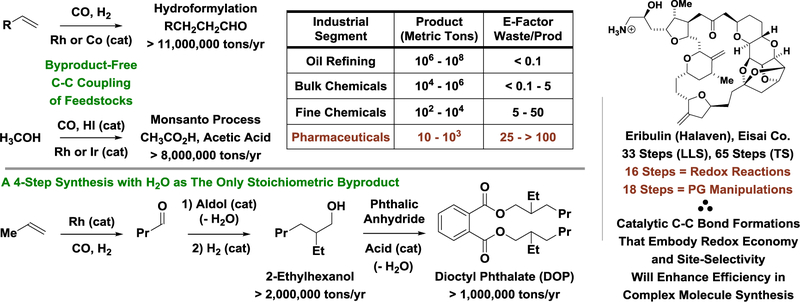
As any reaction may be optimized, we posit that the most fundamental means of assessing synthetic efficiency is to tally the total number of chemical transformations associated with the preparation of each stoichiometric reactant and each stoichiometric reagent from its parent chemical feedstock. As compounds closer to the parent feedstock are more abundant and less expensive, commercial availability and cost is not explicitly considered. It is our hope that this metric will further inform computer-aided route design:
- Klucznik T, Mikulak-Klucznik B, McCormack MP, Lima H, Szymkuć S, Bhowmick M, Molga K, Zhou Y, Rickershauser L, Gajewska EP, Toutchkine A, Dittwald P, Startek MP, Kirkovits GJ, Roszak R, Adamski A, Sieredzińska B, Mrksich M, Trice SLJ, Grzybowski BA, Chem 2018, 4, 522–532.
-
-
-
“The ideal synthesis creates a complex skeleton… in a sequence only of successive construction reactions involving no intermediary refunctionalizations, and leading directly to the structure of the target, not only its skeleton but also its correctly placed functionality.”
- Hendrickson JB, J. Am. Chem. Soc 1975, 97, 5784–5800.
-
-
-
For a review on the synthesis of eribulin, see:
- Yu MJ, Zheng W, Seletsky BM, Nat. Prod. Rep 2013, 30, 1158–1164. - PubMed
-
-
- Slezak Z, Chemik 2003, 56, 153–157.
Publication types
Grants and funding
LinkOut - more resources
Full Text Sources
Research Materials
Miscellaneous
