


Perceived barriers to pre-exposure prophylaxis use and the role of syndemic factors among female sex workers in the Mexico-United States border region: a latent class analysis
- PMID: 31163975
- PMCID: PMC6891112
- DOI: 10.1080/09540121.2019.1626338
Perceived barriers to pre-exposure prophylaxis use and the role of syndemic factors among female sex workers in the Mexico-United States border region: a latent class analysis
Abstract
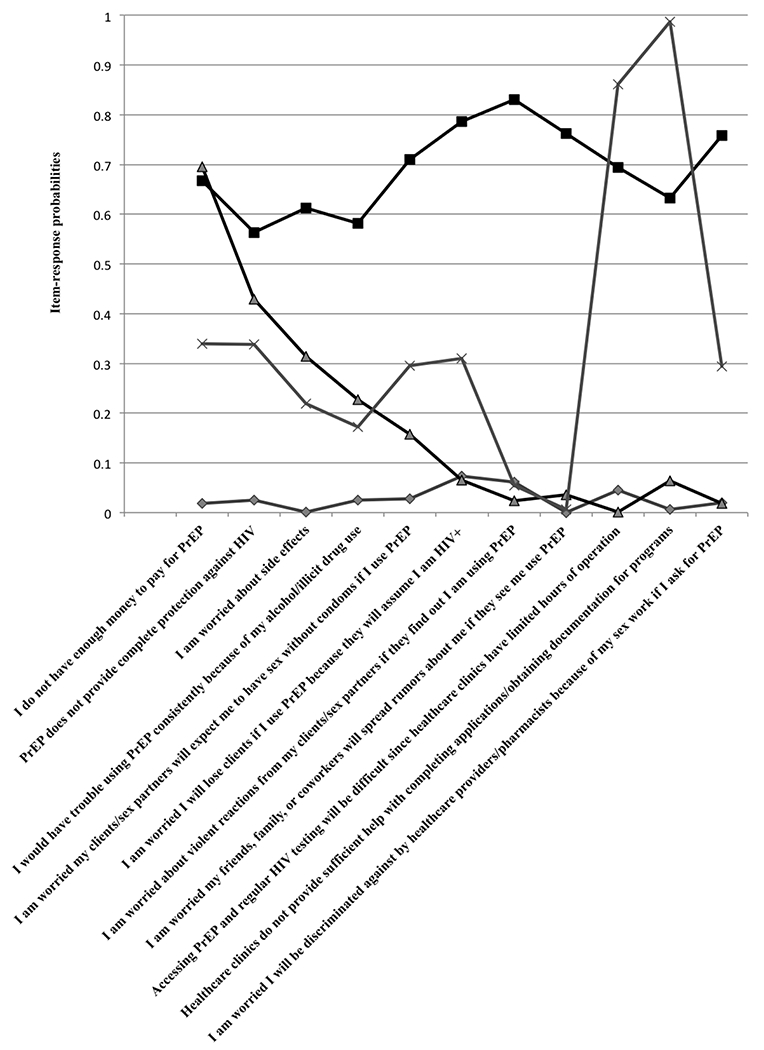
Female sex workers (FSWs) experience syndemic factors (e.g., polydrug use, hazardous alcohol consumption, client-perpetrated violence, depression, and sexually transmitted infections) that often heighten vulnerability to HIV and limit healthcare utilization. We hypothesized that syndemic factors will limit FSWs' uptake of pre-exposure prophylaxis (PrEP). From 2016 to 2017, 295 HIV-negative FSWs were enrolled in a behavioral HIV prevention trial in Tijuana and Ciudad Juarez, Mexico, underwent STI testing, and completed surveys on syndemic factors and perceived barriers to PrEP use. Syndemic scores (0-5) were calculated by summing syndemic factors. Latent class analysis (LCA) was used to identify homogeneous classes with respect to perceived barriers to PrEP use. We identified four classes: (1) perceived healthcare access barriers (8.3%), (2) perceived financial barriers (18.7%), (3) high level of perceived barriers (19.9%), and (4) low level of perceived barriers (53.0%) to PrEP use. Those experiencing three (adjusted odds ratio [aOR] = 3.63, 95% confidence interval [CI] = 1.24-10.67) and four or five (aOR = 6.30, 95% CI = 1.70-23.35) syndemic factors had a higher odds of membership in the class characterized by a high level of perceived barriers than in the class characterized by a low level of perceived barriers. Addressing syndemic factors may maximize PrEP's impact among FSWs along Mexico's northern border.
Keywords: HIV; Mexico; female sex workers; latent class analysis; pre-exposure prophylaxis; syndemic theory.
Figures
References
-
- Beck AT, Steer RA, & Carbin MG (1988). Psychometric properties of the Beck Depression Inventory: Twenty-five years of evaluation. Clinical Psychology Review, 8(1), 77–100. doi: 10.1016/0272-7358(88)90050-5 - DOI
-
- Beck AT, Ward CH, Mendelson M, Mock J, & Erbaugh J (1961). An inventory for measuring depression. Arch Gen Psychiatry, 4, 561–571. - PubMed
Publication types
MeSH terms
Grants and funding
LinkOut - more resources
Full Text Sources
Medical
Research Materials
Miscellaneous
