. 2019 Dec;21(12):2807-2814.
doi: 10.1038/s41436-019-0566-2. Epub 2019 Jun 5.

PEDIA: prioritization of exome data by image analysis

Tzung-Chien Hsieh  1   2   3 Martin A Mensah  2   3 Jean T Pantel  1   2   3 Dione Aguilar  4 Omri Bar  5 Allan Bayat  6 Luis Becerra-Solano  7 Heidi B Bentzen  8 Saskia Biskup  9 Oleg Borisov  1 Oivind Braaten  10 Claudia Ciaccio  11 Marie Coutelier  2 Kirsten Cremer  12 Magdalena Danyel  2 Svenja Daschkey  13 Hilda David Eden  5 Koenraad Devriendt  14 Sandra Wilson  15 Sofia Douzgou  16   17 Dejan Đukić  1 Nadja Ehmke  2 Christine Fauth  18 Björn Fischer-Zirnsak  2 Nicole Fleischer  5 Heinz Gabriel  19 Luitgard Graul-Neumann  2 Karen W Gripp  20 Yaron Gurovich  5 Asya Gusina  21 Nechama Haddad  2 Nurulhuda Hajjir  2 Yair Hanani  5 Jakob Hertzberg  2 Konstanze Hoertnagel  9 Janelle Howell  22 Ivan Ivanovski  23 Angela Kaindl  24 Tom Kamphans  25 Susanne Kamphausen  26 Catherine Karimov  27 Hadil Kathom  28 Anna Keryan  27 Alexej Knaus  1 Sebastian Köhler  29 Uwe Kornak  2 Alexander Lavrov  30 Maximilian Leitheiser  2 Gholson J Lyon  31 Elisabeth Mangold  32 Purificación Marín Reina  33 Antonio Martinez Carrascal  34 Diana Mitter  35 Laura Morlan Herrador  36 Guy Nadav  5 Markus Nöthen  12 Alfredo Orrico  37 Claus-Eric Ott  2 Kristen Park  38 Borut Peterlin  39 Laura Pölsler  18 Annick Raas-Rothschild  40 Linda Randolph  27 Nicole Revencu  41 Christina Ringmann Fagerberg  42 Peter Nick Robinson  43 Stanislav Rosnev  2 Sabine Rudnik  18 Gorazd Rudolf  39 Ulrich Schatz  18 Anna Schossig  18 Max Schubach  3 Or Shanoon  5 Eamonn Sheridan  44 Pola Smirin-Yosef  45 Malte Spielmann  2 Eun-Kyung Suk  46 Yves Sznajer  47 Christian T Thiel  48 Gundula Thiel  46 Alain Verloes  49 Irena Vrecar  39 Dagmar Wahl  50 Ingrid Weber  18 Korina Winter  2 Marzena Wiśniewska  51 Bernd Wollnik  52 Ming W Yeung  1 Max Zhao  2 Na Zhu  2 Johannes Zschocke  18 Stefan Mundlos  2 Denise Horn  2 Peter M Krawitz  53
Affiliations

PEDIA: prioritization of exome data by image analysis

Tzung-Chien Hsieh et al. Genet Med. 2019 Dec.

Abstract

Purpose: Phenotype information is crucial for the interpretation of genomic variants. So far it has only been accessible for bioinformatics workflows after encoding into clinical terms by expert dysmorphologists.

Methods: Here, we introduce an approach driven by artificial intelligence that uses portrait photographs for the interpretation of clinical exome data. We measured the value added by computer-assisted image analysis to the diagnostic yield on a cohort consisting of 679 individuals with 105 different monogenic disorders. For each case in the cohort we compiled frontal photos, clinical features, and the disease-causing variants, and simulated multiple exomes of different ethnic backgrounds.

Results: The additional use of similarity scores from computer-assisted analysis of frontal photos improved the top 1 accuracy rate by more than 20-89% and the top 10 accuracy rate by more than 5-99% for the disease-causing gene.

Conclusion: Image analysis by deep-learning algorithms can be used to quantify the phenotypic similarity (PP4 criterion of the American College of Medical Genetics and Genomics guidelines) and to advance the performance of bioinformatics pipelines for exome analysis.

Keywords: computer vision; deep learning; dysmorphology; exome diagnostics; variant prioritization.


Conflict of interest statement

P.M.K. and K.W.G. receive compensation as consultants for FDNA Inc. H.D.E., Y.H., G.N., O. Bar, O.S., Y.G., N.F. are employees of FDNA; T.K. is an employee of GeneTalk GmbH. The other authors declare no conflicts of interest.

Figures
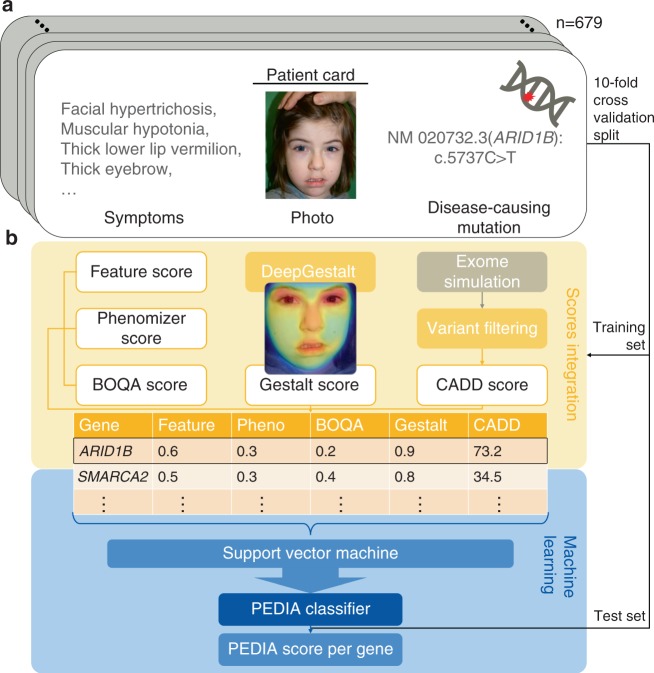
Fig. 1
Fig. 1
Prioritization of exome data by image analysis (PEDIA): cohort and classification approach. (a) Clinical features, facial photograph, and pathogenic variant of one individual of the PEDIA cohort. In total the cohort consists of 679 cases with monogenic disorders that are suitable for a diagnostic workup by exome sequencing. (b) Clinical features, images, and exome variants were evaluated separately and integrated to a single score by a machine learning approach. The disease-causing gene is shown at the top of the list.
Fig. 2
Fig. 2
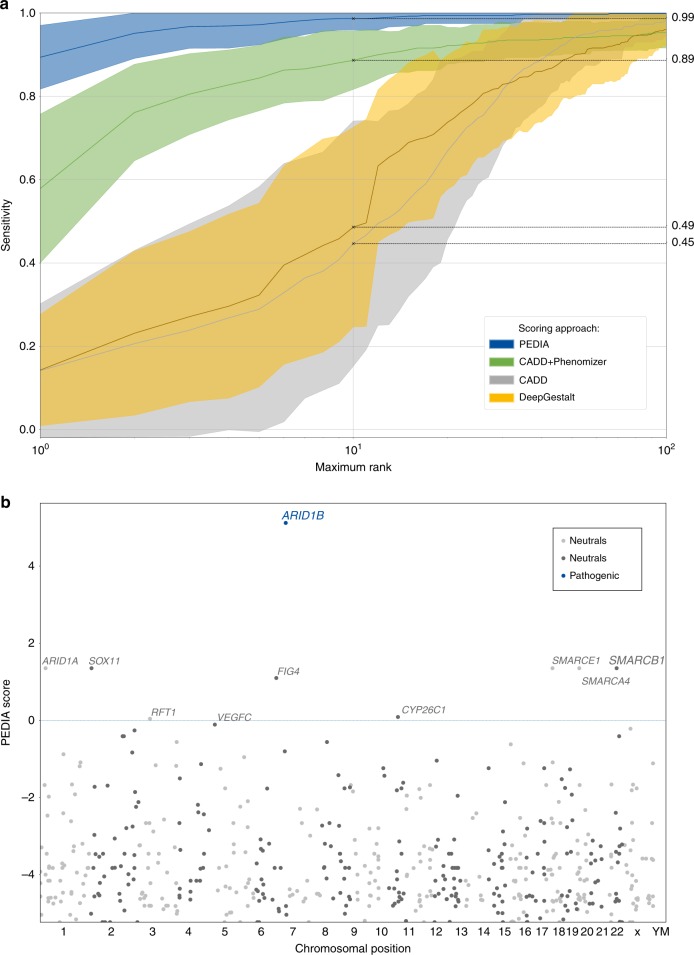
Performance readout and visualization of test results for a representative prioritization of exome data by image analysis (PEDIA) case. (a) For each case the exome variants are ordered according to four different scoring approaches, solely by a molecular deleteriousness score (CADD), by a score from image analysis (DeepGestalt), by a combination of a molecular deleteriousness score and a clinical feature–based semantic similarity score (CADD+Phenomizer), or the PEDIA score that includes all three levels of evidence. The sensitivity of the prioritization approach depends on the number of genes that are considered in an ordered list. The top 1 and top 10 accuracy rates correspond to the intersection of the curves at maximum rank 1 and 10. Note that for benchmarking DeepGestalt on the gene level, syndrome similarity scores first have to be mapped to the gene level, resulting in a lower performance compared with the readout on a phenotype level, due to heterogeneity. The area under the curve is largest for PEDIA scoring. (b) The disease-causing gene of the case depicted in Fig. 1 achieves the highest PEDIA score and molecularly confirms the diagnosis of Coffin–Siris syndrome. Other genes associated with similar phenotypes, such as Nicolaides–Baraitser syndrome, also achieved high scores for gestalt but not for variant deleteriousness.

References

    1. Biesecker LG, Green RC. Diagnostic clinical genome and exome sequencing. N Engl J Med. 2014;371:1170. doi: 10.1056/NEJMc1409040. - DOI - PubMed
    1. Pengelly RJ, et al. Evaluating phenotype-driven approaches for genetic diagnoses from exomes in a clinical setting. Sci Rep. 2017;7:13509. doi: 10.1038/s41598-017-13841-y. - DOI - PMC - PubMed
    1. Robinson PN, et al. The Human Phenotype Ontology: a tool for annotating and analyzing human hereditary disease. Am J Hum Genet. 2008;83:610–615. doi: 10.1016/j.ajhg.2008.09.017. - DOI - PMC - PubMed
    1. Ferry Q, et al. Diagnostically relevant facial gestalt information from ordinary photos. eLife. 2014;3:e02020. doi: 10.7554/eLife.02020. - DOI - PMC - PubMed
    1. Gurovich Y, et al. DeepGestalt—identifying rare genetic syndromes using deep learning. Nat Med. 2019;25:60–64. doi: 10.1038/s41591-018-0279-0. - DOI - PubMed

Publication types