. 2019 May 21:7:348.
doi: 10.3389/fchem.2019.00348. eCollection 2019.

A Fast Transient Absorption Study of Co(AcAc)3

Affiliations

A Fast Transient Absorption Study of Co(AcAc)3

Luisa Ferrari et al. Front Chem. .

Abstract

The study of transition metal coordination complexes has played a key role in establishing quantum chemistry concepts such as that of ligand field theory. Furthermore, the study of the dynamics of their excited states is of primary importance in determining the de-excitation path of electrons to tailor the electronic properties required for important technological applications. This work focuses on femtosecond transient absorption spectroscopy of Cobalt tris(acetylacetonate) (Co(AcAc)3) in solution. The fast transient absorption spectroscopy has been employed to study the excited state dynamics after optical excitation. Density functional theory coupled with the polarizable continuum model has been used to characterize the geometries and the electronic states of the solvated ion. The excited states have been calculated using the time dependent density functional theory formalism. The time resolved dynamics of the ligand to metal charge transfer excitation revealed a biphasic behavior with an ultrafast rise time of 0.07 ± 0.04 ps and a decay time of 1.5 ± 0.3 ps, while the ligand field excitations dynamics is characterized by a rise time of 0.07 ± 0.04 ps and a decay time of 1.8 ± 0.3 ps. Time dependent density functional theory calculations of the spin-orbit coupling suggest that the ultrafast rise time can be related to the intersystem crossing from the originally photoexcited state. The picosecond decay is faster than that of similar cobalt coordination complexes and is mainly assigned to internal conversion within the triplet state manifold. The lack of detectable long living states (>5 ps) suggests that non-radiative decay plays an important role in the dynamics of these molecules.

Keywords: TDDFT (time-dependent density functional theory) calculations; charge - transfer; fast transient absorption; femtosecand laser pulses; metal complexes.


Figures
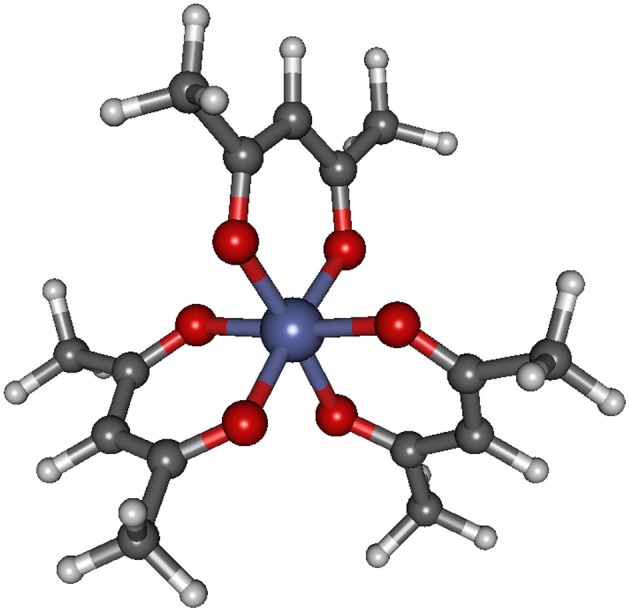
Figure 1
Figure 1
Geometrical structure of Co(AcAc)3. Bond lengths and angles are reported in Table 1 for the singlet, triplet and quintet ground state minimum energy for both gas phase and ACN solvent.
Figure 2
Figure 2
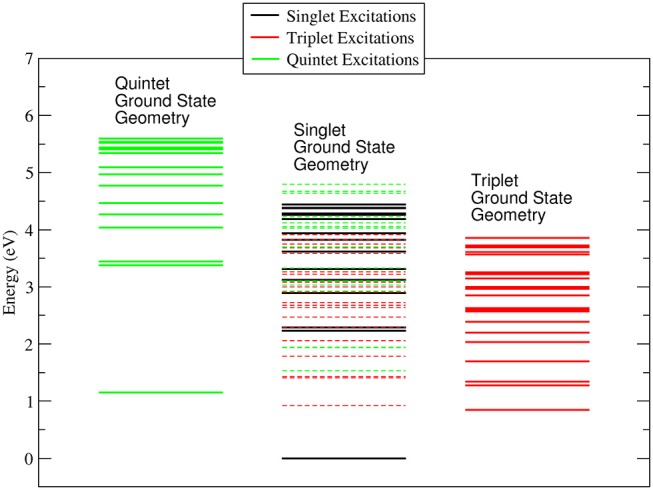
Energy levels calculated for the singlet, triplet and quintet spin configuration of Co(AcAc)3 in the gas phase. In continuous lines are reported the energy levels calculated at the minimum energy geometry of each ground state. In dashed lines are indicated the triplet and quintet excited energy levels evaluated at the geometry of the singlet ground state minimum energy.
Figure 3
Figure 3
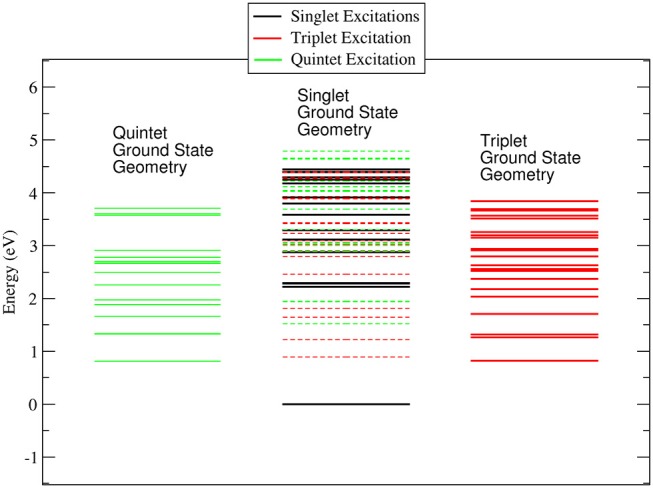
Energy levels calculated for the singlet, triplet and quintet spin configuration of Co(AcAc)3 in ACN solvent. In continuous lines are reported the energy levels calculated at the minimum energy geometry of each ground state. In dashed lines are indicated the triplet and quintet excited energy levels evaluated at the geometry of the singlet ground state minimum energy.
Figure 4
Figure 4
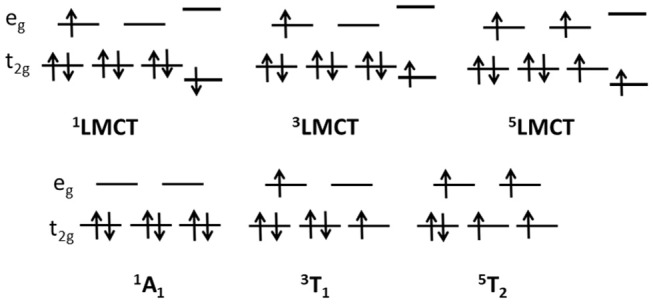
Schematic diagram of one electron excited states for a d6 orbital configuration in an octahedral field (lower row) and LMCT states with the transfer of one electron from the ligand to the metal states (upper row).
Figure 5
Figure 5
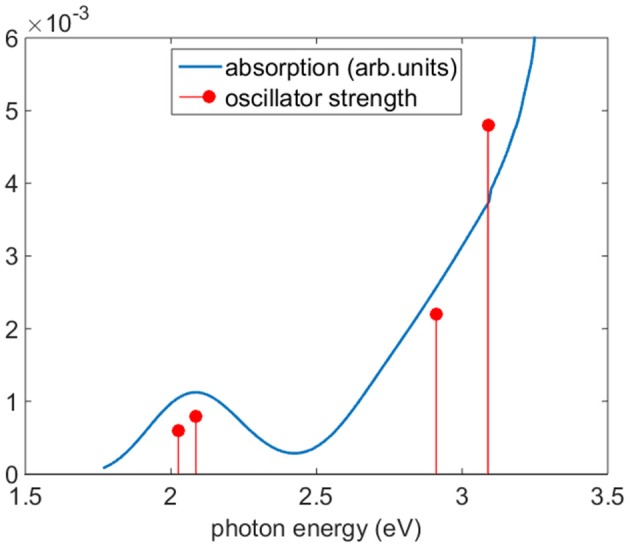
Experimental absorption (blue line) of Co(AcAc)3 and oscillator strengths (red circles). The calculated excitation energies have been shifted of −0.2 eV to improve the accord with experimental data. The oscillator strengths of quasi-degenerate states have been summed.
Figure 6
Figure 6
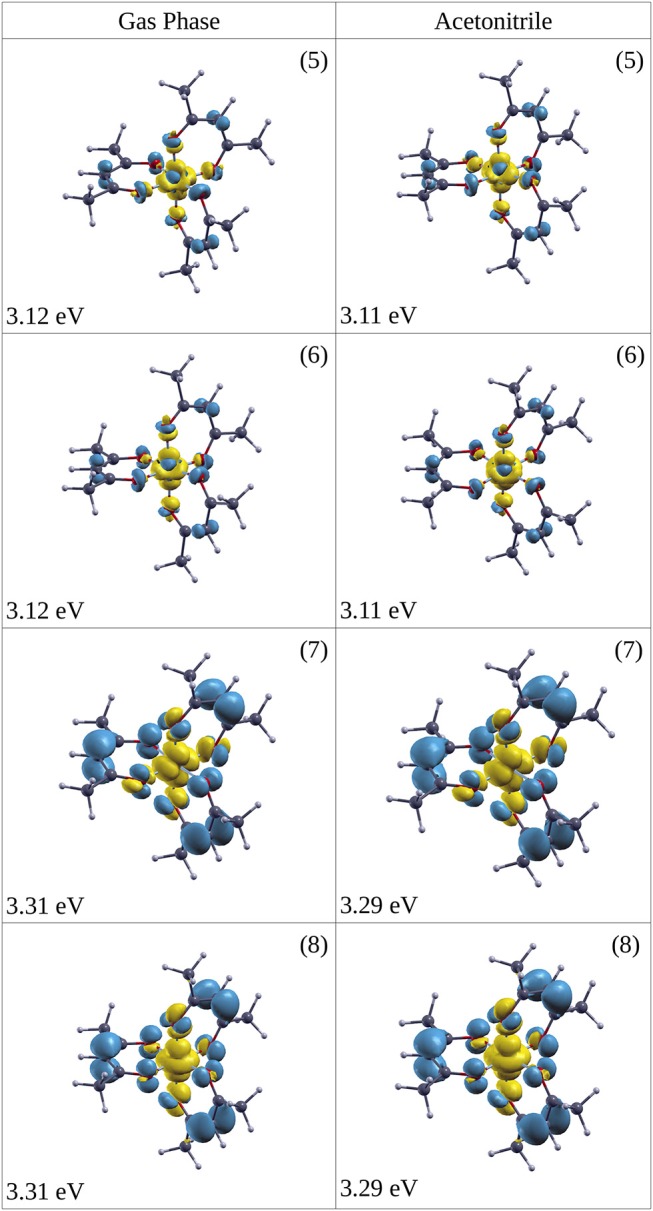
Iso-surface of the change in electron densities upon vertical transitions of optically excited states (singlet) for Co(AcAc)3 in the gas phase (left side) and ACN solvent (right side). In yellow the positive value iso-surface are represented, while with the blue are indicated the negative value ones. The iso-surface threshold is fixed to 0.0025 a.u. The energy of the excitation and the numeric label of the state (see Table 2) are reported.
Figure 7
Figure 7
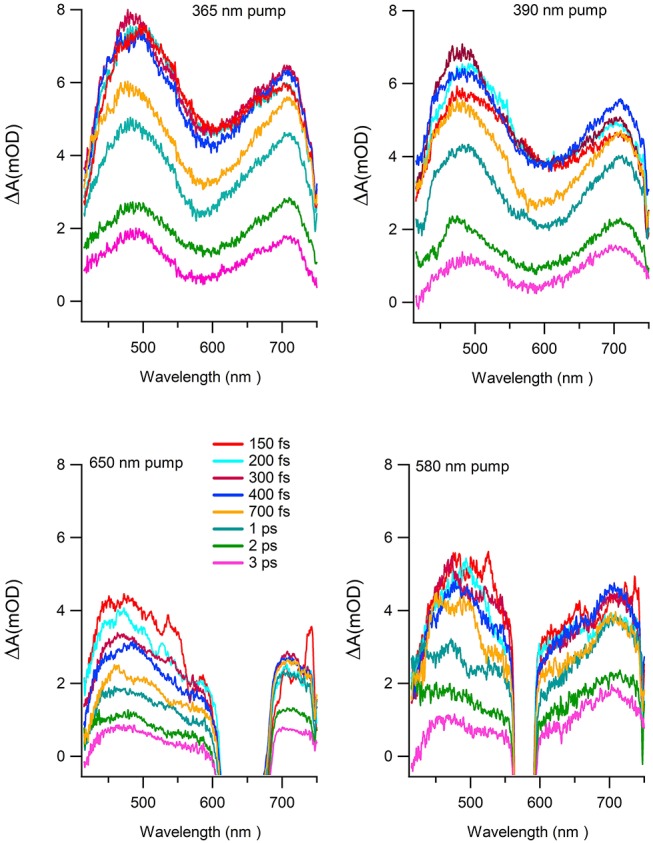
TA spectra as a function of wavelength at different delay times for the following excitation wavelength: 365 nm (upper left panel), 390 nm (upper right panel), 650 nm (lower left panel), 580 nm (lower right panel).
Figure 8
Figure 8
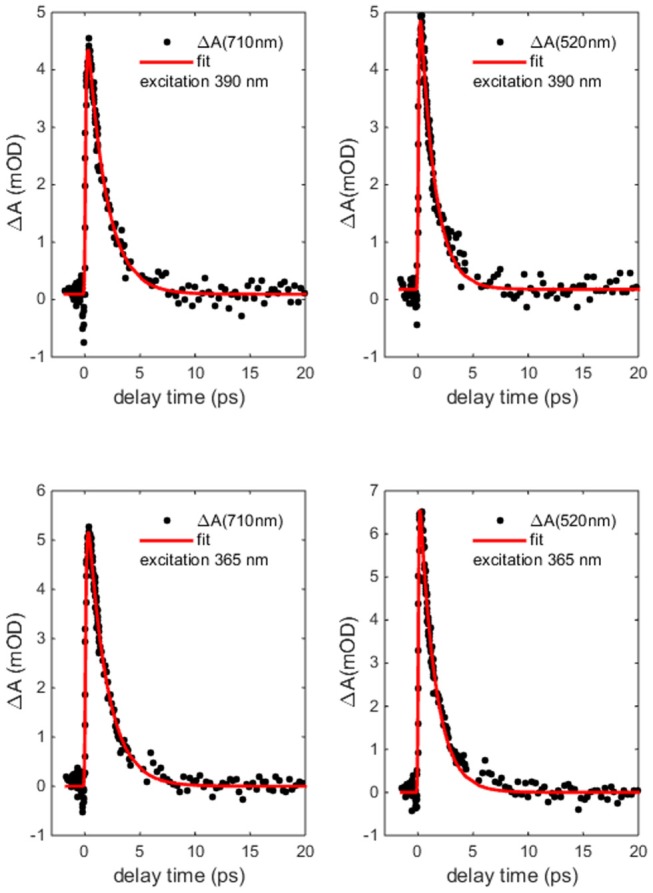
Co(AcAc)3 transient absorption (ΔA) dynamics at probe wavelength 520 and 710 nm as a function of delay time after 365 and 390 nm excitation (points) together with the biphasic exponential fit (solid line).
Figure 9
Figure 9
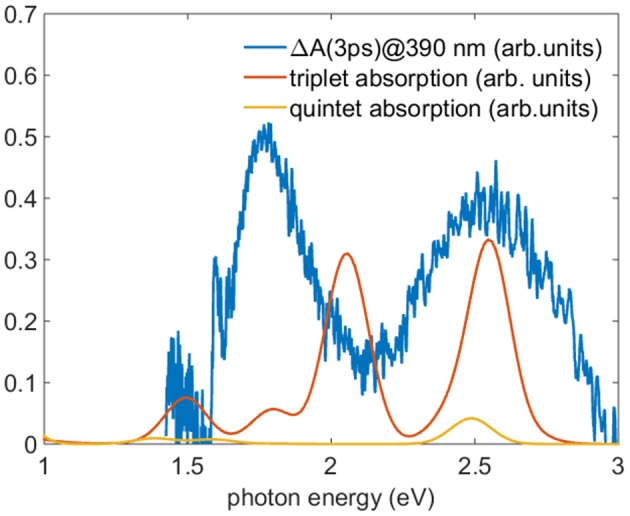
Comparison between the TA spectrum acquired 3 ps after the 390 nm excitation (blue line) and the TDDFT calculated absorption in acetonitrile of the lowest level of the triplet (red line) and quintet (yellow line). To reproduce the absorption the oscillator strength were convoluted with a gaussian function with standard deviation of 100 meV and the energy of the theoretical calculation shifted of 300 meV toward lower energy.
Figure 10
Figure 10
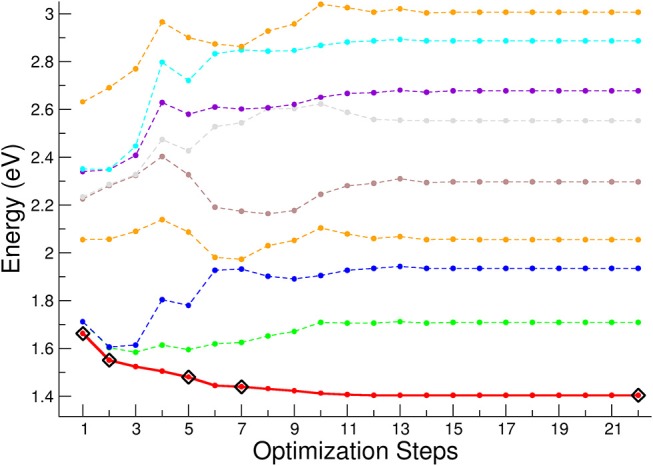
First singlet electronic excited state optimization. The energy is referred to the equilibrium geometry of the electronic ground state. The black rhombuses indicate the geometries where the spin-orbit coupling and ISC lifetimes have been calculated. In red thick line is reported the first singlet excited state, whereas with dashed lines are reported the lowest eight singlet electronic excited states.
Figure 11
Figure 11
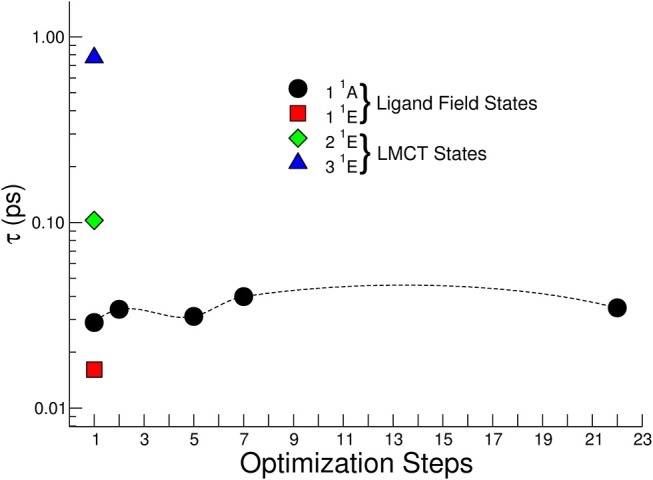
Non-radiative lifetimes for singlet-triplet intersystem crossing for several excited electronic states calculated at the geometry of the vertical transition (optimization step 1). For the 1 1A state the dependence of ISC lifetimes on the optimization geometry steps is reported.
Figure 12
Figure 12
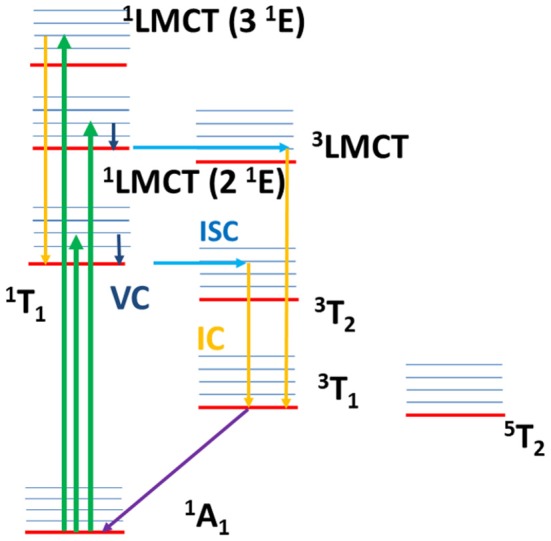
Jablonski diagram with the sketch of the excited state dynamics. The arrows explain qualitatively the dynamics: absorption transitions (green arrows), internal conversion (yellow arrows), intersystem crossing (light blue arrows), vibrational cooling (dark blue arrows), non-radiative decay toward the ground state (violet arrow). After ligand field excitation (1T1), VC and ISC occur with an overall lifetime 0.07 ± 0.04 ps and, successively, IC toward the lower triplet state and relaxation toward the ground state with a lifetime 1.8 ± 0.3 ps. The same dynamics is proposed for the 1LMCT (2 1E) excitation, with VC and ISC (1LMCT → 3LMCT) overall lifetime 0.08 ± 0.04 ps, and IC and non-radiative relaxation overall lifetime 1.5 ± 0.3 ps. For 1LMCT (3 1E) excitation the calculations assign an ISC lifetime about 1 ps, slower than the experimental rise time 0.07 ± 0.04 ps. A fast IC toward the first singlet excited state and a fast singlet-triplet ISC is suggested to be associated with the fast experimental lifetime. The decay toward the ground state is sketched by IC within the triplet states and non-radiative decay with lifetime 1.5 ± 0.3 ps.

References

    1. ADF (2018). SCM, Theoretical Chemistry, eds Baerends E. J., Ziegler T., Atkins A. J., Autschbach J., Baseggio O., Bashford D., et al. (Amsterdam: Vrije Universiteit; ). Available online at: http://www.scm.com
    1. Barone V., Cimino P., Stendardo E. (2008). Development and validation of the B3LYP/N07D computational model for structural parameter and magnetic tensors of large free radicals. J. Chem. Theory Comput. 4, 751–764. 10.1021/ct800034c - DOI - PubMed
    1. Bauernschmitt R., Ahlrichs R. (1996). Treatment of electronic excitations within the adiabatic approximation of time dependent density functional theory. Chem. Phys. Lett. 256, 454–464. 10.1016/0009-2614(96)00440-X - DOI
    1. Becke A. D. (1993). Density-functional thermochemistry. III. The role of exact exchange. J. Chem. Phys. 98, 5648–5652. 10.1063/1.464913 - DOI
    1. Bhasikuttan A. C., Suzuki M., Nakashima S., Okada T. (2002). Ultrafast fluorescence detection in tris(2,2'-bipyridine)ruthenium(II) complex in solution: Relaxation dynamics involving higher excited states. J. Am. Chem. Soc. 124, 8398–8405. 10.1021/ja026135h - DOI - PubMed