


Trends in the incidence of testing for vitamin D deficiency in primary care in the UK: a retrospective analysis of The Health Improvement Network (THIN), 2005-2015
- PMID: 31167871
- PMCID: PMC6561453
- DOI: 10.1136/bmjopen-2018-028355
Trends in the incidence of testing for vitamin D deficiency in primary care in the UK: a retrospective analysis of The Health Improvement Network (THIN), 2005-2015
Abstract
Objective: To investigate trends in the incidence of testing for vitamin D deficiency and the prevalence of patients with circulating concentrations of 25-hydroxyvitamin D (25(OH)D) indicative of deficiency (<30 nmol/L) between 2005 and 2015.
Design: Longitudinal analysis of electronic health records in The Health Improvement Network primary care database.
Setting: UK primary care.
Intervention: None.
Participants: The analysis included 6 416 709 participants aged 18 years and older.
Primary outcomes: Incidence of having a blood test for vitamin D deficiency between 2005 and 2015, the prevalence with blood 25(OH)D <30 nmol/L and the effects of age, ethnicity and socioeconomic status on these measures were assessed.
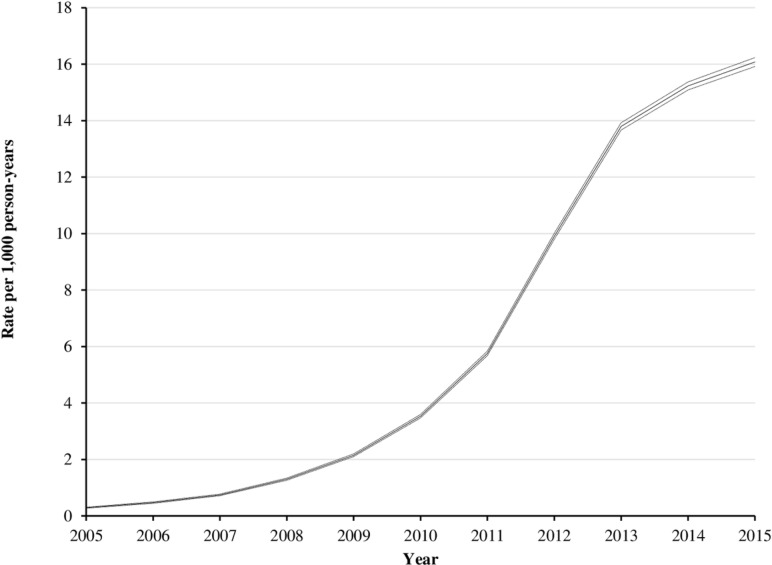
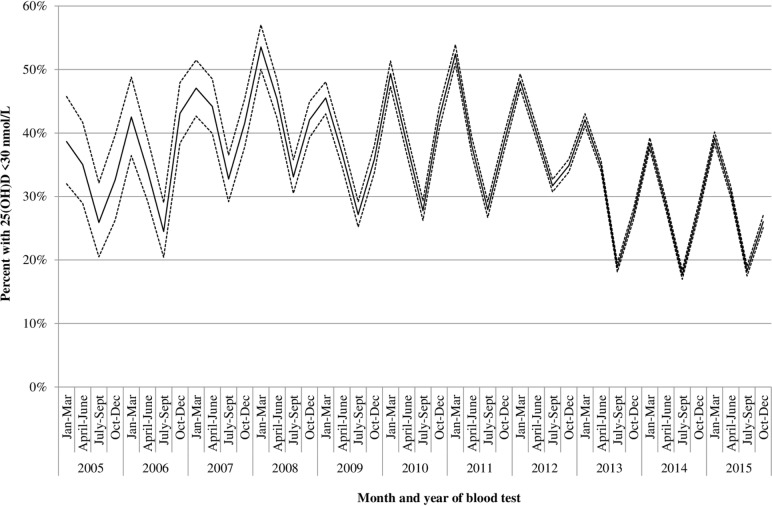
Results: After a mean follow-up time of 5.4 (SD 3.7) years, there were 210 502 patients tested for vitamin D deficiency. The incidence of vitamin D testing rose from 0.29 per 1000 person-years at risk (PYAR) (95% CI 0.27 to 0.31) in 2005 to 16.1 per 1000 PYAR (95% CI 15.9 to 16.2) in 2015. Being female, older, non-white ethnicity and more economically deprived were all strongly associated with being tested. One-third (n=69 515) had 25(OH)D <30 nmol/L, but the per cent deficient among ethnic minority groups ranged from 43% among mixed ethnicity to 66% in Asians. Being male, younger and more economically deprived were also all associated with vitamin D deficiency (p<0.001).
Conclusions: Testing for vitamin D deficiency increased over the past decade among adults in the UK. One-third of UK adults who had a vitamin D test performed in primary care were vitamin D deficient, and deficiency was much higher among ethnic minority patients. Future research should focus on strategies to ensure population intake of vitamin D, particularly in at-risk groups, meets recommendations to reduce the risk of deficiency and need for testing.
Keywords: 25-hydroxyvitamin D; deficiency; primary care; the health improvement network; vitamin D.
© Author(s) (or their employer(s)) 2019. Re-use permitted under CC BY-NC. No commercial re-use. See rights and permissions. Published by BMJ.
Conflict of interest statement
Competing interests: None declared.
Figures
References
-
- Bates B, Lennox A, Prentice A, et al. National diet and nutrition survey results from years 5 and 6 (combined) of the Rolling Programme (2012/2013 – 2013/14). London: Department of Health, 2016.
MeSH terms
LinkOut - more resources
Full Text Sources
Medical
Miscellaneous
