


The genomic basis of mood instability: identification of 46 loci in 363,705 UK Biobank participants, genetic correlation with psychiatric disorders, and association with gene expression and function
- PMID: 31168069
- PMCID: PMC7116257
- DOI: 10.1038/s41380-019-0439-8
The genomic basis of mood instability: identification of 46 loci in 363,705 UK Biobank participants, genetic correlation with psychiatric disorders, and association with gene expression and function
Erratum in
-
Correction: The genomic basis of mood instability: identification of 46 loci in 363,705 UK Biobank participants, genetic correlation with psychiatric disorders, and association with gene expression and function.Mol Psychiatry. 2020 Nov;25(11):3107. doi: 10.1038/s41380-019-0466-5. Mol Psychiatry. 2020. PMID: 31363164 Free PMC article.
Abstract
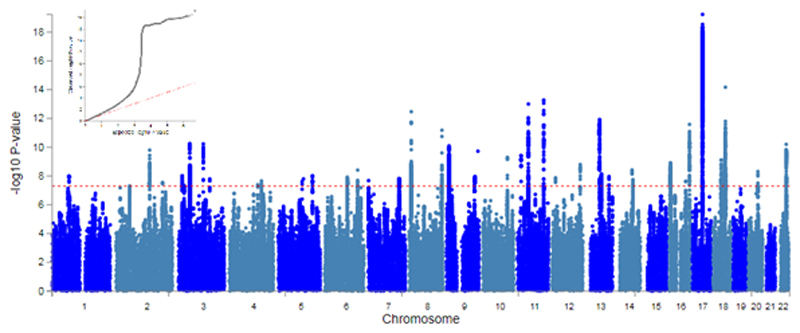
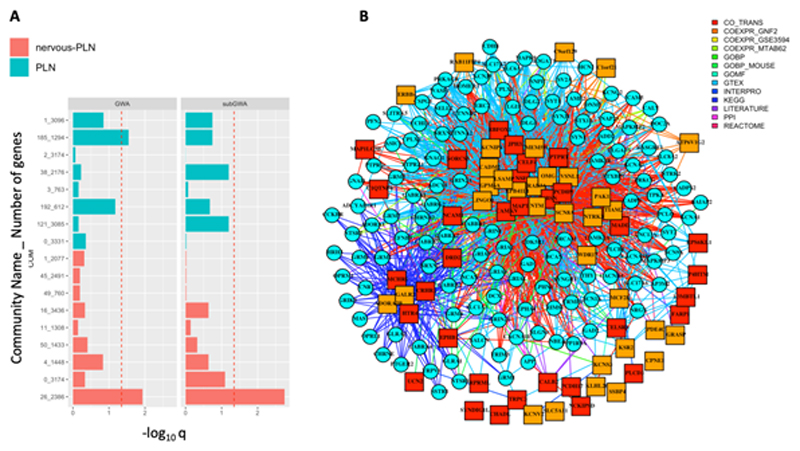
Genome-wide association studies (GWAS) of psychiatric phenotypes have tended to focus on categorical diagnoses, but to understand the biology of mental illness it may be more useful to study traits which cut across traditional boundaries. Here, we report the results of a GWAS of mood instability as a trait in a large population cohort (UK Biobank, n = 363,705). We also assess the clinical and biological relevance of the findings, including whether genetic associations show enrichment for nervous system pathways. Forty six unique loci associated with mood instability were identified with a SNP heritability estimate of 9%. Linkage Disequilibrium Score Regression (LDSR) analyses identified genetic correlations with Major Depressive Disorder (MDD), Bipolar Disorder (BD), Schizophrenia, anxiety, and Post Traumatic Stress Disorder (PTSD). Gene-level and gene set analyses identified 244 significant genes and 6 enriched gene sets. Tissue expression analysis of the SNP-level data found enrichment in multiple brain regions, and eQTL analyses highlighted an inversion on chromosome 17 plus two brain-specific eQTLs. In addition, we used a Phenotype Linkage Network (PLN) analysis and community analysis to assess for enrichment of nervous system gene sets using mouse orthologue databases. The PLN analysis found enrichment in nervous system PLNs for a community containing serotonin and melatonin receptors. In summary, this work has identified novel loci, tissues and gene sets contributing to mood instability. These findings may be relevant for the identification of novel trans-diagnostic drug targets and could help to inform future stratified medicine innovations in mental health.
Conflict of interest statement
The authors have no conflicts of interest to declare.
Figures
References
-
- Marwaha S, He Z, Broome M, Singh SP, Scott J, Eyden J, et al. How is affective instability defined and measured? A systematic review. Psychol Med. 2014;44(9):1793–1808. - PubMed
-
- Ward J, Strawbridge RJ, Bailey MES, Graham N, Ferguson A, Lyall DM, et al. Genome-wide analysis in UK Biobank identifies four loci associated with mood instability and genetic correlation with major depressive disorder, anxiety disorder and schizophrenia. Translational Psychiatry. 2017;7(11) 1264. - PMC - PubMed
Publication types
MeSH terms
Grants and funding
- MR/K501335/1/MRC_/Medical Research Council/United Kingdom
- R37 MH057881/MH/NIMH NIH HHS/United States
- R01 MH075916/MH/NIMH NIH HHS/United States
- DH_/Department of Health/United Kingdom
- MR/S003061/1/MRC_/Medical Research Council/United Kingdom
- P50 MH084053/MH/NIMH NIH HHS/United States
- MC_PC_17217/MRC_/Medical Research Council/United Kingdom
- WT_/Wellcome Trust/United Kingdom
- R01 MH080405/MH/NIMH NIH HHS/United States
- R01 MH085542/MH/NIMH NIH HHS/United States
- R01 MH097276/MH/NIMH NIH HHS/United States
- P01 AG002219/AG/NIA NIH HHS/United States
- R01 MH093725/MH/NIMH NIH HHS/United States
- P50 AG005138/AG/NIA NIH HHS/United States
- P50 MH066392/MH/NIMH NIH HHS/United States
- MR/L023784/2/MRC_/Medical Research Council/United Kingdom
- MR/L010305/1/MRC_/Medical Research Council/United Kingdom
LinkOut - more resources
Full Text Sources
Medical
