. 2019 Jun 6;14(6):e0217626.
doi: 10.1371/journal.pone.0217626. eCollection 2019.

Different mechanisms of serum complement activation in the plasma of common (Chelydra serpentina) and alligator (Macrochelys temminckii) snapping turtles

Affiliations

Different mechanisms of serum complement activation in the plasma of common (Chelydra serpentina) and alligator (Macrochelys temminckii) snapping turtles

Sarah Baker et al. PLoS One. .

Erratum in

Abstract

Reptiles are declining worldwide yet our understanding of their immune function lags far behind other taxa. The innate immune system is the primary mode of defense in reptiles, and the serum complement cascade is its major component. We assessed serum complement activity of plasma in two closely related aquatic turtle species, the common snapping turtle (CST; Chelydra serpentina) and alligator snapping turtle (AST; Macrochelys temminckii). We used a sheep red blood cell (SRBC) hemolysis assay to assess serum complement activity. Although the antibacterial activities of the plasma of these turtle species are similar, the hemolytic activity was much stronger in CST than AST. Treatment with inhibitors of the serum complement cascade indicated differences in the mechanisms of complement activation between the turtle species. We subjected plasma from both turtle species to mannan affinity chromatography and analyzed the eluate with SDS-PAGE, which revealed that plasma from the CSTs contained only small amounts of one C-type lectin protein while the AST plasma contained high concentrations of two C-type lectins (31.0 and 35.9 kDa). Edman degradation analyses confirmed that the two AST proteins contained identical N-terminal sequences. Thus, the CST appears to rely more heavily on the alternative mechanism of serum complement activation, while the AST appears to rely more on the lectin-mediated pathway, which is a pattern recognition response to prokaryotes not activated by the SRBCs. These results are unique in that the use of serum complement pathways are generally assumed to be conserved within clades.


Conflict of interest statement

The authors have declared that no competing interests exist.

Figures
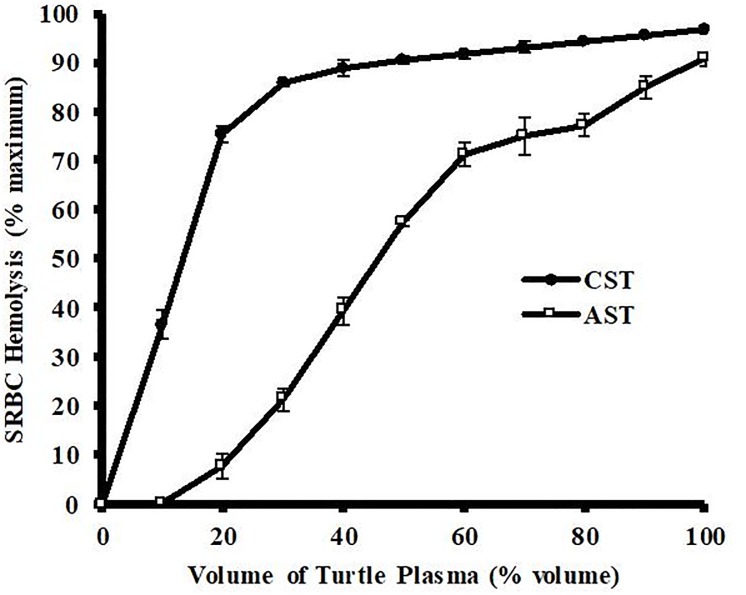
Fig 1
Fig 1. Volume-dependent hemolysis of SRBCS by plasma from Common (CST) and Alligator (AST) Snapping Turtles.
Different volumes of pooled plasma samples derived from ASTs and CSTs diluted in buffer were incubated with 1% SRBCs for 30 min at ambient temperature. Hemolysis activity was determined by spectrophotometry at 540 nm and expressed as % maximum as compared to a complete hemolysis positive control. The data represent the means ± standard deviations for four independent determinations.
Fig 2
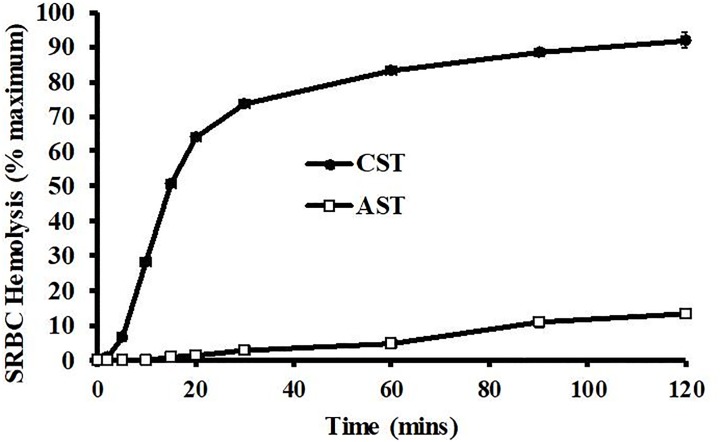
Fig 2. Kinetic analysis of SRBC hemolysis by plasma from Common (CST) and Alligator (AST) Snapping Turtles.
Pooled plasma samples derived from ASTs and CSTs (30% v/v) diluted in unbuffered saline were incubated with 1% SRBCs for different amounts of time. Hemolysis activity was determined by spectrophotometry at 540 nm and expressed as % maximum as compared to a complete hemolysis positive control. The data represent the means ± standard deviations for four independent determinations.
Fig 3
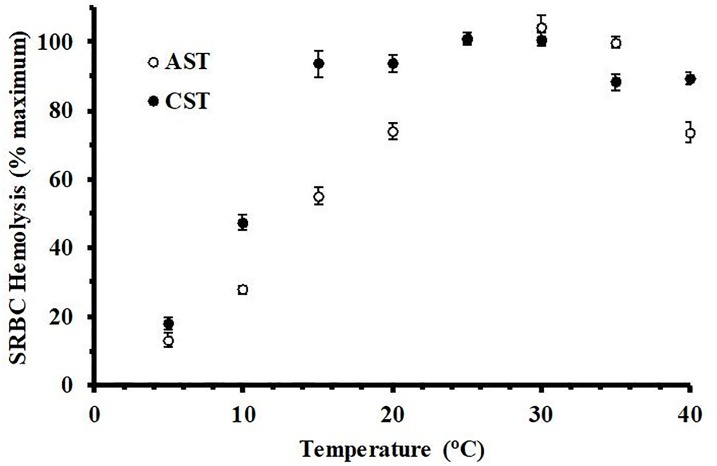
Fig 3. Temperature-dependent hemolysis of SRBCs by plasma from Common and Alligator Snapping Turtles.
Pooled plasma samples derived from ASTs (60%, v/v) and CSTs (20%, v/v) diluted in unbuffered saline were incubated with 1% SRBCs at different temperatures. Hemolysis activity was determined by spectrophotometry at 540 nm and expressed as % maximum as compared to a complete hemolysis positive control. The data represent the means ± standard deviations for four independent determinations. *indicates statistically lower (p ≤ 0.05) than peak values for the respective species.
Fig 4
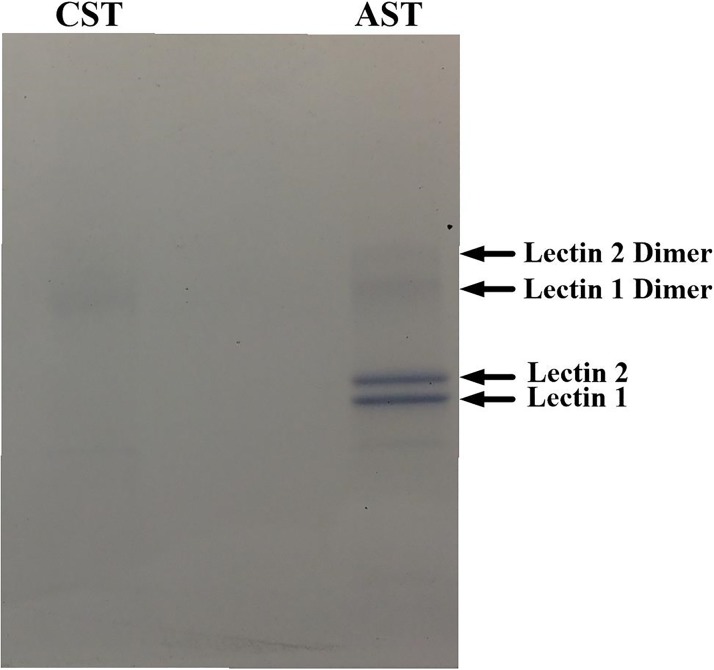
Fig 4. SDS-PAGE analysis of eluates from mannan-agarose affinity column.
Plasma samples (5 mL) from Alligator and Common Snapping Turtles were filtered through a mannan-agarose affinity column in the presence of 20 mM Ca2+. Samples were eluted using EDTA buffer, concentrated and desalted using microcentrifugal concentrators, resolved by SDS PAGE, and stained using Coomassie blue.
Fig 5
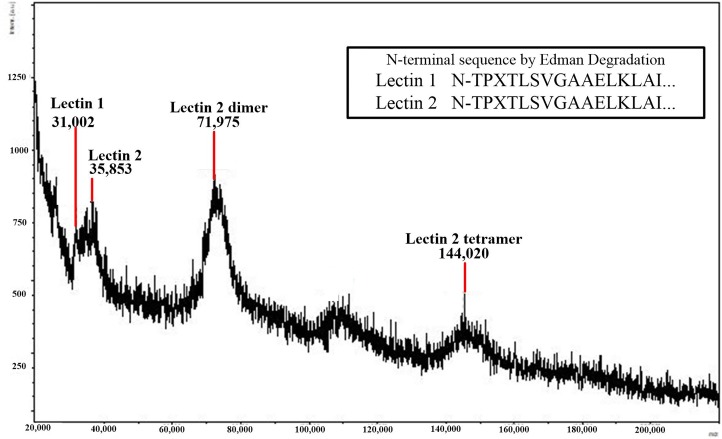
Fig 5. MALDI-TOF analysis of eluates from mannan-agarose affinity column.
Plasma samples (5 mL) from Alligator Snapping Turtles were filtered through a mannan-agarose affinity column in the presence of 20 mM Ca2+. Samples were spotted with sinapinic acid and analyzed in the mass range of 20–200 kDa.

References

    1. Müller-Eberhard H. The membrane attack complex of complement. Ann Rev Immunol. 1986;4:503–528. - PubMed
    1. Ricklin D, Hajishegallis G, Yang K, Lambris JD. Complement: a key component for immune surveillance and homeostasis. Nature Immunol. 2010;11(9):785–797. - PMC - PubMed
    1. Nielsen CH, Fischer EM, Leslie RGQ. The role of complement in the acquired immune response. Immunol. 2000;100(1):4–12. - PMC - PubMed
    1. Porter RR, Reid KBM. Activation of the complement system by antibody-antigen complexes: the classical pathway. Adv Protein Chem. 1979;33:1–71. - PubMed
    1. Law SKA, Dodds AW. The internal thioester and the covalent binding properties of the complement proteins C3 and C4. Prot Sci 1997;6(2):263–4274. - PMC - PubMed

Publication types