


Factors associated with use of injectables, long-acting and permanent contraceptive methods (iLAPMs) among married women in Zambia: analysis of demographic and health surveys, 1992-2014
- PMID: 31171007
- PMCID: PMC6555706
- DOI: 10.1186/s12978-019-0741-6
Factors associated with use of injectables, long-acting and permanent contraceptive methods (iLAPMs) among married women in Zambia: analysis of demographic and health surveys, 1992-2014
Abstract
Background: Zambia, with its women having five children on average, is one of the countries in sub-Saharan African with the highest fertility rates. As the country works on expanding its reproductive health programs, this analysis sought to understand factors behind the current utilisation of injectable, long acting and permanent methods (iLAPMs) of contraception.
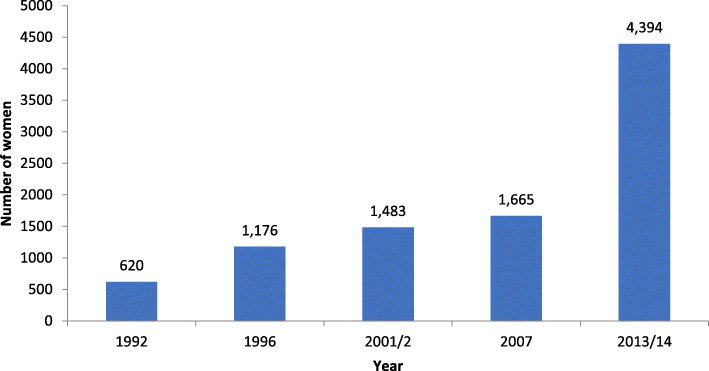
Methods: Cross-sectional secondary data drawn from the Zambia Demographic and Health Surveys (ZDHS) were used. This included married women aged 15-49 for the years 1992 (n = 620), 1996 (n = 1176), 2001/02 (n = 1483), 2007 (n = 1665) and 2013/14 (n = 4394). Frequencies, cross-tabulations and logistic regression were used to analyse levels and differentials in use of iLAPMs.
Results: Except for the variables "religion" and "region", the rest of the independent variables show significance on the use of iLAPMs, at varying levels. "Desire for children" is the strongest predictor of use of iLAPMs as it was significant at all the five data points. This is followed by "age", although it was not significant in 2007. "Education of the woman and partner" and "number of living children" were also significant, but only for two out of the five data collection points. "Ethnicity", "type of residence", "heard about FP in last 12 months", and "main decision maker on woman's health" were only significant for one out of the five data points.
Conclusion: This study has established that women's desire for children is the main factor influencing use of iLAPMs in Zambia. Women who still want to have children are less likely to use iLAPMs even though the odds of using these methods among these women increased between 1992 and 2014. This indicates that most of this increase is due to the desire by these women to space births rather than stop having children. The 2013/2014 data also suggest an increase in access to iLAPMs among the less privileged women i.e. those in rural areas and those with low levels of education. This trend appears to have stemmed from the scaling up of family planning programmes to cover rural communities. Greater effort should be invested into family planning programs that reach all categories of women.
Keywords: Family planning; Modern contraception; Zambia; iLAPMs.
Conflict of interest statement
The authors declare that they have no competing interests.
Figures
References
-
- PRB, 2018 World Population Data Sheet. 2018, Population Reference Bureau (PRB): https://www.prb.org/2018-world-population-data-sheet-with-focus-on-chang....
-
- Shapiro D, Hinde A. On the pace of fertility decline in sub-Saharan Africa. Demogr Res. 2017;37(40):1327–1338. doi: 10.4054/DemRes.2017.37.40. - DOI
-
- Bank, W., Fertility rate, total (births per woman). 2018, The World Bank: https://data.worldbank.org/indicator/SP.DYN.TFRT.IN?locations=ZG.
-
- Institute, G., Adding it up: Investing in Contraception and Maternal and Newborn Health, 2017. Fact Sheet. 2017, Guttmacher Institute: https://www.guttmacher.org/sites/default/files/factsheet/adding-it-up-co....
Publication types
MeSH terms
Substances
LinkOut - more resources
Full Text Sources
Medical
Research Materials
