


The FRAME: an expanded framework for reporting adaptations and modifications to evidence-based interventions
- PMID: 31171014
- PMCID: PMC6554895
- DOI: 10.1186/s13012-019-0898-y
The FRAME: an expanded framework for reporting adaptations and modifications to evidence-based interventions
Abstract
Background: This paper describes the process and results of a refinement of a framework to characterize modifications to interventions. The original version did not fully capture several aspects of modification and adaptation that may be important to document and report. Additionally, the earlier framework did not include a way to differentiate cultural adaptation from adaptations made for other reasons. Reporting additional elements will allow for a more precise understanding of modifications, the process of modifying or adapting, and the relationship between different forms of modification and subsequent health and implementation outcomes.
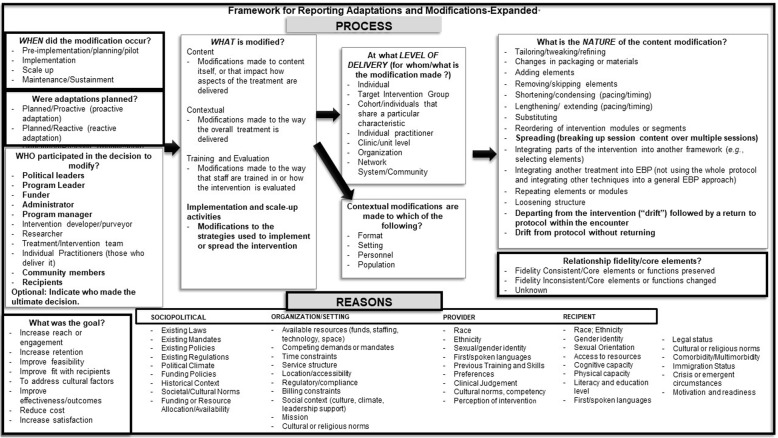
Discussion: We employed a multifaceted approach to develop the updated FRAME involving coding documents identified through a literature review, rapid coding of qualitative interviews, and a refinement process informed by multiple stakeholders. The updated FRAME expands upon Stirman et al.'s original framework by adding components of modification to report: (1) when and how in the implementation process the modification was made, (2) whether the modification was planned/proactive (i.e., an adaptation) or unplanned/reactive, (3) who determined that the modification should be made, (4) what is modified, (5) at what level of delivery the modification is made, (6) type or nature of context or content-level modifications, (7) the extent to which the modification is fidelity-consistent, and (8) the reasons for the modification, including (a) the intent or goal of the modification (e.g., to reduce costs) and (b) contextual factors that influenced the decision. Methods of using the framework to assess modifications are outlined, along with their strengths and weaknesses, and considerations for research to validate these measurement strategies.
Conclusion: The updated FRAME includes consideration of when and how modifications occurred, whether it was planned or unplanned, relationship to fidelity, and reasons and goals for modification. This tool that can be used to support research on the timing, nature, goals and reasons for, and impact of modifications to evidence-based interventions.
Keywords: Adaptation; Cultural adaptation; Implementation outcomes; Modification.
Conflict of interest statement
The authors declare that they have no competing interests.
Figures
References
-
- Cooper BR, Shrestha G, Hyman L, Hill L. Adaptations in a community-based family intervention: replication of two coding schemes. J Primary Prevent. 2016;37(1):33–52. - PubMed
Publication types
MeSH terms
Grants and funding
LinkOut - more resources
Full Text Sources
Medical
Miscellaneous
