


Extended haplodiploidy hypothesis
- PMID: 31171982
- PMCID: PMC6546379
- DOI: 10.1002/evl3.119
Extended haplodiploidy hypothesis
Abstract
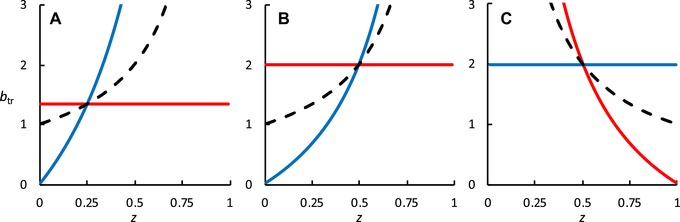
Evolution of altruistic behavior was a hurdle for the logic of Darwinian evolution. Soon after Hamilton formalized the concept of inclusive fitness, which explains how altruism can evolve, he suggested that the high sororal relatedness brought by haplodiploidy could be why Hymenopterans have a high prevalence in eusocial species, and why helpers in Hymenoptera are always female. Later it was noted that in order to capitalize on the high sororal relatedness, helpers would need to direct help toward sisters, and this would bias the population sex ratio. Under a 1:3 males:females sex ratio, the inclusive fitness valuation a female places on her sister, brother, and an own offspring are equal-apparently removing the benefit of helping over independent reproduction. Based on this argumentation, haplodiploidy hypothesis has been considered a red herring. However, here we show that when population sex ratio, cost of altruism, and population growth rate are considered together, haplodiploidy does promote female helping even with female-biased sex ratio, due the lowered cost of altruism in such populations. Our analysis highlights the need to re-evaluate the role of haplodiploidy in the evolution of helping, and the importance of fully exploring the model assumptions when comparing interactions of population sex ratios and social behaviors.
Keywords: Haplodiploidy hypothesis; inclusive fitness; kin selection; reproductive altruism.
Figures

References
-
- Boomsma, J. J. , and Eickwort G. C.. 1993. Colony structure, provisioning and sex allocation in the sweat bee Halictus ligatus (Hymenoptera: Halictidae). Biol. J. Linn. Soc. 48(4):355‐377.
-
- Bourke, A. F. G. , and Franks N. R.. 1995. Social evolution in ants. Princeton Univ. Press, Princeton, NJ.
-
- Bulmer, M. 1994. Theoretical evolutionary ecology. Sinauer Associates, Sunderland, MA.
-
- Charnov, E. L. 1978. Evolution of eusocial behavior: offspring choice or parental parasitism? J. Theor. Biol. 75:451–465. - PubMed
-
- Craig, R. 1979. Parental manipulation, kin selection, and the evolution of altruism. Evolution 33:319. - PubMed
Associated data
LinkOut - more resources
Full Text Sources
Other Literature Sources
