Comparison of Corticosteroids by 3 Approaches to the Treatment of Chronic Rhinosinusitis With Nasal Polyps
- PMID: 31172717
- PMCID: PMC6557780
- DOI: 10.4168/aair.2019.11.4.482
Comparison of Corticosteroids by 3 Approaches to the Treatment of Chronic Rhinosinusitis With Nasal Polyps
Abstract
Purpose: Corticosteroids are regarded as the mainstay of medical treatment of eosinophilic chronic rhinosinusitis with nasal polyps (ECRSwNP). To date, a head-to-head comparison of the efficacy and safety of glucocorticoid preparations administered via different routes for the treatment of chronic rhinosinusitis with nasal polyps has not been reported. To compare the efficacy and safety of steroids administered via the oral, intranasal spray and transnasal nebulization routes in the management of ECRSwNP over a short course.
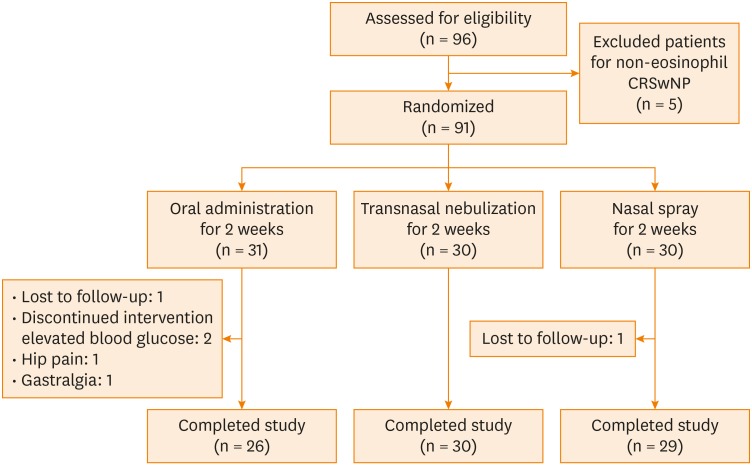
Methods: Overall, 91 patients with ECRSwNP were recruited prospectively and randomized to receive either oral methylprednisolone, budesonide inhalation suspension (BIS) via transnasal nebulization, or budesonide nasal spray (BNS) for 2 weeks. Nasal symptoms and polyp sizes were assessed before and after the treatment. Similarly, nasal polyp samples were evaluated for immunological and tissue remodeling markers. Serum cortisol levels were assessed as a safety outcome.
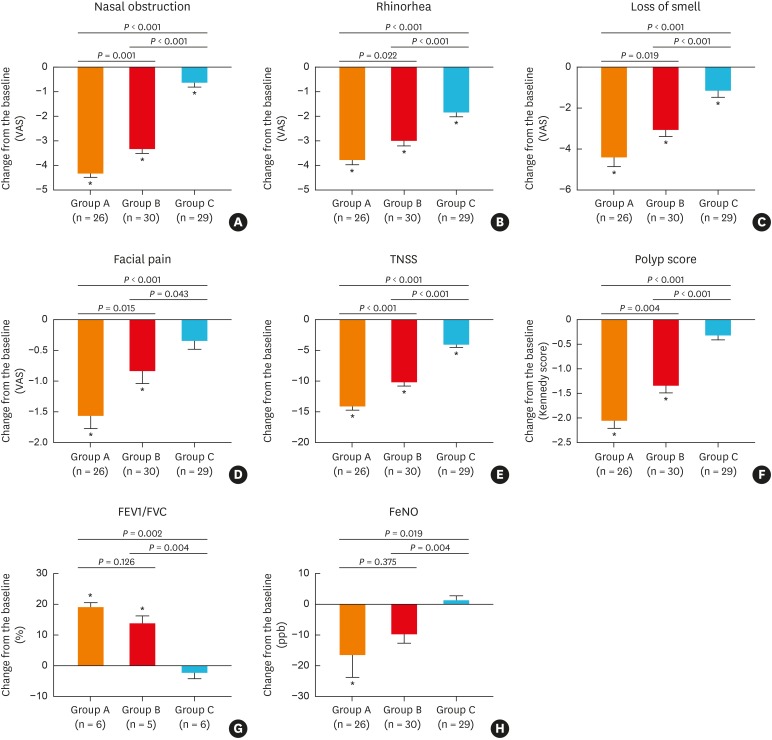
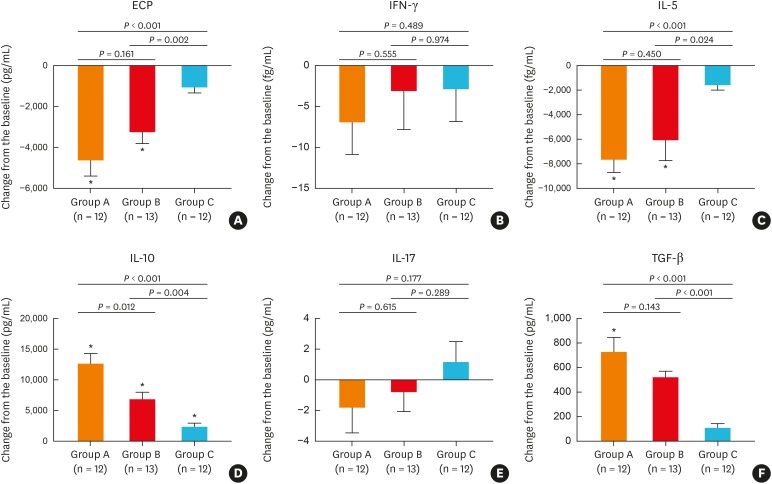
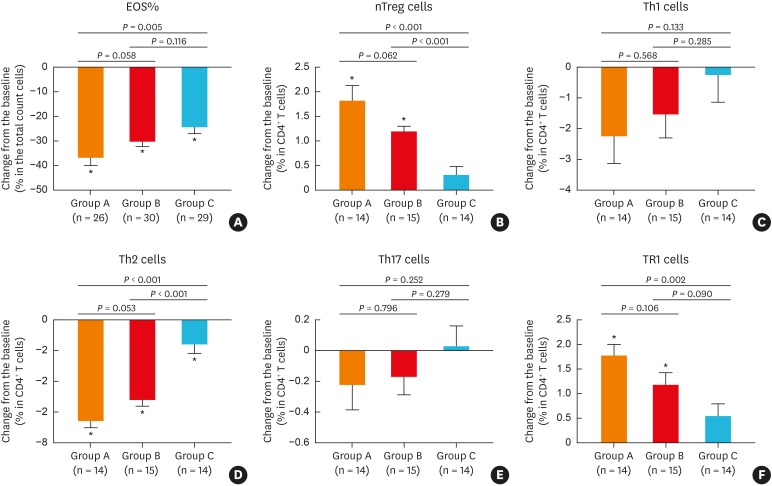
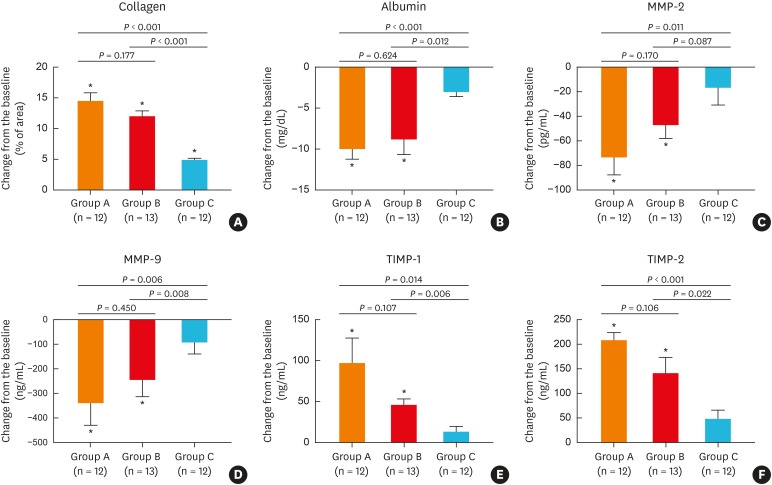
Results: Oral methylprednisolone and BIS decreased symptoms and polyp sizes to a significantly greater extent from baseline (P < 0.05) than BNS. Similarly, BIS and oral methylprednisolone significantly reduced eosinophils, T helper 2 cells, eosinophil cationic protein, interleukin (IL)-5, and expression of matrix metalloproteinases 2 and 9, and significantly increased type 1 regulatory T cells, IL-10, transforming growth factor-β, and tissue inhibitor of metalloproteinases 1 and 2 in nasal polyps to a greater extent than BNS. Post-treatment serum cortisol levels were significantly decreased by oral methylprednisolone compared to BIS or BNS, which did not significantly alter the cortisol levels.
Conclusions: A short course of BIS transnasal nebulization is more efficacious compared to BNS in the management of ECRSwNP and is safer than oral methylprednisolone with respect to hypothalamic-pituitary-adrenal axis function.
Keywords: Chronic rhinosinusitis; glucocorticoids; nasal polyps; nasal spray; transnasal nebulization.
Copyright © 2019 The Korean Academy of Asthma, Allergy and Clinical Immunology · The Korean Academy of Pediatric Allergy and Respiratory Disease.
Conflict of interest statement
There are no financial or other issues that might lead to conflict of interest.
Figures
References
-
- Fokkens WJ, Lund VJ, Mullol J, Bachert C, Alobid I, Baroody F, et al. EPOS 2012: European position paper on rhinosinusitis and nasal polyps 2012. A summary for otorhinolaryngologists. Rhinology. 2012;50:1–12. - PubMed
-
- Small CB, Stryszak P, Danzig M, Damiano A. Onset of symptomatic effect of mometasone furoate nasal spray in the treatment of nasal polyposis. J Allergy Clin Immunol. 2008;121:928–932. - PubMed
-
- Lund VJ, Black JH, Szabó LZ, Schrewelius C, Akerlund A. Efficacy and tolerability of budesonide aqueous nasal spray in chronic rhinosinusitis patients. Rhinology. 2004;42:57–62. - PubMed
-
- Vargas R, Dockhorn RJ, Findlay SR, Korenblat PE, Field EA, Kral KM. Effect of fluticasone propionate aqueous nasal spray versus oral prednisone on the hypothalamic-pituitary-adrenal axis. J Allergy Clin Immunol. 1998;102:191–197. - PubMed
Grants and funding
- 2018YFC0116800/National Key R & D Program of China/China
- 2016YFC20160905200/National Key R & D Program of China/China
- 81630023/NSFC/National Natural Science Foundation of China/China
- 81420108009/NSFC/National Natural Science Foundation of China/China
- 81400444/NSFC/National Natural Science Foundation of China/China
- 81470678/NSFC/National Natural Science Foundation of China/China
- 2016-1-2052/Capital Health Development Foundation/China
- SML20150203/Beijing Municipal Administration of Hospitals' Mission Plan/China
- QML20150202/Beijing Municipal Administration of Hospitals' Youth Programme/China
- 20181045/BTBU/Beijing Technology and Business University/China
LinkOut - more resources
Full Text Sources
Medical
Research Materials
Miscellaneous