


A decade of sustained geographic spread of HIV infections among women in Durban, South Africa
- PMID: 31174475
- PMCID: PMC6555962
- DOI: 10.1186/s12879-019-4080-6
A decade of sustained geographic spread of HIV infections among women in Durban, South Africa
Abstract
Background: Fine scale geospatial analysis of HIV infection patterns can be used to facilitate geographically targeted interventions. Our objective was to use the geospatial technology to map age and time standardized HIV incidence rates over a period of 10 years to identify communities at high risk of HIV in the greater Durban area.
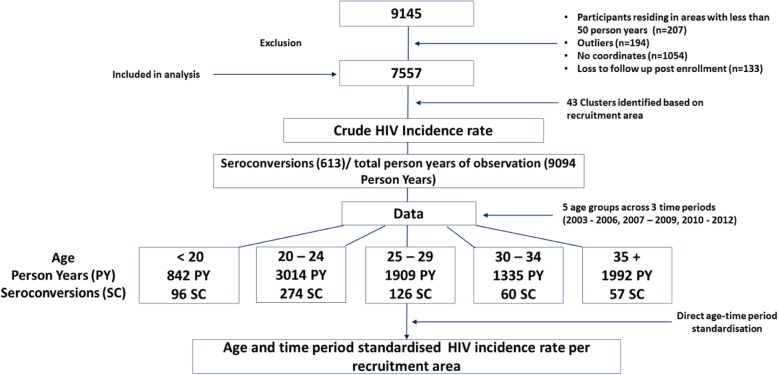
Methods: HIV incidence rates from 7557 South African women enrolled in five community-based HIV prevention trials (2002-2012) were mapped using participant household global positioning system (GPS) coordinates. Age and period standardized HIV incidence rates were calculated for 43 recruitment clusters across greater Durban. Bayesian conditional autoregressive areal spatial regression (CAR) was used to identify significant patterns and clustering of new HIV infections in recruitment communities.
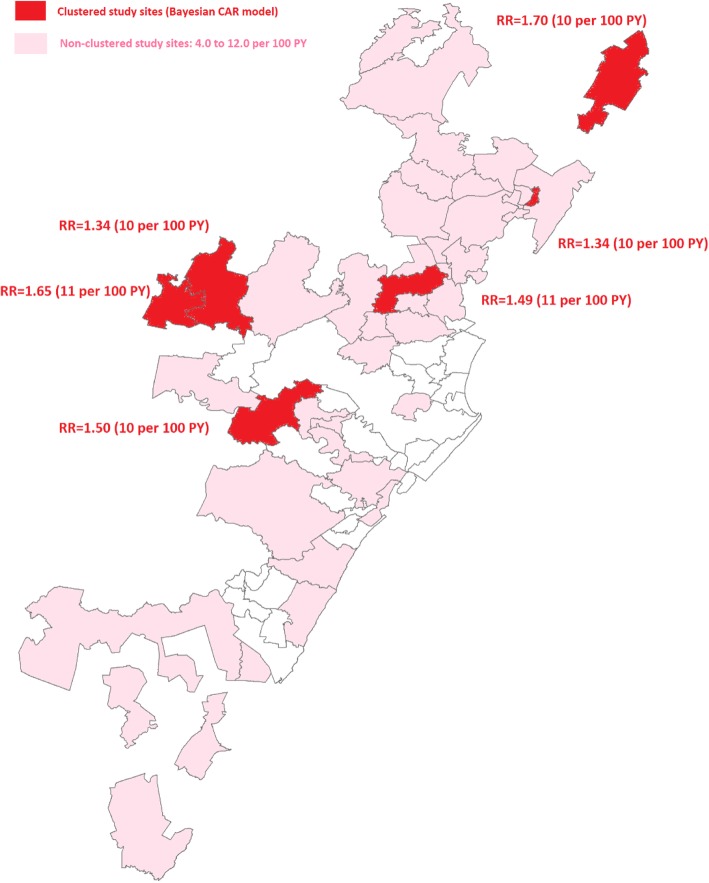
Results: The total person-time in the cohort was 9093.93 years and 613 seroconversions were observed. The overall crude HIV incidence rate across all communities was 6·74 per 100PY (95% CI: 6·22-7·30). 95% of the clusters had HIV incidence rates greater than 3 per 100PY. The CAR analysis identified six communities with significantly high HIV incidence. Estimated relative risks for these clusters ranged from 1.34 to 1.70. Consistent with these results, age standardized HIV incidence rates were also highest in these clusters and estimated to be 10 or more per 100 PY. Compared to women 35+ years old younger women were more likely to reside in the highest incidence areas (aOR: 1·51, 95% CI: 1·06-2·15; aOR: 1.59, 95% CI: 1·19-2·14 and aOR: 1·62, 95% CI: 1·2-2·18 for < 20, 20-24, 25-29 years old respectively). Partnership factors (2+ sex partners and being unmarried/not cohabiting) were also more common in the highest incidence clusters (aOR 1.48, 95% CI: 1.25-1.75 and aOR 1.54, 95% CI: 1.28-1.84 respectively).
Conclusion: Fine geospatial analysis showed a continuous, unrelenting, hyper HIV epidemic in most of the greater Durban region with six communities characterised by particularly high levels of HIV incidence. The results motivate for comprehensive community-based HIV prevention approaches including expanded access to PrEP. In addition, a higher concentration of HIV related services is required in the highest risk communities to effectively reach the most vulnerable populations.
Keywords: HIV; Heterogeneity; Incidence; Mapping; Risk factors; Spatial epidemiology.
Conflict of interest statement
All authors declare that they have no competing interests.
Figures
References
-
- Shisana O, Rehle T, Simbayi L, et al. South African national HIV prevalence, incidence and behaviour survey. Cape Town: HSRC Press; 2012. p. 2014.
-
- HIV/AIDS JUNPo, UNAIDS D. Geneva; 2017. http://www.unaids.org/sites/default/files/media_asset/UNAIDS_FactSheet_e.... Accessed 30 June 2017.
MeSH terms
Grants and funding
LinkOut - more resources
Full Text Sources
Medical
Miscellaneous
