


Does internet-accessed STI (e-STI) testing increase testing uptake for chlamydia and other STIs among a young population who have never tested? Secondary analyses of data from a randomised controlled trial
- PMID: 31175210
- PMCID: PMC6902059
- DOI: 10.1136/sextrans-2019-053992
Does internet-accessed STI (e-STI) testing increase testing uptake for chlamydia and other STIs among a young population who have never tested? Secondary analyses of data from a randomised controlled trial
Abstract
Objectives: To assess the effectiveness of an internet-accessed STI (e-STI) testing and results service on testing uptake among young adults (16-30 years) who have never tested for STIs in London, England.
Methods: We conducted secondary analyses on data from a randomised controlled trial. In the trial, participants were randomly allocated to receive a text message with the web link of an e-STI testing and results service (intervention group) or a text message with the link of a website listing the locations, contact details and websites of seven local sexual health clinics (control group). We analysed a subsample of 528 trial participants who reported never testing for STIs at baseline. Outcomes were self-reported STI testing at 6 weeks, verified by patient record checks, and time from randomisation to completion of an STI test.
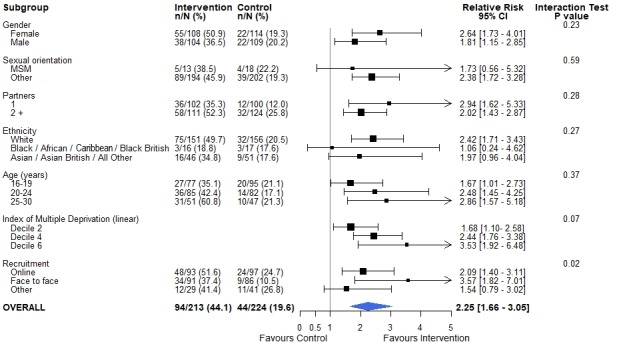
Results: Uptake of STI testing among 'never testers' almost doubled. At 6 weeks, 45.3% of the intervention completed at least one test (chlamydia, gonorrhoea, syphilis and HIV), compared with 24.1% of the control (relative risk [RR] 1.88, 95% CI 1.47 to 2.40, p<0.001). For chlamydia and gonorrhoea testing combined, uptake was 44.3% in the intervention versus 24.1% in controls (RR 1.84, 95% CI 1.44 to 2.36, p<0.001). The intervention reduced time to any STI test (restricted mean survival time: 29.0 days vs 36.3 days, p<0.001) at a time horizon of 42 days. CONCLUSIONS : e-STI testing increased uptake of STI testing and reduced time to test among a young population of 'never testers' recruited in community settings. Although encouraging, questions remain on how best to manage the additional demand generated by e-STI testing in a challenging funding environment. Larger studies are required to assess the effects later in the cascade of care, including STI diagnoses and cases treated.
Keywords: diagnosis; programme evaluation; service delivery; testing.
© Author(s) (or their employer(s)) 2019. Re-use permitted under CC BY-NC. No commercial re-use. See rights and permissions. Published by BMJ.
Conflict of interest statement
Competing interests: EW reports receiving a PhD studentship from Guy’s and St Thomas’ Charity via SH:24 (a not-for-profit community interest company). PB report grants from Guy’s and St Thomas’ charity via SH:24 (a not-for-profit community interest company) during the conduct of the study. CF reports receiving funding for her time from Guy’s and St Thomas’ Charity paid via SH:24 (a not-for-profit community interest company). PB is a director of SH:24 (a not-for-profit community interest company).
Figures
References
-
- Public Health England Sexually transmitted infections and screening for Chlamydia in England, 2017. Available: https://www.gov.uk/government/statistics/sexually-transmitted-infections... [Accessed 03 Jan 2018].
Publication types
MeSH terms
LinkOut - more resources
Full Text Sources
Medical
