


Firefighters' absorption of PAHs and VOCs during controlled residential fires by job assignment and fire attack tactic
- PMID: 31175324
- PMCID: PMC7323473
- DOI: 10.1038/s41370-019-0145-2
Firefighters' absorption of PAHs and VOCs during controlled residential fires by job assignment and fire attack tactic
Abstract
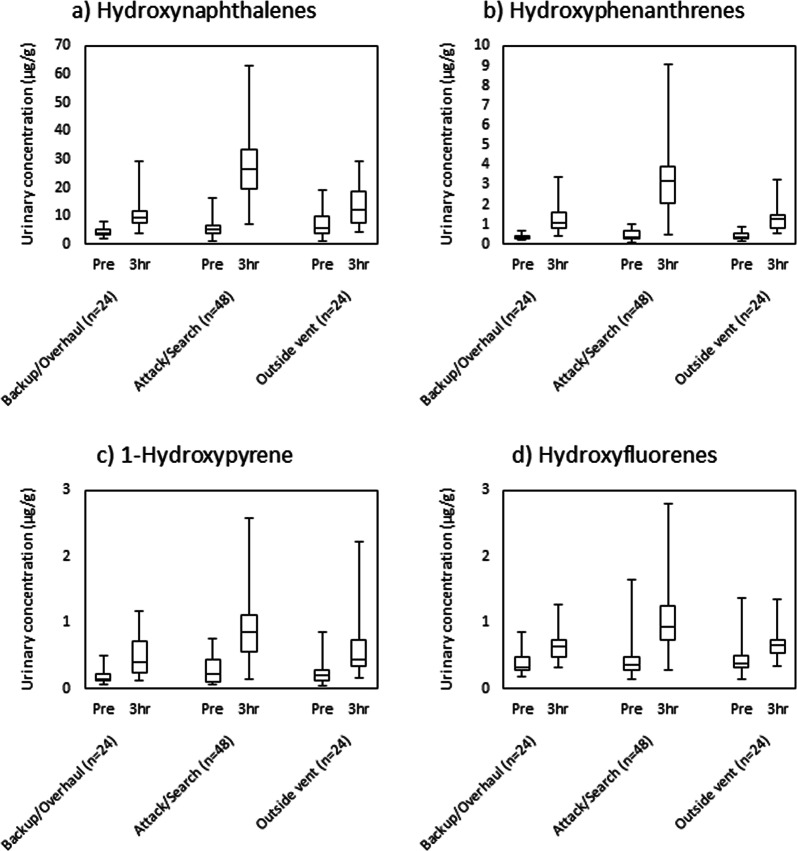
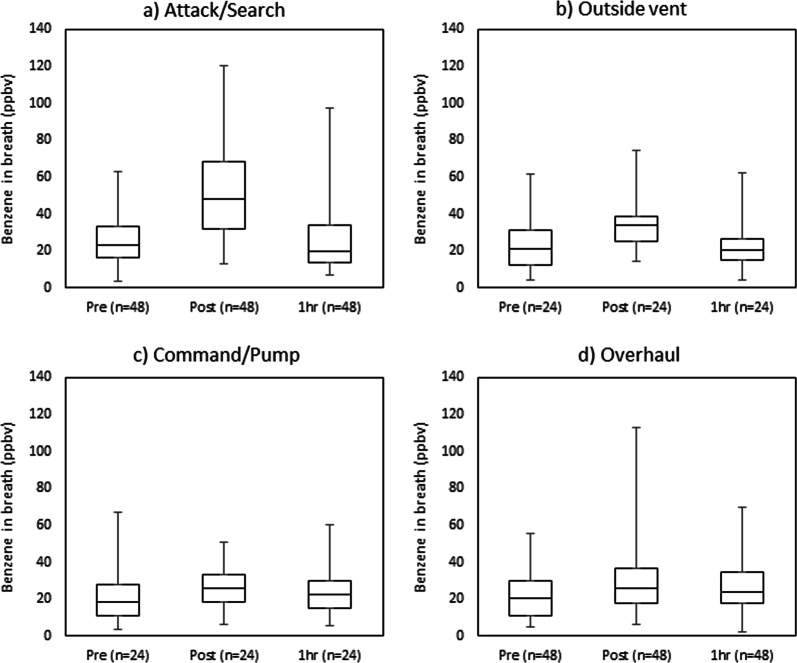
To better understand the absorption of combustion byproducts during firefighting, we performed biological monitoring (breath and urine) on firefighters who responded to controlled residential fires and examined the results by job assignment and fire attack tactic. Urine was analyzed for metabolites of polycyclic aromatic hydrocarbons (PAHs) and breath was analyzed for volatile organic compounds (VOCs) including benzene. Median concentrations of PAH metabolites in urine increased from pre-firefighting to 3-h post firefighting for all job assignments. This change was greatest for firefighters assigned to attack and search with 2.3, 5.6, 3.9, and 1.4-fold median increases in pyrene, phenanthrene, naphthalene, and fluorene metabolites. Median exhaled breath concentrations of benzene increased 2-fold for attack and search firefighters (p < 0.01) and 1.4-fold for outside vent firefighters (p = 0.02). Compared to interior attack, transitional attack resulted in 50% less uptake of pyrene (p = 0.09), 36% less uptake phenanthrene (p = 0.052), and 20% less uptake of fluorene (p < 0.01). Dermal absorption likely contributed to firefighters' exposures in this study. Firefighters' exposures will vary by job assignment and can be reduced by employing a transitional fire attack when feasible.
Keywords: Benzene; Biomarker; Breath; Firefighter; PAH; Urine.
Conflict of interest statement
The authors declare that they have no conflict of interest.
Figures
References
-
- Jankovic J, Jones W, Burkhart J, Noonan G. Environmental study of firefighters. Ann Occup Hyg. 1991;35:581–602. - PubMed
-
- Fabian T, Borgerson J, Gandhi P, Baxter CS, Ross C, Lockey J, et al. Characterization of firefighter smoke exposure. Fire Technol. 2014;50:993–1019. doi: 10.1007/s10694-011-0212-2. - DOI
Publication types
MeSH terms
Substances
Grants and funding
LinkOut - more resources
Full Text Sources
Medical
