


Trends in Pediatric Emergency Department Visits for Mental Health Conditions and Disposition by Presence of a Psychiatric Unit
- PMID: 31175994
- PMCID: PMC7122010
- DOI: 10.1016/j.acap.2019.05.132
Trends in Pediatric Emergency Department Visits for Mental Health Conditions and Disposition by Presence of a Psychiatric Unit
Abstract
Objective: To examine trends in mental health (MH) visits to pediatric emergency departments (EDs) and identify whether ED disposition varies by presence of a hospital inpatient psychiatric unit (IPU).
Study design: Cross-sectional study of 8,479,311 ED visits to 35 children's hospitals from 2012 to 2016 for patients aged 3 to 21 years with a primary MH or non-MH diagnosis. Multivariable generalized estimating equations and bivariate Rao-Scott chi-square tests were used to examine trends in ED visits and ED disposition by IPU status, adjusted for clustering by hospital.
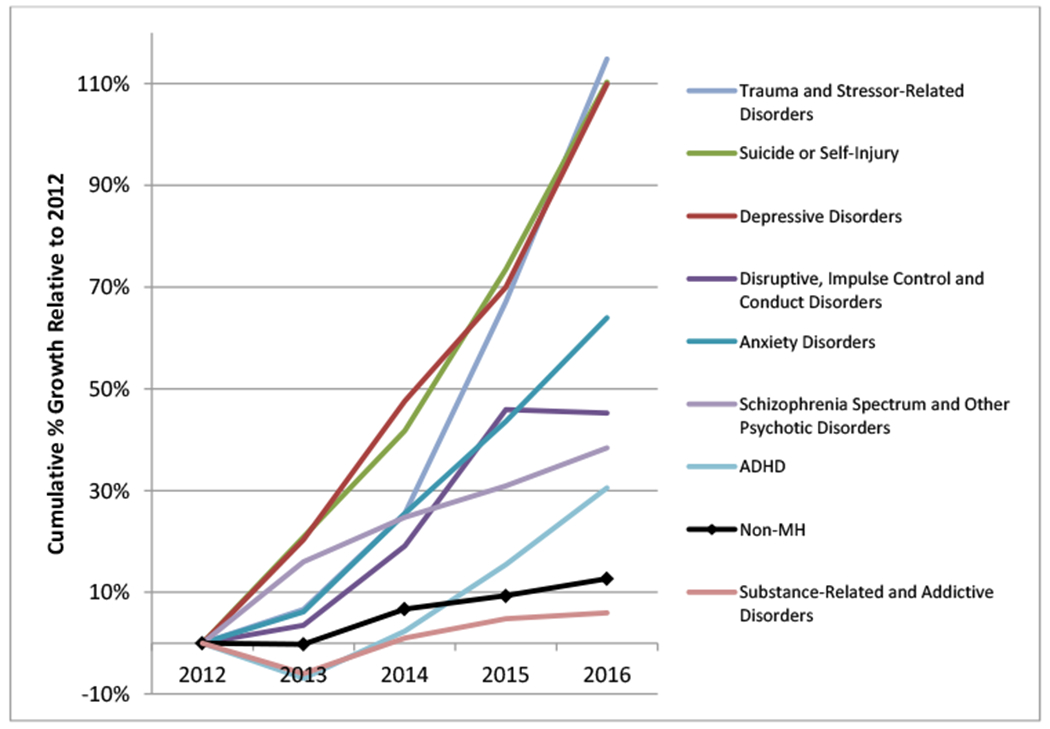
Results: From 2012 to 2016, hospitals experienced a greater increase in ED visits with a primary MH versus non-MH diagnosis (50.7% vs 12.7% cumulative increase, P < .001). MH visits were associated with patients who were older, female, white non-Hispanic, and privately insured compared with patients of non-MH visits (all P < .001). Forty-four percent of MH visits in 2016 had a primary diagnosis of depressive disorders or suicide or self-injury, and the increase in visits was highest for these diagnosis groups (depression: 109.8%; suicide or self-injury: 110.2%). Among MH visits, presence of a hospital IPU was associated with increased hospitalizations (34.6% vs 22.5%, P < .001) and less transfers (9.2% vs 16.2%, P < .001).
Conclusion: The increase in ED MH visits from 2012 to 2016 was 4 times greater than non-MH visits at US children's hospitals and was primarily driven by patients diagnosed with depressive disorders and suicide or self-injury. Our findings have implications for strategic planning in tertiary children's hospitals dealing with a rising demand for acute MH care.
Keywords: depression; discharge disposition; emergency department; pediatric mental health; suicide or self-injury.
Copyright © 2019 Academic Pediatric Association. Published by Elsevier Inc. All rights reserved.
Conflict of interest statement
Figures
References
-
- American Academy of Pediatrics CoPEM, American College of Emergency P, Pediatric C. Care of children in the emergency department: guidelines for preparedness. Pediatrics. 2001;107(4):777–781. - PubMed
-
- Rogers SC, Mulvey CH, Divietro S, Sturm J. Escalating Mental Health Care in Pediatric Emergency Departments. Clin Pediatr (Phila). 2017;56(5):488–491. - PubMed
-
- Mapelli E, Black T, Doan Q. Trends in Pediatric Emergency Department Utilization for Mental Health-Related Visits. J Pediatr. 2015;167(4):905–910. - PubMed
