


Ultrasonic Cavitation Ameliorates Antitumor Efficacy of Residual Cancer After Incomplete Radiofrequency Ablation in Rabbit VX2 Liver Tumor Model
- PMID: 31176089
- PMCID: PMC6556620
- DOI: 10.1016/j.tranon.2019.05.007
Ultrasonic Cavitation Ameliorates Antitumor Efficacy of Residual Cancer After Incomplete Radiofrequency Ablation in Rabbit VX2 Liver Tumor Model
Abstract
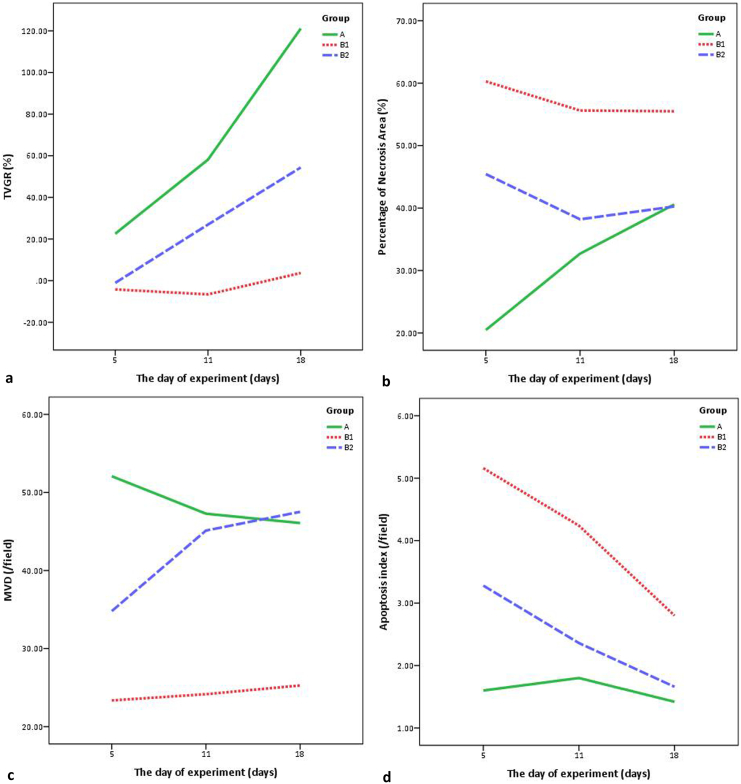
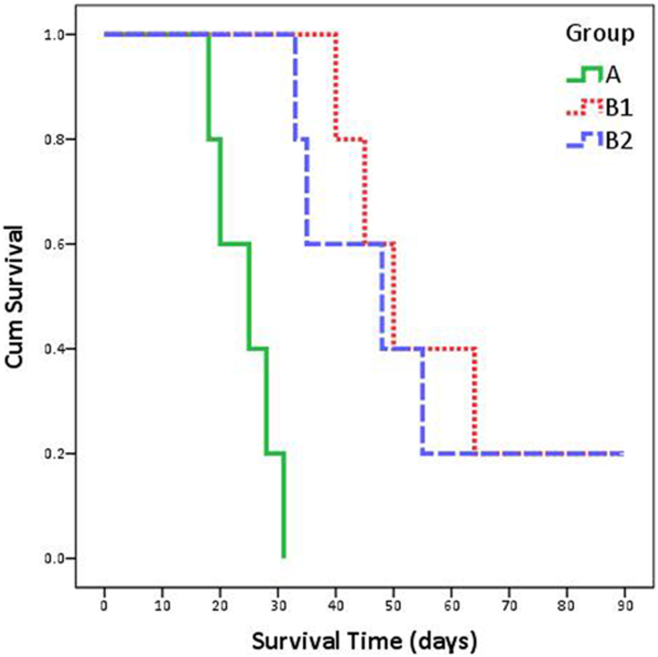
Residual cancer after incomplete ablation remains a major problem for radiofrequency ablation (RFA). We aimed to investigate the synergetic treatment efficacy of RFA combined with ultrasonic cavitation for liver tumor. Sixty rabbits with VX2 liver tumor were randomly divided into three groups. Group A was control group without any treatment. Combined ultrasonic cavitation with RFA was performed for group B1. Group B2 underwent RFA alone. The histopathological results were compared at the 5th, 11th, and 18th day of experiment, and the survival time and metastasis were assessed. The tumor volume growth rate, percentage of necrosis area, microvessel density, and apoptosis index showed significant differences among these groups at the 5th day, 11th day, and 18th day of experiment (P < .05). In contrast, the difference of metastatic score was not significant at the 5th and 11th day (P > .05). At the 18th day, the metastatic score of group A was significant higher than that of group B1 (P < .05), whereas the differences between group A and group B2, or group B1 and group B2 were not significant (P > .05). The median/range interquartile of survival time in groups A, B1, and B2 were 25/8 days, 50/19 days, and 48/20 days, respectively, and there was significant difference between groups A and B1 or B2 (P < .05). The difference between groups B1 and B2 was not significant (P > .05). Ultrasonic cavitation after incomplete RFA for liver tumor improved the antitumor effect, which could be considered as a potentially useful combined therapeutic strategy for liver malignancy.
Keywords: Liver neoplasms; Microbubbles; Radiofrequency ablation; Residual cancer; Ultrasound.
Copyright © 2019 The Authors. Published by Elsevier Inc. All rights reserved.
Figures
References
-
- Bray F, Ferlay J, Soerjomataram I, Siegel RL, Torre LA, Jemal A. Global cancer statistics 2018: GLOBOCAN estimates of incidence and mortality worldwide for 36 cancers in 185 countries. CA Cancer J Clin. 2018;68:394–424. - PubMed
-
- Torre LA, Bray F, Siegel RL, Ferlay J, Lortet-Tieulent J, Jemal A. Global cancer statistics, 2012. CA Cancer J Clin. 2015;65:87–108. - PubMed
-
- Llovet JM, Burroughs A, Bruix J. Hepatocellular carcinoma. Lancet. 2003;362:1907–1917. - PubMed
-
- Song TJ, Ip EW and Fong Y (2004). Hepatocellular carcinoma: current surgical management. Gastroenterology 127, S248-S260. PMID: 15508091 - PubMed
-
- Lau WY, Lai EC. The current role of radiofrequency ablation in the management of hepatocellular carcinoma: a systematic review. Ann Surg. 2009;249:20–25. - PubMed
LinkOut - more resources
Full Text Sources
