Early β-blockers administration might be associated with a reduced risk of contrast-induced acute kidney injury in patients with acute myocardial infarction
- PMID: 31179103
- PMCID: PMC6531699
- DOI: 10.21037/jtd.2019.04.65
Early β-blockers administration might be associated with a reduced risk of contrast-induced acute kidney injury in patients with acute myocardial infarction
Abstract
Background: Contrast-induced acute kidney injury (CI-AKI) is a common complication of coronary angiography (CAG), which is associated with worse prognosis. Some studies indicated β-blockers could preserve renal function among patients with acute myocardial infarction (AMI), but the relationship between β-blockers and CI-AKI has not been well documented among patients with AMI who were undergoing CAG or percutaneous coronary intervention (PCI).
Methods: In this prospective, observational study, 1,309 AMI patients who were undergoing CAG or PCI were consecutively recruited between January 2010 and December 2013. Patients were assigned into β-blockers group (n=1,074) or non-β-blockers group (n=235) according to use or non-use of β-blockers (including metoprolol tartrate/metoprolol succinate/Bisoprolol Fumarate) within 24 hours of perioperative period. CI-AKI was defined as an absolute increase of >0.5 mg/dL from baseline serum creatinine (SCr) within 48-72 hours after contrast medium (CM) exposure.
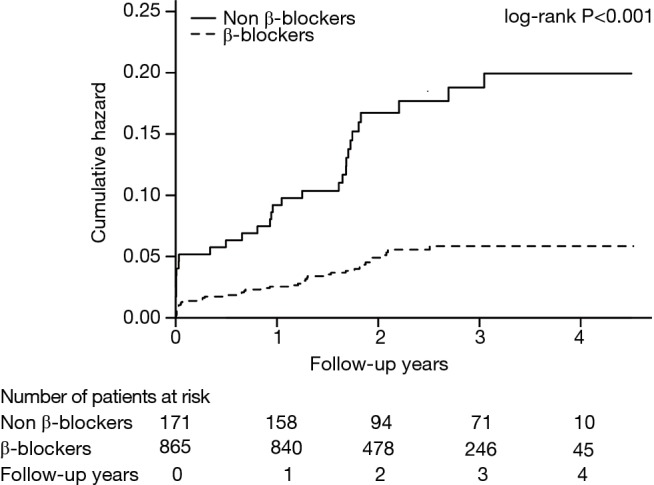
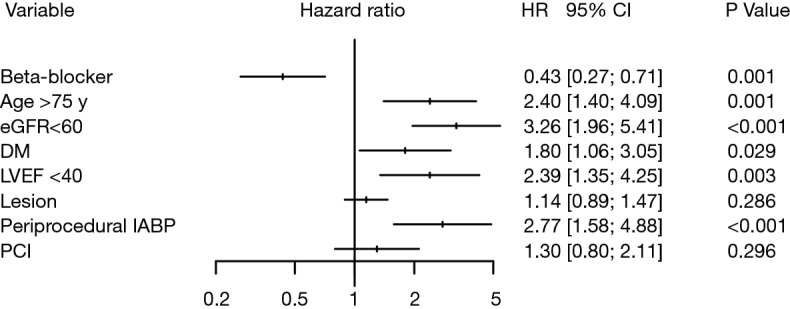
Results: The overall incidence of CI-AKI was 247/1,309 (18.9%).After multivariate adjusting, a total of 10 variables were related to CI-AKI, including β-blockers [β-blockers group vs. non-β-blockers group: odds ratio (OR) =0.520; 95% confidence interval (CI), 0.291-0.930; P=0.027], age, diabetes mellitus, estimated glomerular filtration rate (eGFR) <60 mL/min/1.73 m2, left ventricular ejection fraction (LVEF) <40%, use of intra-aortic balloon pump (IABP), peri-hypotension, emergent PCI, coronary lesions and CM dose >200 mL. During the mean follow-up of 2.35±0.99 years, the β-blockers group was significantly associated with lower rates of mortality [β-blockers group vs. non-β-blockers group: adjusted hazard ratio (HR) =0.43; 95% CI, 0.27-0.71; P=0.001] among patients with AMI.
Conclusions: Use of β-blockers within 24 hours of perioperative period may be associated with lower rates of CI-AKI and long-term mortality among patients with AMI who are undergoing CAG or PCI.
Trial registration: PRECOMIN, ClinicalTrials.gov NCT01400295.
Keywords: acute myocardial infarction (AMI); contrast-induced acute kidney injury (CI-AKI); coronary angiography (CAG); mortality; β-blockers.
Conflict of interest statement
Conflicts of Interest: The authors have no conflicts of interest to declare.
Figures
Comment in
-
Contrast induced acute kidney injury and the role of beta-blockers in its prevention.J Thorac Dis. 2019 Jul;11(7):2689-2694. doi: 10.21037/jtd.2019.06.53. J Thorac Dis. 2019. PMID: 31463094 Free PMC article. No abstract available.
References
-
- Centola M, Lucreziotti S, Salerno-Uriarte D, et al. A comparison between two different definitions of contrast-induced acute kidney injury in patients with ST-segment elevation myocardial infarction undergoing primary percutaneous coronary intervention. Int J Cardiol 2016;210:4-9. 10.1016/j.ijcard.2016.02.086 - DOI - PubMed
Associated data
LinkOut - more resources
Full Text Sources
Medical
Research Materials
Miscellaneous