


Study protocol for a cluster randomized controlled trial to test "¡Míranos! Look at Us, We Are Healthy!" - an early childhood obesity prevention program
- PMID: 31179916
- PMCID: PMC6556954
- DOI: 10.1186/s12887-019-1541-4
Study protocol for a cluster randomized controlled trial to test "¡Míranos! Look at Us, We Are Healthy!" - an early childhood obesity prevention program
Abstract
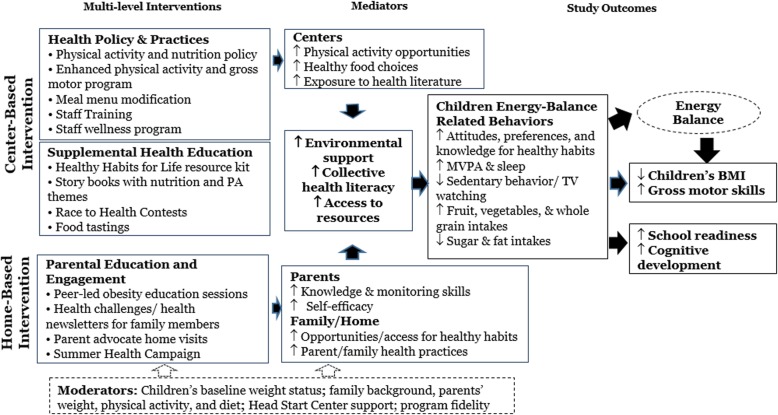
Background: One in three Head Start children is either overweight or obese. We will test the efficacy of an early childhood obesity prevention program, "¡Míranos! Look at Us, We Are Healthy!" (¡Míranos!), which promotes healthy growth and targets multiple energy balance-related behaviors in predominantly Latino children in Head Start. The ¡Míranos! intervention includes center-based (policy changes, staff development, gross motor program, and nutrition education) and home-based (parent engagement/education and home visits) interventions to address key enablers and barriers in obesity prevention in childcare. In partnership with Head Start, we have demonstrated the feasibility and acceptability of the proposed interventions to influence energy balance-related behaviors favorably in Head Start children.
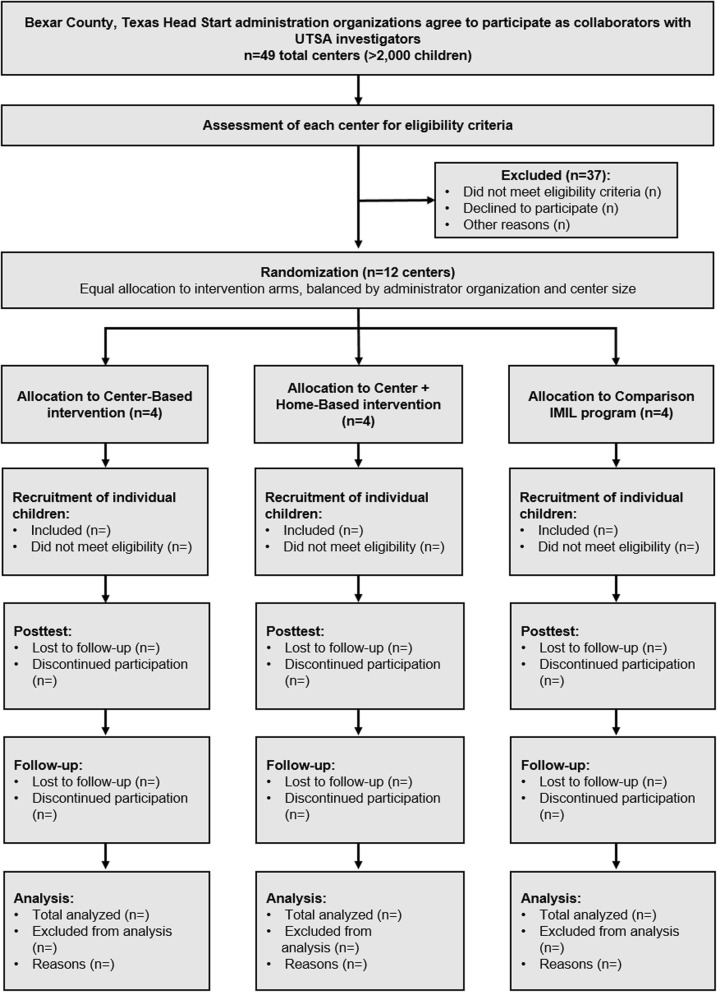
Methods: Using a three-arm cluster randomized controlled design, 12 Head Start centers will be randomly assigned in equal number to one of three conditions: 1) a combined center- and home-based intervention, 2) center-based intervention only, or 3) comparison. The interventions will be delivered by trained Head Start staff during the academic year. A total of 444 3-year-old children (52% females; n = 37 per center at baseline) in two cohorts will be enrolled in the study and followed prospectively 1 year post-intervention. Data collection will be conducted at baseline, immediately post-intervention, and at the one-year follow-up and will include height, weight, physical activity (PA) and sedentary behaviors, sleep duration and screen time, gross motor development, dietary intake and food and activity preferences. Information on family background, parental weight, PA- and nutrition-related practices and behaviors, PA and nutrition policy and environment at center and home, intervention program costs, and treatment fidelity will also be collected.
Discussion: With endorsement and collaboration of two local Head Start administrators, ¡Míranos!, as a culturally tailored obesity prevention program, is poised to provide evidence of efficacy and cost-effectiveness of a policy and environmental approach to prevent early onset of obesity in low-income Latino preschool children. ¡Míranos! can be disseminated to various organized childcare settings, as it is built on the Head Start program and its infrastructure, which set a gold standard for early childhood education, as well as current PA and nutrition recommendations for preschool children.
Trial registration: ClinicalTrials.Gov ( NCT03590834 ) July 18, 2018.
Keywords: Childcare; Home; Nutrition; Obesity; Parent; Physical activity; Policy; Preschool children; Sedentary time; Sleep.
Conflict of interest statement
The authors declare that they have no competing interests.
Figures
Similar articles
-
Impact of ¡Míranos! on parent-reported home-based healthy energy balance-related behaviors in low-income Latino preschool children: a clustered randomized controlled trial.Int J Behav Nutr Phys Act. 2023 Mar 21;20(1):33. doi: 10.1186/s12966-023-01427-z. Int J Behav Nutr Phys Act. 2023. PMID: 36944986 Free PMC article. Clinical Trial.
-
¡Miranos! (Look at Us! We Are Healthy!): Home-Based and Parent Peer-Led Childhood Obesity Prevention.Health Promot Pract. 2016 Sep;17(5):675-81. doi: 10.1177/1524839915623762. Epub 2016 Feb 19. Health Promot Pract. 2016. PMID: 26895848
-
Improving nutrition and physical activity environments of family child care homes: the rationale, design and study protocol of the 'Healthy Start/Comienzos Sanos' cluster randomized trial.BMC Public Health. 2019 Apr 18;19(1):419. doi: 10.1186/s12889-019-6704-6. BMC Public Health. 2019. PMID: 30999881 Free PMC article. Clinical Trial.
-
Home Environmental Influences on Childhood Obesity in the Latino Population: A Decade Review of Literature.J Immigr Minor Health. 2017 Apr;19(2):430-447. doi: 10.1007/s10903-016-0539-3. J Immigr Minor Health. 2017. PMID: 28005241 Free PMC article. Review.
-
Early childhood obesity prevention efforts through a life course health development perspective: A scoping review.PLoS One. 2018 Dec 28;13(12):e0209787. doi: 10.1371/journal.pone.0209787. eCollection 2018. PLoS One. 2018. PMID: 30592757 Free PMC article.
Cited by
-
Profiles of Cultural Adaptation and Parenting Approach for Childhood Obesity in Lifestyle Interventions for Families With Young Children: A Systematic Review.Fam Community Health. 2024 Apr-Jun 01;47(2):95-107. doi: 10.1097/FCH.0000000000000397. Fam Community Health. 2024. PMID: 38372327 Free PMC article.
-
¡Miranos! An 8-Month Comprehensive Preschool Obesity Prevention Program in Low-Income Latino Children: Effects on Children's Gross Motor Development.Int J Environ Res Public Health. 2023 Oct 25;20(21):6974. doi: 10.3390/ijerph20216974. Int J Environ Res Public Health. 2023. PMID: 37947532 Free PMC article. Clinical Trial.
-
Healthy eating interventions delivered in early childhood education and care settings for improving the diet of children aged six months to six years.Cochrane Database Syst Rev. 2023 Aug 22;8(8):CD013862. doi: 10.1002/14651858.CD013862.pub3. Cochrane Database Syst Rev. 2023. PMID: 37606067 Free PMC article.
-
Policy, system, and environmental interventions addressing obesity and diet-related outcomes in early childhood education settings: A systematic review.Obes Rev. 2023 Apr;24(4):e13547. doi: 10.1111/obr.13547. Epub 2023 Jan 5. Obes Rev. 2023. PMID: 36601716 Free PMC article.
-
The impact of early childhood education and care-based interventions on child physical activity, anthropometrics, fundamental movement skills, cognitive functioning, and social-emotional wellbeing: A systematic review and meta-analysis.Obes Rev. 2025 Feb;26(2):e13852. doi: 10.1111/obr.13852. Epub 2024 Nov 7. Obes Rev. 2025. PMID: 39511821 Free PMC article.
References
-
- Guo SS. Predicting overweight and obesity in adulthood from body mass index values in childhood and adolescence. Am J Clin Nutr. 2002;76(3):653–658. - PubMed
-
- Dietz WH. Health consequences of obesity in youth: childhood predictors of adult disease. Pediatrics. 1998;101(Supplement 2):518–525. - PubMed
-
- Schwartz MB, Puhl R. Childhood obesity: a societal problem to solve. Obes Rev. 2003;4(1):57–71. - PubMed
-
- Kosti RI, Panagiotakos DB. The epidemic of obesity in children and adolescents in the world. Cent Eur J Public Health. 2006;14(4):151–159. - PubMed
Publication types
MeSH terms
Associated data
Grants and funding
LinkOut - more resources
Full Text Sources
Medical
