Review
. 2019 Jun 7;11(6):529.
doi: 10.3390/v11060529.

The Ecology of New Constituents of the Tick Virome and Their Relevance to Public Health

Affiliations
Review

The Ecology of New Constituents of the Tick Virome and Their Relevance to Public Health

Kurt J Vandegrift et al. Viruses. .

Abstract

Ticks are vectors of several pathogens that can be transmitted to humans and their geographic ranges are expanding. The exposure of ticks to new hosts in a rapidly changing environment is likely to further increase the prevalence and diversity of tick-borne diseases. Although ticks are known to transmit bacteria and viruses, most studies of tick-borne disease have focused upon Lyme disease, which is caused by infection with Borrelia burgdorferi. Until recently, ticks were considered as the vectors of a few viruses that can infect humans and animals, such as Powassan, Tick-Borne Encephalitis and Crimean-Congo hemorrhagic fever viruses. Interestingly, however, several new studies undertaken to reveal the etiology of unknown human febrile illnesses, or to describe the virome of ticks collected in different countries, have uncovered a plethora of novel viruses in ticks. Here, we compared the virome compositions of ticks from different countries and our analysis indicates that the global tick virome is dominated by RNA viruses. Comparative phylogenetic analyses of tick viruses from these different countries reveals distinct geographical clustering of the new tick viruses. Some of these new tick RNA viruses (notably severe fever with thrombocytopenia syndrome virus and Heartland virus) were found to be associated with serious human diseases. Their relevance to public health remains unknown. It is plausible that most of these newly identified tick viruses are of endogenous origin or are restricted in their transmission potential, but the efforts to identify new tick viruses should continue. Indeed, future research aimed at defining the origin, the ecology and the spillover potential of this novel viral biodiversity will be critical to understand the relevance to public health.

Keywords: Alongshan; Ambylomma; Dermacentor; Emerging infectious disease; Haemaphysalis; Hyalomma; Ixodes; Jingmen; climate change; flavivirus.


Conflict of interest statement

The authors declare no conflict of interest.

Figures

Figure 1
Figure 1
Phylogenetic relatedness of newly identified and known tick nairoviruses. This analysis involved seven amino acid sequences of the viral polymerase gene. Genbank accession numbers of sequences used for phylogenetic analysis are: ASY03236 Norway nairovirus 1, AXQ59276 Beiji nairovirus, AAZ38661 Crimean–Congo hemorrhagic fever virus, YP_009111284 Leopards Hill virus and YP_009361832 Nairobi sheep disease virus.
Figure 2
Figure 2
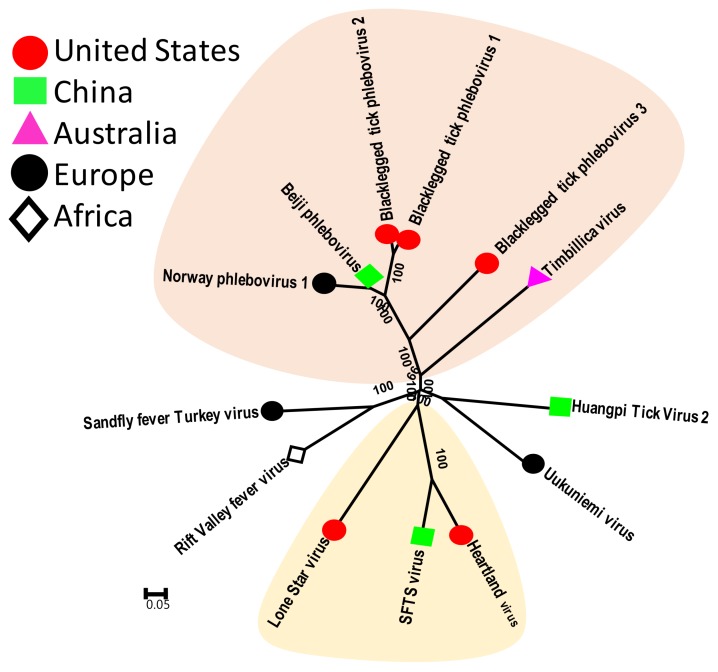
Phylogenetic relatedness among tick phleboviruses. This analysis involved 13 amino acid sequences of the viral polymerase gene. Genbank accession numbers of sequences used for phylogenetic analysis are: YP_009293590 Huangpi Tick Virus 2, NP_941973 Uukuniemi virus, YP_004382743 Sandfly fever Turkey virus, YP_003848704 Rift Valley fever virus, YP_006504091 SFTS virus HB29, YP_009047242 Heartland virus, ANC97695 Black-legged tick phlebovirus 3, ASY03242 Norway phlebovirus 1, AII01803 Black-legged tick phlebovirus 2, ANT80544 Black-legged tick phlebovirus 1, AYP67564 Timbillica virus, AXQ59272 Beiji phlebovirus and YP_008003507 Lone Star virus.
Figure 3
Figure 3
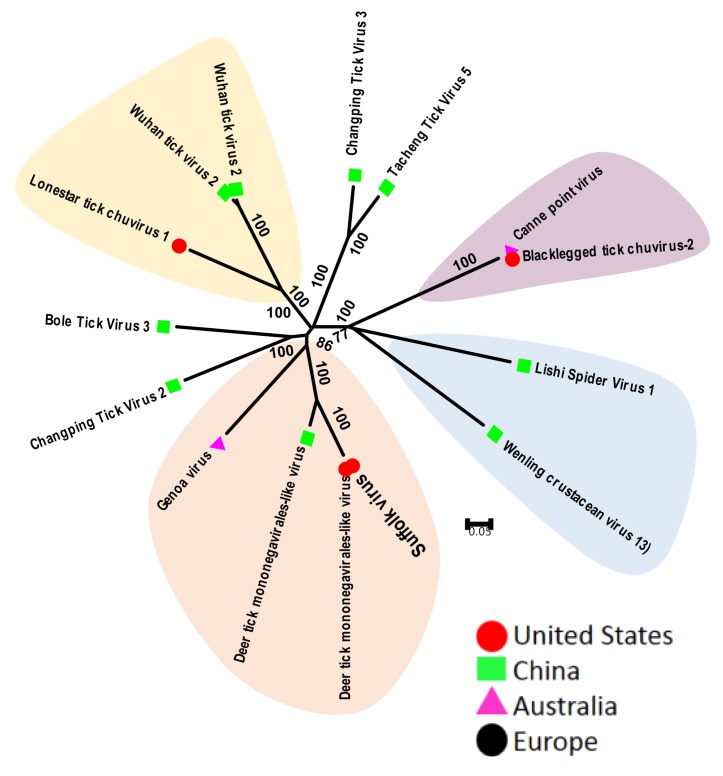
Phylogenetic relatedness between tick chuviruses. This analysis used 15 amino acid sequences of the viral polymerase gene. Genbank accession numbers of sequences used for phylogenetic analysis are: YP_009177218 Suffolk virus, AIE42676 Deer tick mononegavirales-like virus, AXQ59273 Deer tick mononegavirales-like virus, AYP67566 Genoa virus, YP_009177704 Changping Tick Virus 2, YP_009177701 Bole Tick Virus 3, YP_009254000 Lonestar tick chuvirus 1, YP_009177707 Changping Tick Virus 3, YP_009177717 Tacheng Tick Virus 5, YP_009177722 Wuhan tick virus 2, AYV61060 Wuhan tick virus 2, AYP67535 Canne point virus, AJG39051 Lishi Spider Virus 1, AUW34382.1 L Black-legged tick chuvirus-2 and YP_009337860 Wenling crustacean virus 13.
Figure 4
Figure 4
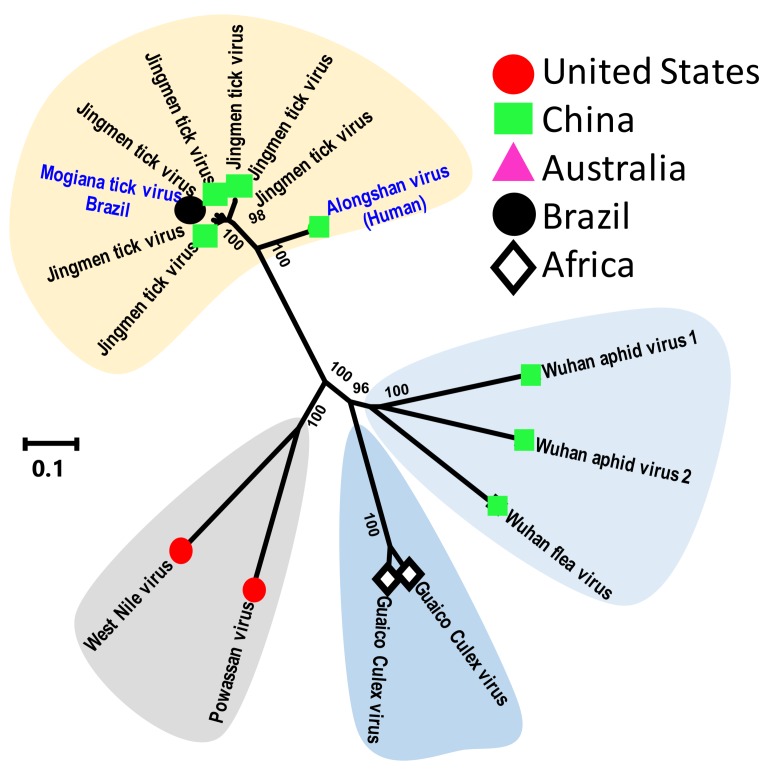
Phylogenetic relatedness based on the NS3-helicase protein of the JMTV-like viruses of ticks, aphids and mosquitoes and classical flaviviruses (Powassan and West Nile virus). This analysis involved 16 amino acid sequences. All ambiguous positions were removed for each sequence pair. There were a total of 983 positions in the final dataset. Genbank accession numbers of sequences used for phylogenetic analysis are: YP_009030000 Jingmen tick virus, YP_009351918 Mogiana tick virus, YP_009179379 Wuhan aphid virus 2, YP_009179404 Wuhan flea virus, YP_009179389 Wuhan aphid virus 1, AYV61015 Jingmen tick virus, AYV61032 Jingmen tick virus, AYV61020 Jingmen tick virus, AXH38008 Jingmen tick virus, AXH38007 Jingmen tick virus, AXE71876 Alongshan virus, AHZ31717 Jingmen tick virus, ALP82430 Powassan virus, AKL90418 Guaico Culex virus, AKL90453 Guaico Culex virus and AFI56962 West Nile virus.

References

    1. Anderson J.F., Magnarelli L.A. Biology of ticks. Infect. Dis. Clin. N. Am. 2008;22:195–215. doi: 10.1016/j.idc.2007.12.006. - DOI - PubMed
    1. Brites-Neto J., Duarte K.M., Martins T.F. Tick-borne infections in human and animal population worldwide. Vet. World. 2015;8:301–315. doi: 10.14202/vetworld.2015.301-315. - DOI - PMC - PubMed
    1. Burgdorfer W., Barbour A.G., Hayes S.F., Benach J.L., Grunwaldt E., Davis J.P. Lyme disease-a tick-borne spirochetosis? Science. 1982;216:1317–1319. doi: 10.1126/science.7043737. - DOI - PubMed
    1. Steere A.C. Lyme borreliosis in 2005, 30 years after initial observations in lyme connecticut. Wien. Klin. Wochenschr. 2006;118:625–633. doi: 10.1007/s00508-006-0687-x. - DOI - PubMed
    1. Dyer O. Illnesses caused by us ticks and mosquitoes tripled in recent years. BMJ. 2018;361:k1997. doi: 10.1136/bmj.k1997. - DOI - PubMed

Publication types