. 2019 Jul 25;63(8):e00374-19.
doi: 10.1128/AAC.00374-19. Print 2019 Aug.

The Novel Arylamidine T-2307 Selectively Disrupts Yeast Mitochondrial Function by Inhibiting Respiratory Chain Complexes

Affiliations

The Novel Arylamidine T-2307 Selectively Disrupts Yeast Mitochondrial Function by Inhibiting Respiratory Chain Complexes

Kohei Yamashita et al. Antimicrob Agents Chemother. .

Abstract

The novel arylamidine T-2307 exhibits broad-spectrum in vitro and in vivo antifungal activities against clinically significant pathogens. Previous studies have shown that T-2307 accumulates in yeast cells via a specific polyamine transporter and disrupts yeast mitochondrial membrane potential. Further, it has little effect on rat liver mitochondrial function. The mechanism by which T-2307 disrupts yeast mitochondrial function is poorly understood, and its elucidation may provide important information for developing novel antifungal agents. This study aimed to determine how T-2307 promotes yeast mitochondrial dysfunction and to investigate the selectivity of this mechanism between fungi and mammals. T-2307 inhibited the respiration of yeast whole cells and isolated yeast mitochondria in a dose-dependent manner. The similarity of the effects of T-2307 and respiratory chain inhibitors on mitochondrial respiration prompted us to investigate the effect of T-2307 on mitochondrial respiratory chain complexes. T-2307 particularly inhibited respiratory chain complexes III and IV not only in Saccharomyces cerevisiae but also in Candida albicans, indicating that T-2307 acts against pathogenic fungi in a manner similar to that of yeast. Conversely, T-2307 showed little effect on bovine respiratory chain complexes. Additionally, we demonstrated that the inhibition of respiratory chain complexes by T-2307 resulted in a decrease in the intracellular ATP levels in yeast cells. These results indicate that inhibition of respiratory chain complexes III and IV is a key factor for selective disruption of yeast mitochondrial function and antifungal activity.

Keywords: Candida albicans; antifungal; mechanism of action; respiratory chain; yeast.


Figures

FIG 1
FIG 1
Chemical structure of T-2307.
FIG 2
FIG 2
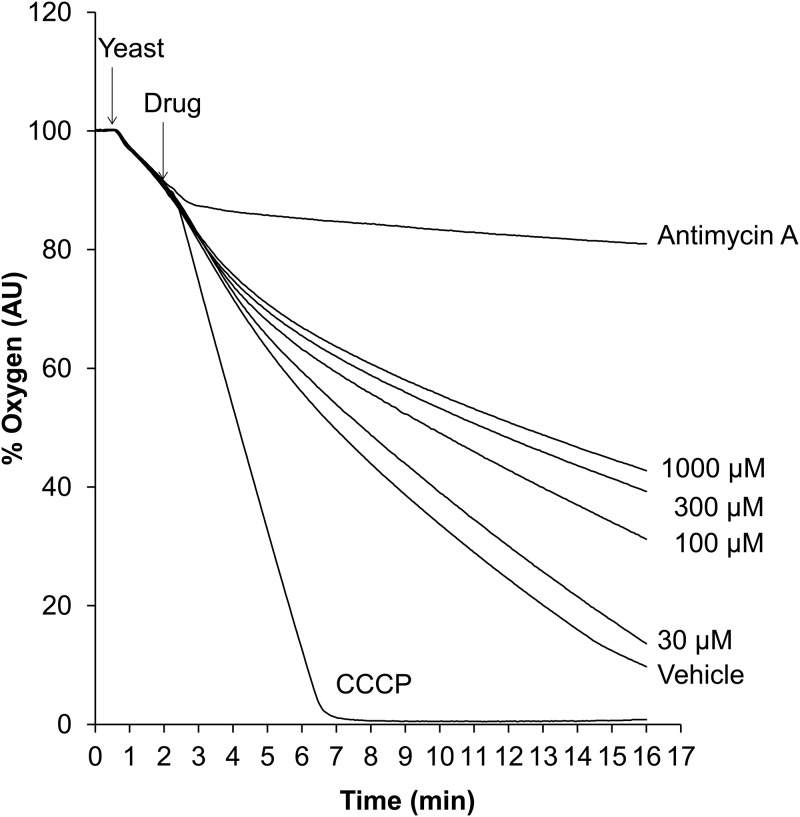
Dose-dependent effect of T-2307 on oxygen consumption in whole yeast cells. Oxygen consumption was measured in distilled water at a cell density of 3 × 107 cells/ml. Antimycin A and CCCP were added at final concentrations of 10 μg/ml and 4 μM, respectively. T-2307 was added at final concentrations of 30, 100, 300, and 1,000 μM. Distilled water was added to the control group as a vehicle control. The time of yeast cell and agent addition is indicated by the arrows. All measurements were conducted at 23°C. Curves are representative of three independent experiments. AU, arbitrary units.
FIG 3
FIG 3
Effect of T-2307 on oxygen consumption in isolated yeast mitochondria. Oxygen consumption of isolated mitochondria was measured using a MitoXpress probe. The inhibitory effects of T-2307, oligomycin A (OLI), and KCN were evaluated in the presence of ADP (ADP-stimulated condition) (a) and in the absence of ADP (basal condition) (b). Oxygen consumption rates (OCRs) were determined from the slope of the initial 7.5 min of the time-oxygen concentration curve. The values represent the mean and standard deviation values of pooled data from two independent experiments, each performed in triplicate (total six replicates per group). Statistical analysis was performed using the parametric Dunnett’s multiple-comparison test. Asterisks indicate a significant difference from the control (**, P < 0.01; ***, P < 0.001).
FIG 4
FIG 4
Dose-response curves representing the effect of T-2307 on the enzymatic activities of respiratory chain complexes in Saccharomyces cerevisiae (a) and Candida albicans (b). The reaction rate of each enzyme was determined by calculating the slope of the linear portion of the curve representing the trace of the reaction of each complex. Percent control was calculated based on the slope in the control. The values represent the mean and standard deviation values of pooled data from two independent experiments, each performed in triplicate (total six replicates per group).
FIG 5
FIG 5
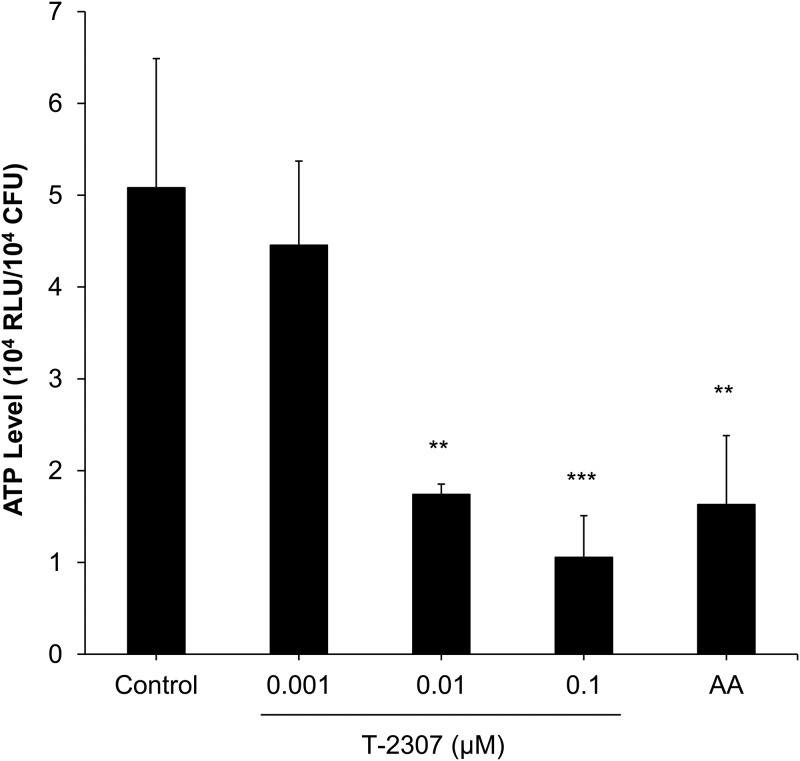
Effect of T-2307 on intracellular ATP levels in Saccharomyces cerevisiae. Cells were incubated for 8 h at 30°C in a semisynthetic medium in the presence or absence of T-2307 and antimycin A (AA). AA at 0.5 μg/ml was used as a positive control. ATP levels were measured using a luminescence assay. Intracellular ATP levels were expressed as relative light units (RLU)/CFU. Data are expressed as mean and standard deviation values of results from three independent experiments. Statistical analysis was performed using the parametric Dunnett’s multiple-comparison test. Asterisks indicate a significant difference from the control (**, P < 0.01; ***, P < 0.001).
FIG 6
FIG 6
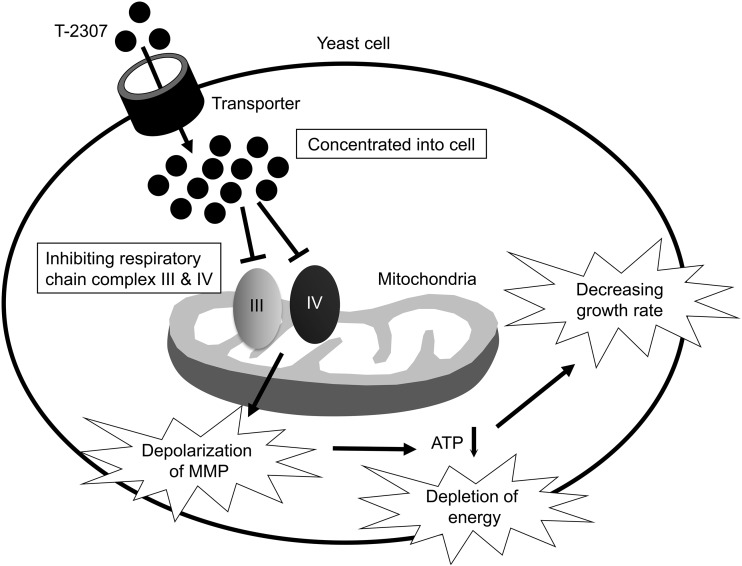
The hypothesized mechanism of action of T-2307. T-2307 is concentrated in yeast cells by a specific transporter (12, 13). T-2307 inhibits mitochondrial respiratory chain complexes, which leads to a decrease in intracellular ATP levels. Finally, cell growth decreases due to energy depletion.

References

    1. Chang YL, Yu SJ, Heitman J, Wellington M, Chen YL. 2017. New facets of antifungal therapy. Virulence 8:222–236. doi:10.1080/21505594.2016.1257457. - DOI - PMC - PubMed
    1. Denning DW, Bromley MJ. 2015. How to bolster the antifungal pipeline. Science 347:1414–1416. doi:10.1126/science.aaa6097. - DOI - PubMed
    1. Schwartz IS, Patterson TF. 2018. The emerging threat of antifungal resistance in transplant infectious diseases. Curr Infect Dis Rep 20:2. doi:10.1007/s11908-018-0608-y. - DOI - PubMed
    1. Vallabhaneni S, Cleveland AA, Farley MM, Harrison LH, Schaffner W, Beldavs ZG, Derado G, Pham CD, Lockhart SR, Smith RM. 2015. Epidemiology and risk factors for echinocandin nonsusceptible Candida glabrata bloodstream infections: data from a large multisite population-based candidemia surveillance program, 2008–2014. Open Forum Infect Dis 2:ofv163. doi:10.1093/ofid/ofv163. - DOI - PMC - PubMed
    1. Tsay S, Kallen A, Jackson BR, Chiller TM, Vallabhaneni S. 2018. Approach to the investigation and management of patients with Candida auris, an emerging multidrug-resistant yeast. Clin Infect Dis 66:306–311. doi:10.1093/cid/cix744. - DOI - PMC - PubMed

Publication types

MeSH terms

LinkOut - more resources