. 2019 Aug 21;10(8):3718-3730.
doi: 10.1021/acschemneuro.9b00262. Epub 2019 Jun 24.

Identification of a Novel Allosteric Modulator of the Human Dopamine Transporter

Affiliations

Identification of a Novel Allosteric Modulator of the Human Dopamine Transporter

Shaili Aggarwal et al. ACS Chem Neurosci. .

Abstract

The dopamine transporter (DAT) serves a pivotal role in controlling dopamine (DA)-mediated neurotransmission by clearing DA from synaptic and perisynaptic spaces and controlling its action at postsynaptic DA receptors. Major drugs of abuse such as amphetamine and cocaine interact with DAT to mediate their effects by enhancing extracellular DA concentrations. We previously identified a novel allosteric site in the related human serotonin transporter that lies outside the central substrate and inhibitor binding pocket. We used the hybrid structure based (HSB) method to screen for allosteric modulator molecules that target a similar site in DAT. We identified a compound, KM822, that was found to be a selective, noncompetitive inhibitor of DAT. We confirmed the structural determinants of KM822 allosteric binding within the allosteric site by structure/function and substituted cysteine scanning accessibility biotinylation experiments. In the in vitro cell-based assay and ex vivo in both rat striatal synaptosomal and slice preparations, KM822 was found to decrease the affinity of cocaine for DAT. The in vivo effects of KM822 on cocaine were tested on psychostimulant-associated behaviors in a planarian model where KM822 specifically inhibited the locomotion elicited by DAT-interacting stimulants amphetamine and cocaine. Overall, KM822 provides a unique opportunity as a molecular probe to examine allosteric modulation of DAT function.

Keywords: Allosteric modulation; cocaine use disorder; dopamine transporter; hybrid structure based method; substituted cysteine scanning accessibility method.


Conflict of interest statement

The authors declare the following competing financial interest(s): KM822 and its analogues are listed in the US Patent 9616065 with S.K., O.V.M., A.C.K.F., and J.M.S. as named inventors.

Figures

Figure 1.
Figure 1.
KM822 interactions with hDAT. (A) molecular model of hDAT represented as ribbons bound to KM822 shown as van der Waals surface and colored atom type (carbon, cyan; oxygen, red; nitrogen, blue; and sulfur, yellow). Transmembrane domains and loop regions contributing to the binding of KM822 are colored as follows: TMD1 = blue, TMD3 = light green, TMD10 = yellow, TMD11 = pink; EL4 = magenta and EL5 = orange; EL6 = mauve while the rest of the protein is colored gray. (B) Five-point receptor based pharmacophore formed by residues W84, D385, D476, R544 and Y548 along with distance restraints are shown. (C) Schematic interaction diagram of KM822 in the allosteric site was generated using ligand interactions module of MOE. Legend details the nature of the interactions.
Figure 2.
Figure 2.
(A) Radioactive neurotransmitter transport inhibition assay of KM822 against hDAT, hNET, and hSERT in stably transfected MDCK cells. KM822 IC50 for hDAT, hNET, and hSERT is 3.7 ± 0.65, 119 ± 22.82, and 191.6 ± 34.45 μM, respectively. The data was fitted using nonlinear regression, the figure was plotted using average of three independent experiments, and IC50 means and SEM were calculated using the same three experiments. Results are normalized to percent of the highest response in each group. (B) [3H]-DA uptake kinetic assay of wild type DAT transiently transfected COS-7 cells in the absence and presence of 1 μM and 5 μM KM822. Data were fitted to a Michaelis−Menten equation using nonlinear regression. Vmax is 71.5 ± 6.12, 65.8 ± 8.71, and 57.9 ± 4.15 μmol/min/well in the presence of vehicle, 1 μM KM822, and 5 μM KM822, respectively. Km is 6.2 ± 0.69, 7.0 ± 0.58, and 10.54 ± 0.78 μM in the presence of vehicle, 1 μM KM822, and 5 μM KM822, respectively. The figure was generated using an average of four independent experiments. Vmax and Km were calculated based on the same four experiments. For Vmax, vehicle versus 1 μM showed no significance but Vmax for vehicle versus 5 μM showed significant difference (*p < 0.05) when compared using one-way ANOVA with Dunnett’s multiple comparison post-test. No statistical significance was found in Km values using one-way ANOVA with Dunnett’s multiple comparison post-test.
Figure 3.
Figure 3.
(A) IC50 (mean ± SEM, μM) values of KM822 against the kinetically active DAT mutants. Averages and SEM were calculated from three or more independent experiments. Statistical analysis was performed using Student’s paired t test. The cysteine mutants IC50 values were compared to that of DAT-XC and D476 mutants IC50 were compared to that of DAT-WT. *p < 0.05, **p < 0.01, n.s. no significance. (B) Shows the relative position of each of the mutants with respect to KM822 (shown as orange sticks) in the binding pocket of hDAT represented as gray ribbons.
Figure 4.
Figure 4.
(A) Immunoblots of biotinylated DAT-XC based cysteine mutants and total DAT protein in the absence and presence of 20 μM KM822. (B) Quantification of the biotinylation data. The biotinylated DAT is normalized to total DAT protein and then KM822-treated biotinylated DAT band intensity is normalized to the untreated band intensity. (C) Representative immunoblots of biotinylated DAT-XC/W84C mutant and total DAT protein in the absence and presence of 20 μM KM822 and 100 μM cocaine. (D) Quantification of the biotinylation data. The biotinylated DAT is normalized to total DAT protein and then KM822-treated biotinylated DAT band intensity is normalized to the untreated band intensity. All the data in the bar graphs B and D represent three or more independent experiments. Statistical analysis was performed using ANOVA with Dunnett’s multiple comparison test comparing to vehicle. **p < 0.01; n.s., no significance.
Figure 5.
Figure 5.
(A) Representative immunoblots showing the dose-dependent decrease in biotinylation intensity of DAT-XC/W84C mutant with increasing concentration of KM822 in SCAM analysis using HEK-293 cells. (B) Data in the graph is represented as intensity of biotinylated DAT-XC/W84C bands normalized to the total DAT-XC/W84C bands for respective concentrations of KM822. The nonlinear regression analysis of the results gave the IC50 of KM822 as 0.45 ± 0.08 μM where average and SEM were calculated from three independent experiments.
Figure 6.
Figure 6.
Dose–response assay of KM822 against DAT mutants Y156F and Y335A versus WT-DAT. Nonlinear regression analysis of normalized response gave KM822 IC50 as 3.8 ± 0.88, 3.3 ± 0.45, and 12.8 ± 1.4 μM in WT-DAT, Y156F-DAT, and Y335A-DAT transfected COS-7 cells, respectively. Averages and SEM were calculated from three independent experiments.
Figure 7.
Figure 7.
KM822 does not bind to the inward-facing conformation of hDAT. (A) Structural model of inward-facing conformation of hDAT represented as ribbons. Transmembrane domains and loop regions that contributed to the binding pocket of KM822 in the outward-facing conformation are colored as follows: TMD1 = blue, TMD10 = green and TMD11 = pink; EL4 = magenta, EL5 = orange; EL6 = mauve while the rest of the protein is colored gray. KM822 does not bind to the inward-facing conformation and is sterically hindered from entering the binding pocket while the rest of the molecule sits outside the binding pocket. (B) Schematic interaction map of KM822 docked to inward-facing model of hDAT generated using ligand interactions module of MOE. Part of the ligand that is clashing with hDAT is shown in red and the rest of the molecule is outside the binding pocket of hDAT with no specific interactions. Legend details the nature of interactions.
Figure 8.
Figure 8.
Representative immunoblots of biotinylated (A) DAT-XC/T316C and (B) DAT-XC/T316C and their respective total DAT protein in the absence and presence of 20 μM KM822 and 100 μM cocaine. Bar graphs represent quantification of the biotinylation data for each mutant. The biotinylated DAT for each mutant is normalized to total DAT protein and then KM822-treated biotinylated DAT band intensity is normalized to the untreated band intensity. The data for each mutant represents eight independent experiments. Statistical analysis was performed using ANOVA with Dunnett’s multiple comparison test comparing to vehicle. **p < 0.01; *p < 0.05; n.s., not significant.
Figure 9.
Figure 9.
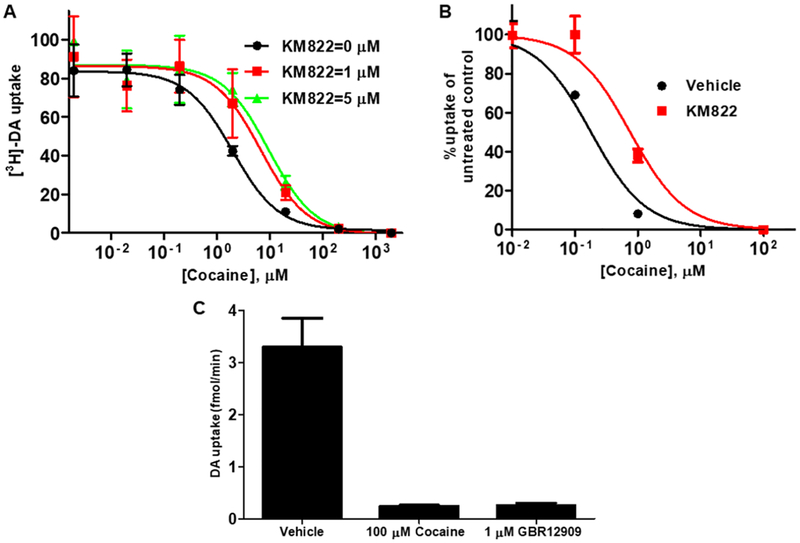
(A) Dopamine transport inhibition assay of cocaine in the presence of varying concentrations of KM822 in hDAT transfected COS-7 cells. IC50’s of cocaine are 1.2 ± 0.47 μM (at KM822 = 0), 4.2 ± 0.42 μM (at KM822 = 1 μM), and 8.1 ± 2.62 μM (at KM822 = 5 μM). The figure was plotted using average of three independent experiments, and IC50 means and SEM was calculated using the same three experiments. Results are normalized to percent of the highest response in each group. (B) Dose–response curve for inhibition of dopamine in varying concentrations of cocaine in striatal synaptosomal preparations in the absence and presence of 5 μM KM822. (C) Bar graph shows total DA uptake in striatal synaptosomes which is significantly blocked by 100 μM cocaine and 1 μM GBR12909.
Figure 10.
Figure 10.
KM822 decreases cocaine-induced inhibition of DA uptake (app Km) in the NAc. Shown are the mean ± SEM for (A) stimulated DA release expressed as a percent of baseline (BL) and (B) DA uptake inhibition following cumulative concentrations of cocaine. 50 μM KM822 did not affect DA release but significantly reduced the effects of cocaine. Statistical analysis was performed using two-way repeated measures ANOVA and indicated a significant main effect of cocaine on DA uptake inhibition (app Km; F(4,10) = 215.9, p < 0.001), a significant interaction (F(4,40) =4.13, p < 0.01), but no significant main effect of drug (F(1,10) = 2.75, p = 0.13). Bonferroni analyses indicated that KM822 significantly attenuated the effects of cocaine at the 30 μM cocaine concentration. ***p < 0.001.
Figure 11.
Figure 11.
Locomotion assay in planarians. (A) KM822 has no effect on baseline locomotion. (B) It blocks locomotion elicited by cocaine and amphetamine but not by nicotine. ***p < 0.001, n.s.; not significant. Statistical analysis was performed using Student’s t test.

References

    1. Kristensen AS, Andersen J, Jorgensen TN, Sorensen L, Eriksen J, Loland CJ, Stromgaard K, and Gether U (2011) SLC6 neurotransmitter transporters: structure, function, and regulation. Pharmacol Rev. 63, 585–640. - PubMed
    1. Aggarwal S, and Mortensen OV (2017) Overview of Monoamine Transporters. Curr. Protoc. Pharmacol 79, 12 16 11–12 16 17. - PMC - PubMed
    1. Zhu J, and Reith ME (2008) Role of the dopamine transporter in the action of psychostimulants, nicotine, and other drugs of abuse. CNS Neurol Disord.:Drug Targets 7, 393–409. - PMC - PubMed
    1. Schmitt KC, and Reith ME (2011) The atypical stimulant and nootropic modafinil interacts with the dopamine transporter in a different manner than classical cocaine-like inhibitors. PLoS One 6, No. e25790. - PMC - PubMed
    1. Yamashita A, Singh SK, Kawate T, Jin Y, and Gouaux E (2005) Crystal structure of a bacterial homologue of Na+/Cl– dependent neurotransmitter transporters. Nature 437, 215–223. - PubMed

Publication types